
Machine-translated by Google Translate. H/T: Alfred de Zayas’ Human Rights Corner.
“There is nothing more democratic than referendums” (original in German)
“NATO does not want to allow self-determination of the Russians”
Interview with Prof. Dr. iur. et phil. Alfred de Zayas, international law expert and former UN mandate holder
Current affairs in focus: Were the elections in the Lugansk, Donetsk, Zaparozhye and Kherson oblasts in accordance with international law?
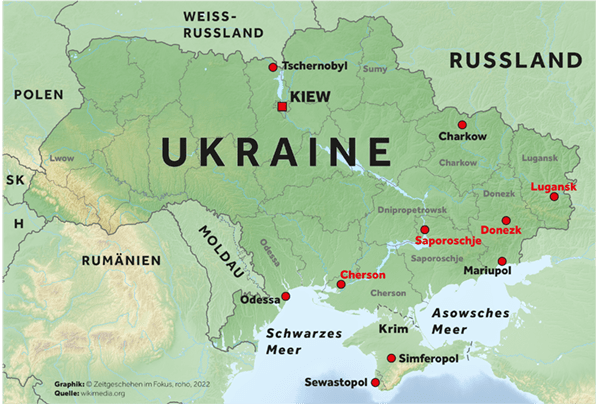
Prof. Dr. Alfred de Zaya: Referenda are fundamentally a human rights-compliant method of “taking the temperature” and determining the will of a population. Art. 1 of the UN pact on civil and political rights stipulates the right of self-determination for all peoples – including the people of Lugansk, Donetsk, Zaparozhye and Kherson – and of course the people of Crimea.
Article 19 of the Covenant stipulates the right of all people to freedom of expression. There is nothing more democratic than referendums. However, the UN has failed here. The UN has held self-determination referendums in Sudan, Timor-Leste and Ethiopia/Eritrea. But only after tens of thousands of people had been killed. The UN should have intervened earlier and held preventive referenda.¹
Are referendums irrelevant if they are not conducted by the UN?
Of course, popular referendums are important, even if international bodies ignore them. Of course, there are referendums all over the world, which unfortunately are not organized and carried out by the UN, but solely by the affected population themselves, for example the 1962 referendum in Algeria, which led to independence.²
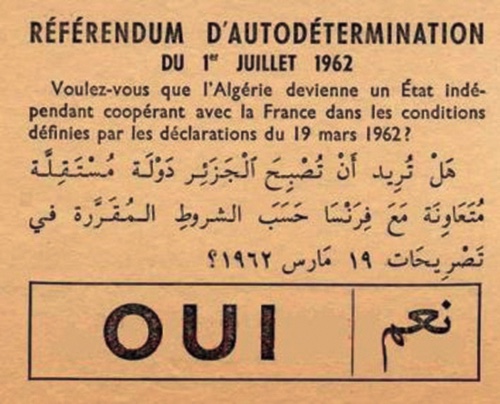
SELF-DETERMINATION REFERENDUM FROM JULY 1, 1962:
Do you want Algeria to become an independent state while cooperating with France under the conditions defined by the declarations of March 19, 1962?
There, too, the referendum was only carried out after there had been many deaths on both sides. The referendum enabled a modus vivendi between France and Algeria, and then led to lasting peace. Some would have questioned the result of the referendum – 99.72% for independence with a turnout of 91.88% – in Algeria. In comparison, the results of the 2014 referendum in Crimea – 96% with a turnout of 83% – and those in Donbas this year are not surprising – namely 87%, 93.1%, 98.4% and 99.2% in Kherson, Zaparozhye, Lugansk and Donetsk with a participation of 76 to 97% of the population.³
However, it is very unfortunate that some referendums take place without reliable international monitoring, even if observers are invited.
In 1991, a number of popular referendums were held, for example in Kosovo, where 99% of the population voted for independence. The Serbs boycotted the referendum there, and the then Federal Republic of Yugoslavia did not recognize the referendum, much like Ukraine, which opposes the referendums in Crimea and Donbas.
Wouldn’t it have been better if the UN had at least observed the referendums in Donbas?
Of course it would have been better and the results would then be more credible.
The UN or the OSCE should have taken responsibility for the organization and procedure of the referendum. Also, the UN should have held these referendums as early as 1991 – when Ukraine broke away from the USSR, taking a large Russian minority (30% of the Ukrainian population) with it.
A UN referendum should have been organized by 2014 at the latest, after the illegal and unconstitutional Maidan coup. These are missed opportunities. In order to legitimize secession, you first have to know what people want. Otherwise one could speak of an “annexation”.
A referendum is actually a pure exercise of democracy, of popular sovereignty. On the other hand, there is nothing more undemocratic than a coup – for example the Maidan coup d’état of February 2014.
Did the referendums meet the standards of international law?
It is extremely difficult to hold a referendum in the middle of a war. But there are many precedents for this. However, the results in the Donbas surprise no one. It is hard to imagine that the Russian majority would vote for Ukraine after suffering 15,000 deaths from Ukraine’s bombings. Here one can even speak of a “remedial secession” – a buzzword that came about at the time of the separation from Kosovo. “Remedial Secession” is recommended when the coexistence of ethnic groups is so disrupted that peaceful coexistence is no longer possible. Nobody wants a permanent war. After all, peace is a human right.
Were there election observers in the four oblasts?
It was reported that around 130 international election monitors were there, including from South Africa. However, the UN, EU and OSCE did not observe the referenda.⁴
Why didn’t these international organizations send election observers? The Council of Europe usually does that, doesn’t it?
The UN, the OSCE and the Council of Europe are notorious for their double standards. Wherever they want a referendum, they go. Wherever they shy away from the results of a referendum, they stay away. It was the same with the referendum in Crimea in 2014. It was the same with Abkhazia, Ossetia, etc.
Is the incorporation of the oblasts into the Russian Federation in accordance with international law?
First, one should ask whether the recordings were constitutional under Russian law. Russia is governed by the rule of law, and Crimea’s admission in 2014 was legal, had been considered by the Duma and approved by the Constitutional Court before Putin signed it.
Seen in international law, the right of peoples to self-determination allows both secession from one state and application for admission to another state. For example, it would be entirely conceivable and legal for Kosovo to be integrated into Albania one day. However, there is no common historical development there – unlike the Russians in the Donbas, who lived for centuries in Tsarist Russia, and then in the Soviet Union with its capital in Moscow. When it comes to questions about exercising the right to self-determination, you always have to put it into context or know the history and act accordingly.
Are you saying that the Russians in Ukraine have some historical legitimacy to integrate into the Russian Federation?
The historical legitimation is more than given. But that is not enough to legitimize the integration under international law in Russia. That’s why you have to know what the population actually wants. It is a pity that the UN, OSCE and EU clearly have no interest in determining the will of the people there. Actually, that’s all that matters. If, for example, the people of Crimea would prefer to live in Ukraine, that is their right. If the people of the Donbas would rather live in Ukraine, that is also legal.
What does it mean if the EU states ignore these votes?
It is yet another example of the EU’s double standards. The EU states are all obliged not only to respect the right of peoples to self-determination in accordance with Article 1 of the International Covenant on Civil and Political Rights and the International Covenant on Economic, Social and Cultural Rights, but also to promote it. In addition, the right of peoples to self-determination is enshrined in the UN Charter and a number of UN resolutions.
Is it possible to compare Kosovo’s independence from Serbia, which the West immediately recognized, with developments in Ukraine?
Certainly. However, the NATO attacks against Yugoslavia in 1999 were completely illegal and incompatible with the UN Charter. The NATO states have seriously violated the prohibition on the use of force in Article 2(4) of the UN Charter by attacking a country without the approval of the Security Council – and not in order to achieve the “liberation” of Kosovo, but to achieve strategic NATO goals enforce. Kosovo was only the occasion, but not the cause, of the illegal aggression against Yugoslavia.
What was NATO and the USA actually about?
It was about the further expansion of NATO, which has meanwhile grown into a “criminal organization” if you look at the war crimes and crimes against humanity that the NATO states in Yugoslavia, Afghanistan, Iraq, Libya, Syria, etc., have now committed have in mind. Articles 9 and 10 of the statute of the Nuremberg Tribunal speak of “criminal organizations” that have waged wars – but only of German wars.⁵ However, the Nuremberg Principles still apply today.
How is the process in Ukraine different from Kosovo?
Kosovo sets a precedent for Russians in the Donbas to draw upon. However, the West believes that it will only accept international law if it is in line with the geopolitical goals of the USA and NATO. I encourage everyone to read the 2010 International Court of Justice Opinion on Kosovo.
Could you summarize that briefly?
All in all, the International Court of Justice approved the separation of Kosovo and made it clear that the people’s right to self-determination has a higher value than the principle of territorial integrity. The main thing there – as here – is to restore peace, and to allow a modus vivendi that protects everyone’s life to some extent. It should be noted that Serbia’s behavior towards the people of Kosovo was not as grotesque as the crimes committed by the Ukrainian government since the Maidan coup, which left more than 15,000 dead. Paragraph 80 of the Opinion is particularly pertinent.
What does this paragraph say?
In short, that the principle of territorial integrity, i.e. the integrity of states, cannot eliminate the right of peoples to self-determination.⁶
What are the deeper reasons for the integration of the four oblasts into the Russian Federation?
Without the illegal Maidan coup of February 2014, there would be no war in Ukraine today. The war did not start in February 2022, but eight years ago. If Ukraine had implemented the Minsk agreements, there would have been no war in Ukraine today. If NATO had accepted Ukraine’s neutrality, there would have been no war. We have been dealing with NATO provocations here for many years, and many American professors have predicted it – including Prof. John Mearsheimer (Chicago), Prof. Jeffrey Sachs (Columbia University)⁷, Prof. Richard Falk (Princeton).
What are the consequences of incorporation for Russia and the population living there?
Hopefully things will calm down for the integrated Russians. You have a right to peace. However, NATO does not want to allow the self-determination of the Russians and will continue bombing. I hope it doesn’t come to all-out war.
Besides you, are there other reasonable voices with international weight? There should be an initiative that calls for prudence and reason.
A number of such initiatives have already been undertaken – including by Professor Hans Köchler⁸ with the International Progress Organization and by Fredrik Heffermehl in Norway⁹. Several open letters were addressed to the UN Secretary-General António Guterres and to politicians. So far without success. And our media remain silent about such initiatives and continue war propaganda. Even Elon Musk spread an initiative that Zelensky immediately dismissed¹⁰. This is shameful!
Professor de Zayas, thank you for the interview.
Interview with Thomas Kaiser
References:
2 Declaration recognising Algeria’s independence (Paris, 3 July 1962)
3 Results of Referendums on Joining Russia in Donbass, Kherson and Zaporozhye Regions
International referendum observers slam Western intimidation as unacceptable
South Africa’s ruling party ANC amongst international observers in Putin’s referendum in Ukraine
5 The Charter and Judgment of the Nürnberg Tribunal – History and Analysis
6 See chapter 5 of my book «Building a Just World Order»
7 The Great Game in Ukraine is Spinning Out of Control
8 Civil Society Appeal on Ukraine Crisis: “Peace policy instead of war hysteria”
9 Russia – Ukraine: What Peaceful Co-existence?
10 Elon Musk has peace plan for Ukraine. Zelensky, his officials are not pleased
 Ms. Cat’s Chronicles
You must be logged in to post a comment.