
The vultures are ready to “make the economy scream” if Javier Milei wins!*
Argentina election 2023: what you need to know
Far-right libertarian Javier Milei is leading the polls ahead of Argentina’s Oct. 22 presidential vote, but it remains a tight race between the top three candidates, three surveys showed.
Related:
Argentina election: from peso to dollar?
But dollarisation would also mean immediate recession and slump. It would have to start with a massive devaluation of the domestic peso monetary base. In a very optimistic scenario, if Argentina received a loan of say $12 billion from the IMF and used $5 billion as a reserve for the banking system and $7 billion to dollarise the monetary base, the domestic peso monetary base would still have to be reduced by nearly 400%. Argentine salaries (then in US dollars) would become among the lowest globally and poverty would rise to unprecedented levels. And Argentina is already in a recession with real GDP expected to drop by around 2% this year. So either way: peso or dollar, Argentine households would pay the price in living standards.
…
Desperation has driven many Argentines to consider a ‘libertarian, anarcho-capitalist’ as president. If this were to happen, it will be going down another blind alley. Argentina’s capitalist economy will continue to fail.
Just scratching the surface:
Perón, The Central Bank, And The Argentine Elections (Author, Alejandro Chaufen, managing director of the Acton Institute, which is part of the Atlas Network)
Javier Milei is leading the polls. He is something of a mixture of Donald Trump and Murray Rothbard. Some argued that Trump entered the 2016 race as a tease to show the lies in the political scene, and his success encouraged him to do more. Similarly, critics from Juntos por el Cambio argue that Milei is an instrument placed by the Peronist status quo to divide the opposition; even if that were true, they would have expected that he would get at most 10%, not be leading in the polls. Now that he is polling first, incentives have changed; Milei has committed to appointing several pro-free economy figures in cabinet posts. His candidate for foreign minister is Diana Mondino, an economist with an MBA from IESE, one of the top ten business schools in the world. She is an expert on risk assessment. For culture and education, he has also chosen an economist, Martin Krause, a professor at the University of Buenos Aires and a trustee of the Mont Pelerin Society. Milei’s philosophical mentor is Alberto Benegas Lynch, Jr., whom most see as Argentina’s leading classical liberal.
Milei, however, has a small team and will be obliged to go beyond his base. He has many enemies, from left-libertarians to the consultocracy. He is pro-life, pro-victims of crime, and anti-socialist; he wants to close the Central Bank, the sugar daddy of crony capitalists in banking worldwide. Milei is an existential threat to the alliance of government and part of the business sector. If he succeeds in closing the Central Bank, his impact would be well beyond Argentine borders.
Branding is essential for successful politics, and in this line Milei has chosen two main enemies. The first is the “cast,” the ruling class in alliance with governments of different stripes, which has controlled economic policy. The second is the Central Bank, which he proposes to close. They are not disconnected. Part of the cast, the financial consultants, have profited from their contacts and contracts with the Central Bank of Argentina.
…
*A month ago, 170 Argentine economists signed a letter arguing against Milei’s plan to close the Central Bank and dollarize. It is no coincidence that this group includes former presidents of the Central Bank and many who profited from their privileged relationship with it. But Milei has his guns; a former president of the Central Bank, Roque Fernández, a “Chicago Boy,” is ready to collaborate with him. So is the “Pope” of the Chicago boys in Argentina, Carlos Rodríguez, whom Milei has announced will be his chief of economic advisers. He also has past and new blueprints for such plans; in 2001, former President Carlos Menem endorsed dollarization in an introduction to a book by economist Enrique Blasco Garma. Last year, banker Emilio Ocampo and Nicolás Cachanosky, a US-based Argentine economist, until recently a trustee of the Mont Pelerin Society, published a similar book, “Dollarization: a Solution for Argentina.”
*Is Argentina’s presidential frontrunner Javier Milei US’ “boy?” Rejects China+Mercosur, embraces $$
The Chicago Boys were a group of Chilean economists prominent around the 1970s and 1980s, the majority of whom were educated at the Department of Economics of the University of Chicago under Milton Friedman and Arnold Harberger, or at its affiliate in the economics department at the Pontifical Catholic University of Chile. After they finished their studies and returned to Latin America, they adopted positions in numerous South American governments including, prominently, the military dictatorship of Chile (1973–1990), as economic advisors. Many of them reached the highest positions within those governments. While The Heritage Foundation credits them with transforming Chile into Latin America’s best performing economy and one of the world’s most business-friendly jurisdictions, critics point to drastic increases in unemployment that can be attributed to counter-inflation policies implemented on their advice. Ronald Reagan and Margaret Thatcher were influenced by Chile’s policies and economic reforms.
…
The training program was the result of the “Chile Project” organized in the 1950s by the U.S. State Department, through the Point Four program, the first US program for global economic development. It was funded by the Ford Foundation and the Rockefeller Foundation aimed at influencing Chilean economic thinking. The University of Chicago’s Department of Economics set up scholarship programs with Chile’s Catholic University. About one hundred select students between 1957 and 1970 received training, first in an apprenticeship program in Chile and then in post-graduate work in Chicago.
Chicago Boys
The Atlas Network and the Building of Argentina’s Donald Trump (Kochtopus & WEF)
Orinoco Tribune Editor: There Was a Coup Against Pedro Castillo in Peru + Some Notes
As of 2005, Atlas Network had received $440,000 from ExxonMobil, and has received at least $825,000 USD from the tobacco company Philip Morris. Of Atlas Network partners, 57% in the United States had received funding from the tobacco industry. Atlas Network has received funding from Koch family foundations. Corporate funding accounted for less than 2% of Atlas Network’s total donations in 2020. Atlas Network partners have received tobacco-related funding in the past, although “fossil-fuel and tobacco interests” have provided less than 1% of Atlas’ funding over the last two decades.
Atlas Network
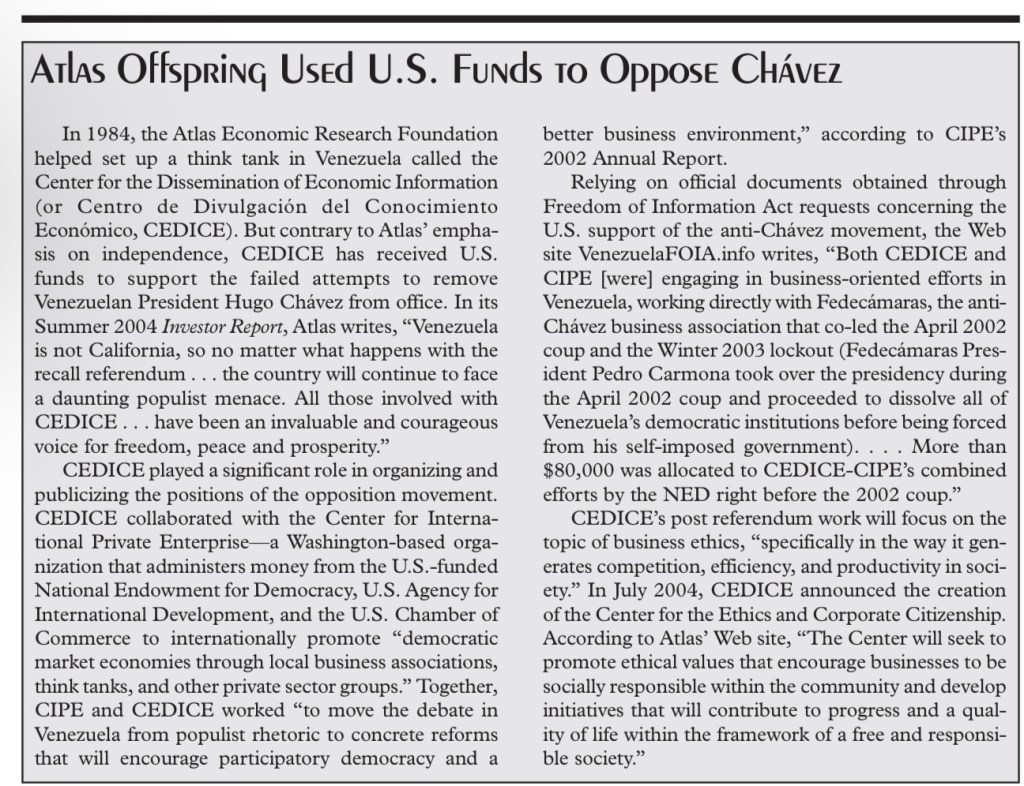
Scratch a (failed) color revolution and you’ll most likely find an Atlas Network affiliate behind it:
 Ms. Cat’s Chronicles
You must be logged in to post a comment.