The doctrine of “assertive transparency” has dramatically escalated the South China Sea tensions. Among other things, it has been used to justify the trilateral alignment of the US, Japan and Philippines. How did it come about?
…
From Washington’s perspective, the collaboration is designed to weaken China prior to a potential Taiwan crisis. Tokyo shares the view. Though the Philippines is positioned to bear most risks and losses, it is not entirely clear how it will benefit from the new trajectory.
….
Without policy recalibration, Manila seems to be stumbling into a major geopolitical minefield even before an expected Taiwan crisis, while the Filipinos’ trust in their political leaders’ domestic policies is dwindling.
…
That same day, China’s Defense Ministry spokesperson Wu Qian stated that the Philippines’ harassment and provocations are the direct cause of the SCS escalation. Counting on the support of external forces, the Philippines has infringed upon China’s sovereignty and violated international law and the spirit of the Declaration on the Conduct of Parties in the SCS, Wu stated. Reportedly, Philippine government has ignored several concept papers China submitted almost a year ago that proposed ways to normalize the situation in the disputed areas of the SCS.
…
The opposing stands remain what they were in the Duterte era. A the time, both sides agreed to disagree on the divisive SCS issues, which became subject of pragmatic long-term negotiations, in anticipation of the ASEAN-China code of conduct on the SCS. Diplomacy ensured focus on economic development, which is very much in the interest of all countries in the region.
In Washington, the tactic is portrayed as Manila’s response to counter China. Yet, the architects of the policy seem to be linked with the US Department of Defense. Instead of just a narrow information war of “naming and shaming,” the tactic involves broad counterinsurgency operations.
Bringing Vietnam to the Philippines
Working in the US Naval College in 2016, a young policy wonk Hunter Stires sought to develop the strategic concept of “maritime insurgency/counterinsurgency” (Maritime COIN). Essentially, his goal was to reframe Chinese challenge in the SCS and reorient U.S. strategy to defeat it.
…
Intriguingly, Stires compared Beijing’s efforts in the SCS with Viet Cong’s activities against rural civilian populations in South Vietnam arguing that “large numbers of small U.S. units brigaded with allied forces can produce disproportionate outcomes.”
Offering an alternative to big and broad military campaigns, the Combined Action Program (CAP) platoons would patrol in villages and hamlets full-time to degrade the insurgents’ capabilities. The trick was to convert the rural anti-guerrilla tactic into maritime counter-insurgency and bring the CAPs to the Philippines and the SCS.
Philippine Insurrection déjà vu
In Stires’s odd comparison, president Marcos Jr serves as the contemporary equivalent of South Vietnam’s Nguyen Van Thieu who got into power after a rigged election and was defeated by Ho Chi Minh’s Viet Cong. The bigger lesson – the massive human and economic, particularly civilian losses caused with the CAP and other doctrines, and the US defeat in Vietnam – is simply ignored.
…
The CAP experiences promoted by Stires originated at least partially onMarine “pacification programs” (read: violent subjugation) in Haiti, Nicaragua, the Dominican Republic, and elsewhere during the Banana Wars in the late 19th and early 20th century. More recent operations include those in Iraq and Afghanistan.
There are also links to other pacification programs, such as what the U.S. historians call the “Philippine Insurrection” (1899-1903) when the US conquered the country eventually engaging in massacres during the Moro Rebellion (1899-1913). Hence, too, the scorched earth campaigns and forcible relocations of civilians to concentration camps in which thousands perished, as America eventually replaced Spain as the colonial power. On the Philippine side, the war led to at least 200,000 civilian deaths, although some estimates put civilian deaths up to a million.
In January, US Navy hired Stires to serve as “maritime strategist” for the Secretary of Navy. To him, the Philippines and the SCS are South Vietnam’s maritime reincarnation. Ironically, the maritime counterinsurgency idea rests in part on the US counterinsurgency doctrine deployed in the lethal conquest of the Philippines.
…
US Navy, Big Defense, and think-tanks
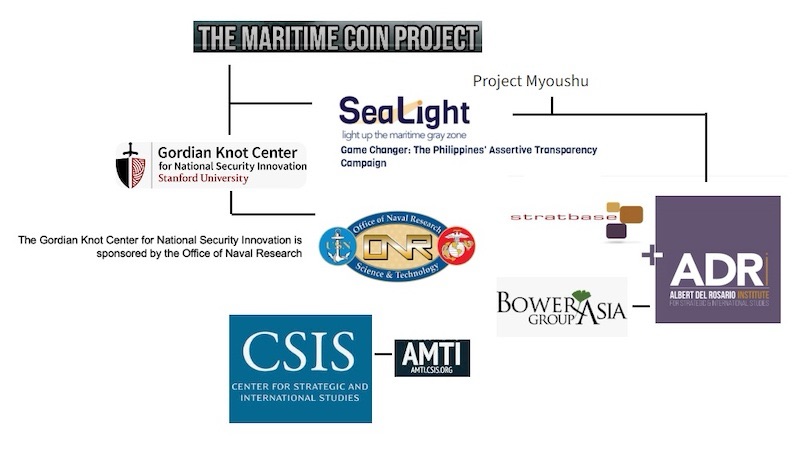
But tactical doctrines are one thing, actionable military campaigns another. What ensued was the controversial Project Myoushu, a derivative of the U.S Naval Institute’s Maritime Counterinsurgency (COIN) Project. Tailored to counter China in the SCS, Myoushu is one of the core projects of SeaLight, an initiative by Stanford University’s Gordian Knot Center for National Security Innovation (GKC).
The GKC was created in fall 2021, in parallel with Philippine presidential rivalry. It was sponsored by the US Office of Naval Research (ONR), which reports directly to the Secretary of the Navy.
The GKC’s resources originate from U.S. government agencies, the Center for Strategic and International Studies (CSIS) and its Asia Maritime Transparency Initiative (AMTI). The CSIS is a major U.S. think-tank, funded by government agencies, the Pentagon, the Big Defense, banking behemoths and energy giants.
AMTI is an arm of the CSIS; a sort of high-tech intelligence assembler supporting U.S.interests in maritime Asia. In the Philippines, it has cooperated with Stratbase ADR Institute, the late foreign minister Alberto del Rosario’s think-tank, which is linked withBowerGroup Asia, headquartered in Fairfax, Virginia, west of Washington, DC.
Located at Stanford in the heart of California’s Silicon Valley, the GKC seeks to provide a new vision of naval power in the coming decades, when “the U.S. will be engaged in great power competition with our strategic rivals,” says Joe Felter, one of its founders. An ex-Special Forces officer, Felter has served as US deputy assistant defense secretary for South Asia, Southeast Asia, and Oceania. His combat deployments include Iraq and Afghanistan, where he reported to Generals Stanley McChrystal and David Petraeus.
In brief, the doctrine of assertive transparency seems to be a part of a broader maritime counterinsurgency campaign, seeking to contribute to China’s containment in South China Sea. And it has been developed and refined by high-level senior officers and major think-tanks in the US Defense Department.
Behind the “assertive transparency” doctrine
In the Philippines, the use of the “assertive transparency” doctrine has been paralleled by the dramatic plummeting of the approval ratings of President Marcos and other government leaders. The decline is due to the growing Filipino concerns regarding issues like inflation, corruption and perceived weak leadership.

 Ms. Cat’s Chronicles
You must be logged in to post a comment.