
Why Are There Fears of War in the South China Sea?
The South China Sea has some of the world’s most productive fisheries, as well as shipping channels that carry about a third of global ocean trade [1]. Surveys suggest that it may also contain large oil and natural gas deposits.
…
The sea’s features were mostly beyond “the administration and often the awareness” of governments until the late 19th century, the scholar Gregory B. Poling [2] wrote in a recent book. But in the mid-20th century, Beijing laid claim to most of the sea with a sweeping, U-shaped boundary.
…
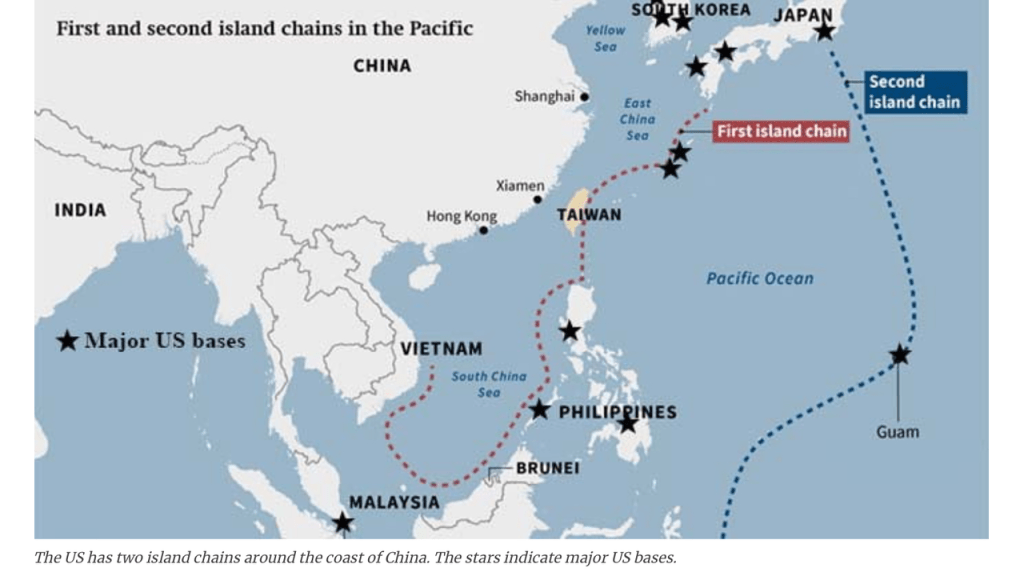
Governments with competing claims in the sea — Brunei, Indonesia, Malaysia, Taiwan, Vietnam and the Philippines — have limited options for resisting Beijing’s pressure. That’s partly because Chinese investments in those places put them in the difficult position of wanting to defending their maritime claims without damaging their economic interests.
…
Song Zhongping, a military affairs analyst in Beijing, said that the United States — which has sent warships sailing through the sea and military aircraft flying over it — is the real “troublemaker.” [3]
…
The current Philippine government is also far less conciliatory toward China than the one it replaced. President Ferdinand Marcos Jr., who took office in 2022, has beefed up the U.S. alliance and sought support from a wide network of partners, including Japan and Australia.
…
Weeks after the June clash near the shoal, China and the Philippines reached an apparent deal to prevent clashes there. The Philippines later conducted a resupply mission without incident.
…
Then again, China and the Philippines both “appear quite ready to de-escalate,” and Beijing has little incentive to provoke a war over the shoal, said Collin Koh, an expert on maritime security in Southeast Asia.
Then, Blinken and Austin said, hold my beer! [4]
Related:
[1] How Much Trade Transits the South China Sea?
The United Nations Conference on Trade and Development (UNCTAD) estimates that roughly 80 percent of global trade by volume and 70 percent by value is transported by sea. Of that volume, 60 percent of maritime trade passes through Asia, with the South China Sea carrying an estimated one-third of global shipping.1 Its waters are particularly critical for China, Taiwan, Japan, and South Korea, all of which rely on the Strait of Malacca, which connects the South China Sea and, by extension, the Pacific Ocean with the Indian Ocean. As the second-largest economy in the world with over 60 percent of its trade in value traveling by sea, China’s economic security is closely tied to the South China Sea.
[2] CSIS: Gregory B. Poling / CSIS’ Donors
[3] Philippines, Japan militaries hold first joint exercises in South China Sea
[3] Philippines, US forces hold joint military exercises in West Philippine South China Sea
[4] Washington’s Use and Abuse of the Philippines Takes Next Step
 Ms. Cat’s Chronicles
You must be logged in to post a comment.