
Dr Muhammad Yunus, the chief adviser in Bangladesh’s interim government, on Tuesday introduced Mahfuz Alam, his special assistant, as the “brain” behind the country’s recent student-led movement and subsequent push to topple the Awami League regime, at an event in New York, US.
…
Dr Yunus praised Mahfuz for his leadership, calling him the “brain of the whole revolution,” though Mahfuz humbly insisted that the movement had been a collective effort.
Dr Yunus introduces Mahfuz Alam as mastermind of student movement
Related:
Who was the third youth to join Yunus on stage at the Clinton Global Initiative event?
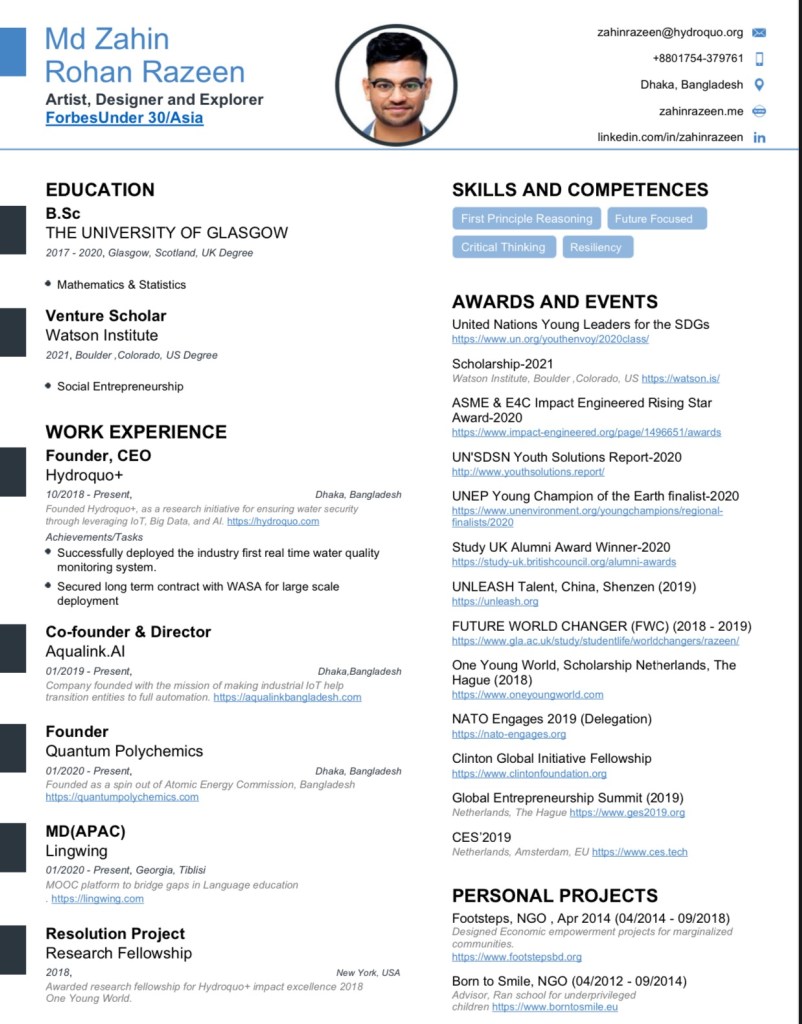
In response, Mahfuj Alam, a Dhaka University student leader of the Anti-Discrimination Student Movement and the chief adviser’s special assistant, along with Ayesha Siddiqa Tithi, a student at Brac University, came up to the stage, accompanied by a third young man whose name was not on the official list of companions.
…
Dr Yunus’s press wing later identified him as Zahin Razeen, founder of Hydroquo+.
Council on Foreign Relations: Can Bangladesh Really Reform?
But now, several months after the caretaker government assumed power and announced plans to reform state institutions and call new elections at some time in the future—elections that could lead to a broader swath of political parties than the two giants that have dominated Bangladeshi politics—Yunus’ government is struggling to maintain even basic stability. The caretaker government has plans to reform the security forces, the civil service, the judiciary, the police, financial institutions, and the election commission, among other institutions. All of these reforms—if successful—could go a long way toward reducing the often-violent polarization that has characterized Bangladeshi politics for decades and the patronage politics that have destroyed democratic institutions.
…
Yunus may also try to reform some of the patronage-ridden economy, which would open the door to greater foreign investment outside of the already prosperous garment sector. The United States, recognizing this possibility, has dangled the chance of greater aid to Bangladesh’s interim government. But Bangladesh needs far more than reform plans, which it cannot fund itself. It could desperately use something akin to a donor conference, say, organized by Japan (which has led many other such conferences), through which a sizable amount of aid would flow into the country for the caretaker government to use for rebuilding state institutions, preparing the way for elections, reforming the economy, and achieving many other goals.
USAID: U.S. Delegation Meets Interim Government of Bangladesh to Underscore Continued Partnership
Dhaka, September 15, 2024 – The U.S. Embassy welcomed an U.S. interagency delegation to Dhaka to hold meetings with key advisers for the Bangladesh Interim Government, including Chief Adviser Muhammad Yunus, Foreign Affairs Adviser Touhid Hossain, and Finance and Commerce Adviser Dr. Salehuddin Ahmed. The U.S. delegation included Department of Treasury Assistant Secretary Brent Neiman, Assistant Secretary of State for the Bureau of South and Central Asian Affairs Donald Lu, USAID Deputy Assistant Administrator for Asia Änjali Kaur, and Assistant U.S. Trade Representative Brendan Lynch.
 Ms. Cat’s Chronicles
You must be logged in to post a comment.