
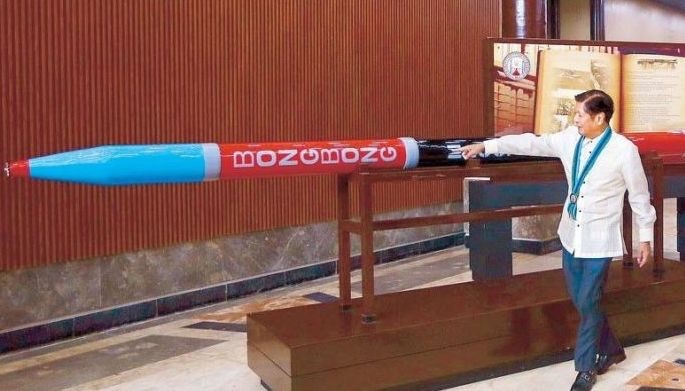
The Mystery of Marcos’ Rocket Program
’A Failed Project?’
The only VALID reason I could think of for all these “secrecy” or lack of transparency is that the program itself was NOT successful, and there are a number of ways that it could have failed. For one, the FAILURE or SUCCESS RATE of the launches were never published, and it’s possible that there were just too many launch failures, like the rockets exploding or veering off course at their launch pad or after launch, or even rockets not taking off at all. And even if the launches were successful, there is the issue of how accurate the rocket was in terms of hitting its target. If it ends up several hundreds or thousands of meters from its intended target, then it’s not very useful. And just like the Launch Rate, the Accuracy of the rockets were also never published.
It was an “epic fail.”
Marines tout the Bongbong rockets that went bust during Marcos Sr.’s regime – Diktadura
A declassified confidential cable from the US Department of State, dated February 6, 1974 concerns an aide memoire from Melchor about a standing request for assistance in the Philippine rocket research program, first made in October 1973. Melchor stated that the program would be a “heavy burden” on the “finances of the [Philippine] economy,” and rocket development thus far had “been met with early technical reverses primarily due to the absence of the much needed logistics support base”; he emphasized that “The critical lack of experience and a working model proved very costly and has drained heavily the meager resources appropriated for [the] endeavor.” Melchor noted that what they wanted to build was a multipurpose rocket, both for defense and for sparing the Philippines from “yearly destructions caused by the extremes of weather.”
The US ambassador, William Sullivan, recommended “modest assistance in technical package with training and advice as well as models,” but no accessible records show that any such assistance was given. US National Security Adviser Henry Kissinger believed such assistance would be going down a slippery slope: “We saw no particular problems in giving Melchor ‘exces’ Nikes [Nike-Hercules missile ‘cadavers’] as tinker toys,” but “Our feeling is that any meaningful assistance to the Philippine missile program would be overly expensive, wasteful of Philippine resources and unhelpful to the Philippines or to the USA.” In a July 3, 1974 cable, Sullivan tried to argue to give Melchor his missile cadavers, to no avail.
 Ms. Cat’s Chronicles
You must be logged in to post a comment.