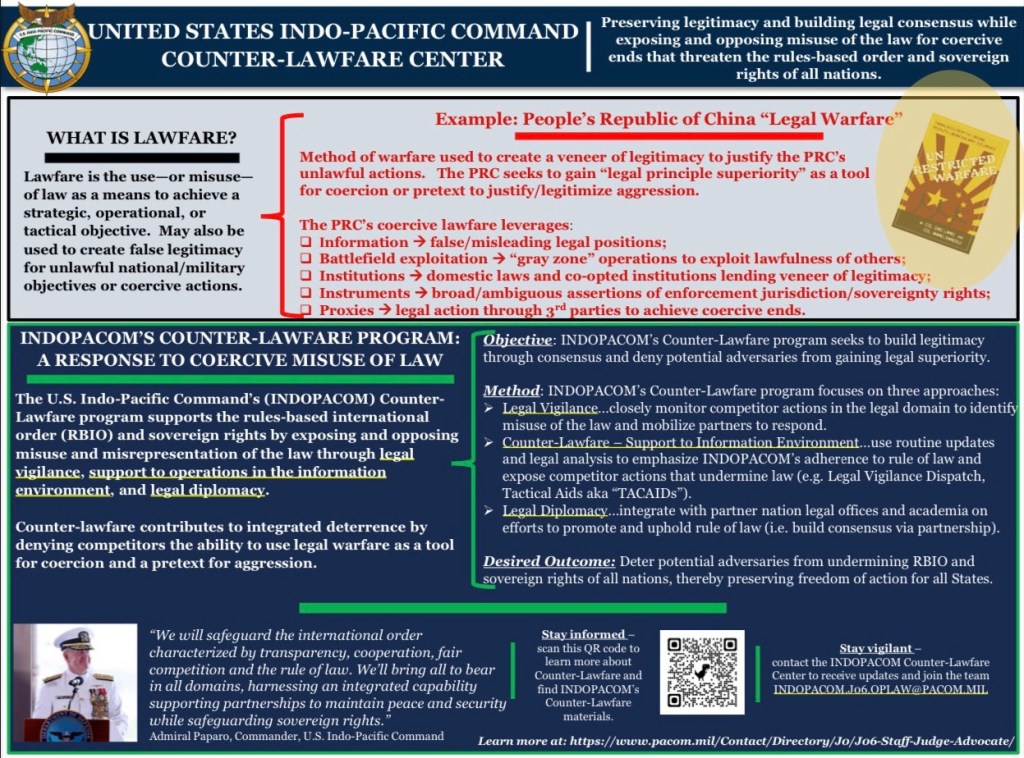
I found this while looking up “lawfare and tactical aids,” while browsing through the RAND paper, yesterday. It must be mandatory reading for military personnel, right?
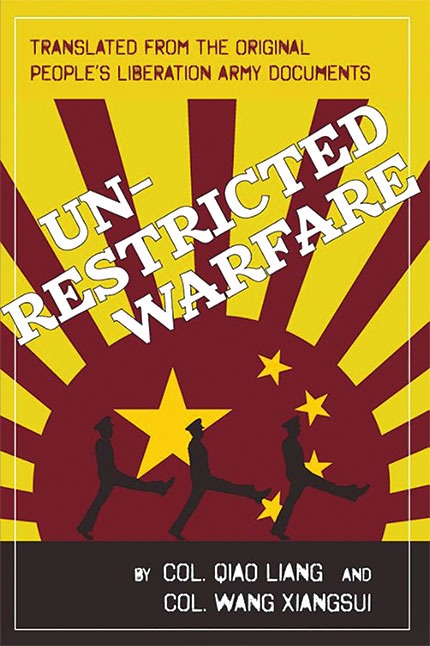
The Foreign Broadcast Information Service (FBIS), once an open-source intelligence division of the CIA’s Directorate of Science & Technology, “translated” the book. Eventually, the FBIS was incorporated into the Open Source Enterprise, which is a division of the Directorate of Digital Innovation at CIA.
As noted, there appear to be real challenges working through the necessary technologies to support command messaging efforts from being able to acquire simple programs, such as Adobe [1], that can help improve image quality of released content to access to social media. It would seem prudent that an assessment of such issues should be conducted by the command with necessary remediation actions undertaken when the new commander comes into USINDOPACOM.
…
The Global Engagement Center (GEC) at the U.S. Department of State [2], for example, partially funds the Asia Maritime Transparency Initiative [Center for Strategic and International Studies]. The GEC, the State Department, or DoD should seek to identify other voices that can support and that can more credibly communicate key messages.
I was just listening to Jeff Rich’s video, “Russophobia and the Anxiety of American Primacy” and it made me think of my previous post on “demonizing the enemy.” That led to me rereading my posts on propaganda and “The Blob.” For some reason, this chapter came up when searching for “Clausewitz and demonizing the enemy.” It’s an interesting read, and much better than reading Freud. 🤭 On another note, I have yet to finish reading “Lenin’s Notebook on Clausewitz” that I downloaded earlier from this website.
Senior Col. Wu Qian, a spokesman for China’s Ministry of National Defense, accused the Philippines of causing disturbances in various areas with the support and encouragement of the United States.
“From Ren’ai Jiao (Ayungin Shoal) to Xianbin Jiao (Sabina Shoal) and from Houteng Jiao to Huangyan Dao (Scarborough Shoal), such repeated provocations have allowed the international community to see clearly who is undermining peace and stability in the South China Sea and who is fabricating and spreading lies,” Wu said.
I’ve always known that they would try to expand their information operation to the other countries that are in ASEAN, just by following the SeaLight podcast. If not their information operation, regimechange and terrorism (in Balochistan and Myanmar). I’ve also noticed that Powell has been referring to the Philippines’ “transparency initiative” as “non-violent resistance,” lately (RAND refers to it as “assertive transparency”). Ironic, considering that they’ve already succeeded in overthrowing the government of Bangladesh and are now attempting it in Cambodia, India and Pakistan. For those who don’t know about the regime change asset Gene Sharp and his neoliberal “nonviolence,” see the links on this page. Unfortunately, I don’t have as much time to dedicate to this right now due to other obligations.
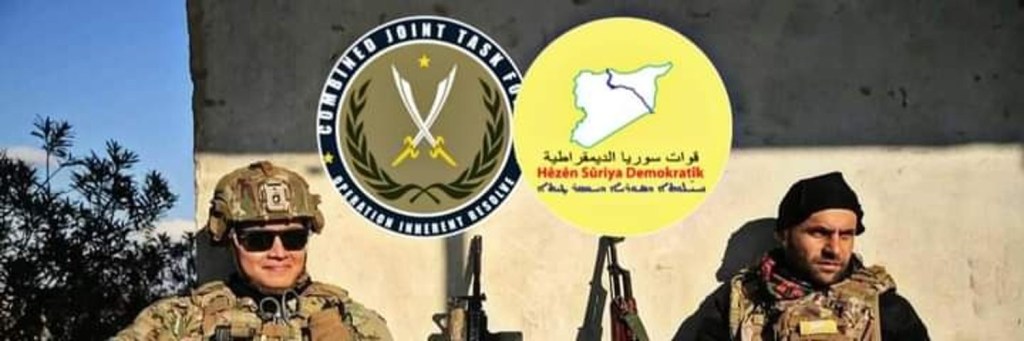
The seal on the left is the seal of the Combined Joint Task Force – Operation Inherent Resolve (CJTF–OIR). The seal on the right is of the Kurdish-led Syrian Democratic Forces (SDF).According to Reason, the CJTF–OIR is embedded with the SDF (see below*).
But Ahmed al-Sharaa AKA Abu Mohammad al-Julani said that the Kurds were the brethren of Hayʼat Tahrir al-Sham (HTS). /s
The Universal Health Care (UHC) Act of 2019, a landmark legislation for equitable healthcare access, places PhilHealth at the forefront of its implementation. However, recent controversies—ranging from the unlawful transfer of funds to the National Treasury to Congress denying PhilHealth a budget for 2025—have exposed systemic failures and raised serious questions about accountability and leadership.





 Ms. Cat’s Chronicles
You must be logged in to post a comment.