
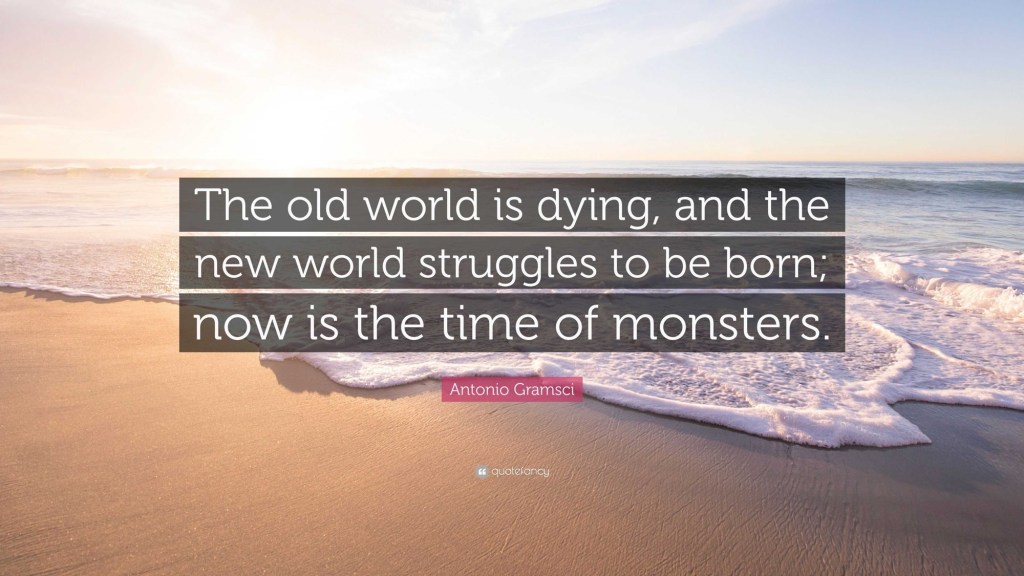
This Valentine’s Day, Let’s Look to Marxists to Reimagine Love, Romance and Sex
It’s certainly fitting to think of what Gramsci was writing from a fascist prison in today’s political climate. But it’s also true that we’re in another sort of interregnum, one of romance, sexuality and gender itself. And this one comes with its very own set of morbid symptoms, as anyone who’s tried dating lately can attest. Dating apps are a plague, every week there seems to be a new term for bad behavior (“ghosting,” “breadcrumbing,” whatever), work demands more and more of our time, leaving less and less for love, and a constantly destabilized economy leaves us anxious and stressed even if we do happen to have stable work. Abortion is now illegal in a huge chunk of the country, and homophobic and transphobic violence — not to mention actual bans on trans healthcare and drag — are on the rise. And even if you do make it to coupledom and want to have children, our country still has precisely no support for working parents. The material basis on which you might have thought you’d be able to build a life is crumbling.
If there’s one thing we can learn from Marxists in this moment, it’s that material circumstances matter — even when it comes to romance. Gramsci wasn’t exactly sitting in his prison cell dishing out relationship advice — he was trying to analyze the world that had locked him up, the capitalist system he was trying to bring down, and its effects on human life. But in “Americanism and Fordism,” one of the many pieces collected in the most commonly published English translation of those Prison Notebooks, he did turn his gaze to sexuality and relationships in order to explain how those relationships were created and coerced by industrial capitalism.
…
What both Gramsci and Engels point out (the latter at considerable length) is that the family form they had been raised to think of as normal was, in fact, a recent invention, created with some degree of coercion and molded into “common sense,” a term Gramsci used for the kinds of popular beliefs that shape our world, even when they’re wrong. (He counterposed it to “good sense,” a more accurate understanding of the forces at play in the world.)
Heterosexuality, as it existed in both men’s lifetimes, was a particular construct of industrial capitalism, designed to suit the needs of factory employers rather than to make people happy. A wife at home to do the cooking, cleaning and caring sent workers off to the factory better rested and ready for another day of work. Such “reproductive labor,” the Wages for Housework movement, decades later, would note, makes husbands’ work possible.
Heterosexuality, as it existed in both men’s lifetimes, was a particular construct of industrial capitalism, designed to suit the needs of factory employers rather than to make people happy.
…
We should probably note at this juncture that Gramsci had a rather prudish take on these issues — he wasn’t entirely disapproving of Ford’s methods. Certainly he, unlike Engels, did not write glowingly of the need to liberate love from the demands of industrial capital. But he too was clear: “the new industrialism wants monogamy” because the “exaltation of passion cannot be reconciled with the timed movements of productive motions connected with the most perfected automatism.” For the working classes, both Engels and Gramsci stress, freedom is only the freedom to sell their time for a wage; freedom when it comes to relationships and marriage follows the same logic. Civil law, Engels wrote, might hold that marriage is a free contract between men and women, but the reality is as unequal as the relationship between a worker and her employer. This still holds up today: women still make less money, and during the pandemic we saw large numbers of women leaving the workforce due to caring responsibilities. And the #MeToo movement reminds us of the unequal threat faced by women who might want to have relationships, romantic or otherwise, with men.
…
The solution, wrote Engels (and echoed by generations of liberal and radical feminists after him), is to “remove the economic considerations that now force women to submit to the customary disloyalty of men, and you will place women on equal footing with men.” Of course, what he meant was full communism, but he was also interested in “a more unconventional intercourse of the sexes” and the end of what we might now call slut-shaming.
It’s worth noting that these relations are not described along a gender binary because that’s what people recognized in Engels’s time, but rather that these relations are what created our ideas of men and women in the first place. Material circumstances led to dividing people along purportedly biological lines in order to control reproduction, and built an entire mountain of common sense about gender on top of that seemingly simple division.
But as the material relations that upheld and coerced binary gender collapse, so too does binary gender and sexuality. Without jobs that pay a family wage, women are pushed into the workplace; when that set of tectonic plates shifts, so too does everything built upon it. The nuclear family might have seemed like a decent deal for which to trade other forms of freedom when its promise of economic stability held up, but when that stability is gone, the sacrifices the nuclear family requires no longer look terribly attractive. Binary gender very much among them.
…
Our struggles with love are profoundly political. If the old industrial labor wanted monogamy, neoliberalism (even in its zombie phase) wants us alone and constantly overwhelmed with choices. Housing insecurity both compels people into cohabitation and encourages them to stay when things go to hell (and so does employer-based health insurance), but stagnant wages and rising costs mean increased strain on those same relationships. It’s not an accident that dating apps and gig-work apps arose together and use similar interfaces and tools to keep us swiping, always hoping there’ll be something better a tap away. Dating apps are the gig work of romance, where we are both worker and product. The skills and lifestyles of today’s networked, job-hopping worker, in the low- or mid-wage economy, are colossally unsuited to healthy relationships.
…
The old form is dying, but its death throes are lingering, and those morbid symptoms are everywhere. Heterosexuality is broken, but just opting out of it isn’t actually an option because the strains on relationships are everywhere — they exist for queer couples and throuples and casual flings too. Despite what the TERFs would have us think, it’s just not all men’s fault — the violence of a capitalist world takes many forms, and shifting power relations mean that women have new opportunities, including new opportunities to be brutal ourselves. Engels might be right, that the full freedom of relationships based on “mutual fondness” will only be possible after the abolition of capitalist property relations, but that’s not terribly helpful for those of us who are lonely right now.
 Ms. Cat’s Chronicles
You must be logged in to post a comment.