The People’s Liberation Army Navy Z-9 utility helicopter that intercepted the Philippine Cessna. Photo Courtesy of Camille Elemia.
…
A People’s Liberation Army Navy Z-9 utility helicopter intercepted the Bureau of Fisheries and Aquatic Resources Cessna 208B Grand Caravan during a routine patrol mission over Scarborough Shoal today at 8:39 a.m. local time, according to Philippine officials. A number of Philippine journalists [embedded journalists] were on board the Cessna during the encounter, which saw the Chinese helicopter fly as close as three meters from the turboprop aircraft. Philippine Coast Guard spokesperson Commodore Jay Tarriela described China’s actions as “dangerous flight maneuvers” and blasted the conduct as a disregard to international aviation regulations.
…
Dubbed by China as Huangyan Dao and the Philippines as Bajo de Masinloc, Scarborough Shoal has been disputed by the two countries for decades. Beijing’s Ten Dash Line map puts the South China Sea maritime feature under Chinese jurisdiction despite its location 120 nautical miles off the Philippine island of Luzon and within Manila’s exclusive economic zone. Chinese forces gained de facto control of Scarborough following a 2012 standoff with the Philippines.
Despite the 2016 South China Sea arbitration, in which an international court ruled in favor of Manila and solidified that maritime features were not extensions of a nation’s exclusive economic zone, Beijing still considers the remote shoal its own.
The Scarborough Shoal is in the Spratly Islands, which is disputed by Brunei, China, Malaysia, the Philippines, Taiwan (a province of China, as recognized by the United Nations’ Resolution No. 2758), and Vietnam.
Behind the scenes, an information operation has been going on. Information operations, also known as influence operations, involve spreading misleading information and obtaining tactical knowledge about competitors to get the upper hand. Think tank representatives, financed by the US government and corporate sponsors, have been working with the Philippine Coast Guard on “assertive transparency,” or what the Philippines calls their “transparency initiative.” With grants from the U.S. State Department, between 2022 and 2024, the Stratbase ADR Institute held a series of roundtable discussions highlighting the importance of multilateral cooperation and strategic alliances in addressing regional “security challenges” and “public diplomacy,” or the act of “influencing foreign publics” to support “U.S. foreign policy goals.”
…
The “transparency initiative” tactic highlights China’s “gray zone activities”, in the South China Sea. One aspect used is embedding journalists on these resupply missions. The original purpose of embedding was to control journalists, according to Helen Benedict, a professor at the Columbia Journalism School. Citing award-winning Australian journalist Phillip Knightley’s book “The First Casualty: The War Correspondent as Hero and Myth-Maker from the Crimea to Iraq” which describes how the U.S. government invented embedded journalism in response to critical coverage of the Vietnam War. As civilian casualties in Afghanistan reached 5,000, the Pentagon sought a media strategy that would bring attention back to the military’s role in the war, especially the role played by ordinary American service members. This would require bringing war correspondents on side.
…
While 60 Minutes did state that “in 2016, an international tribunal at The Hague ruled the Philippines has exclusive economic rights in a 200-mile zone that includes Sabina Shoal” and that “China does not recognize the ruling”, their statements were misleading. The South China Sea Arbitration did not rule on sovereignty, and China does not recognize it because the Arbitral Tribunal lacked jurisdiction. “The Arbitral Tribunal violated the principle of state consent, exercised its jurisdiction ultra vires and rendered an award in disregard of the law. This is a grave violation of UNCLOS and general international law, Wang said.” The United Nations Convention on the Law of the Sea (UNCLOS) is an international treaty that establishes a legal framework for all marine and maritime activities. The Permanent Court of Arbitration (PCA) is not an agency of the United Nations. The PCA rents space in the same building as the UN’s International Court of Justice. A Congressional Research Service report, dated August 2023, stated that the U.S. has not declared its position regarding sovereignty over any of the geographical elements that comprise the South China Sea.
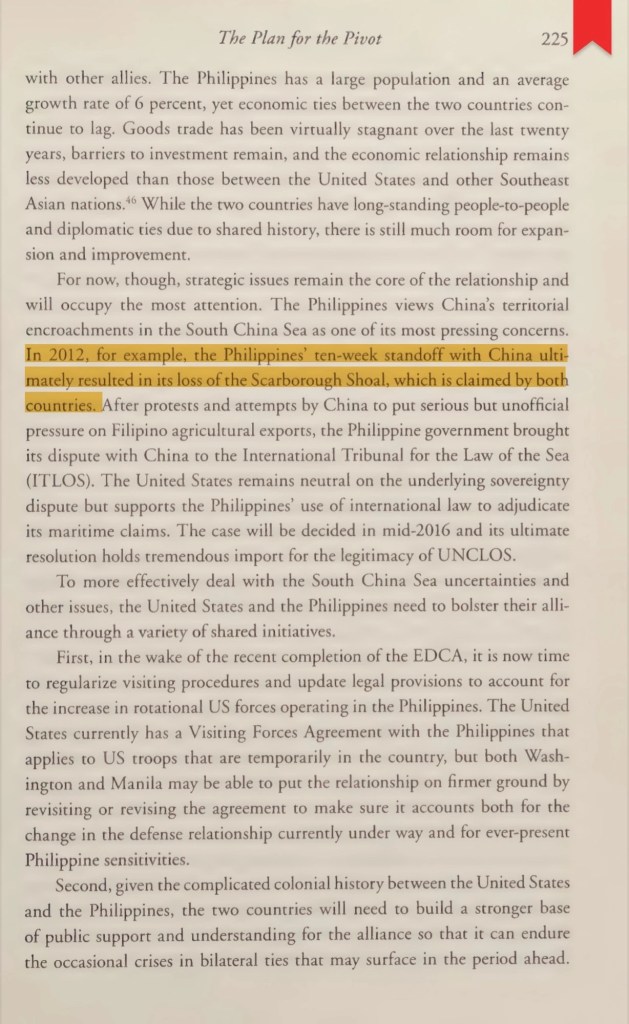
Former US Assistant Secretary of State Kurt Campbell [Zichen’s note: currently Deputy Assistant to the President and Coordinator for Indo-Pacific Affairs on the National Security Council and recently nominated for Deputy Secretary of State, Department of State] wrote in his book The Pivot: -The Future of American Statecraft in Asia that, “In 2012…the Philippines’ ten-week standoff with China ultimately resulted in its loss of the Scarborough Shoal, which is claimed by both countries. After protests and attempts by China to put serious but unofficial pressure on Philippine agricultural exports, the Philippine government brought its dispute with China to the International Tribunal for the Law of the Sea (ITLOS).”[1]


 Ms. Cat’s Chronicles
You must be logged in to post a comment.