
Strengthening the Financial Independence of Independent Media Organisations
The key findings of the literature review with regard to international donor assistance and private funding for independent media are as follows:
- The United States and Germany are the largest contributors of international media assistance (Myers & Juma, 2018); China is emerging as a large donor for media and communications infrastructure projects
although it is less interested in freedom of the media(Myers & Juma, 2018);
- Most aid agencies are not willing to provide long term support which can incubate independent media until they become financially self-sufficient (World Association of Newspapers, 2011);
- Donors acknowledge that in some regions the market does not provide adequate incentives for private media to become financially independent (Peters, 2010);
- The majority of independent media start-ups in developing countries obtain most of their funding from grants from private foundations (Cook, 2016).
- The Media Development Loan Fund (MDLF) [now known as the Media Development Investment Fund (MDIF)] is a revolving loan fund which provides low or no interest loans, leases or equity to independent media, especially in developing and former Soviet bloc countries (Weiss, 2010). B29, The Mail & Guardian and Malaysiakini.com are examples of sustainable independent media which were initially financed by MDLF (World Association of Newspapers, 2011);
- There are models for using guarantees to support independent media such as USAID’s Development Credit Authority, but adaptation is necessary and the risks are not fully known (World Association of Newspapers, 2011), and
- There are very few examples of accelerators. The Open Society Foundation sponsors the JamLab accelerator in South Africa (Tshabalala, 2018).
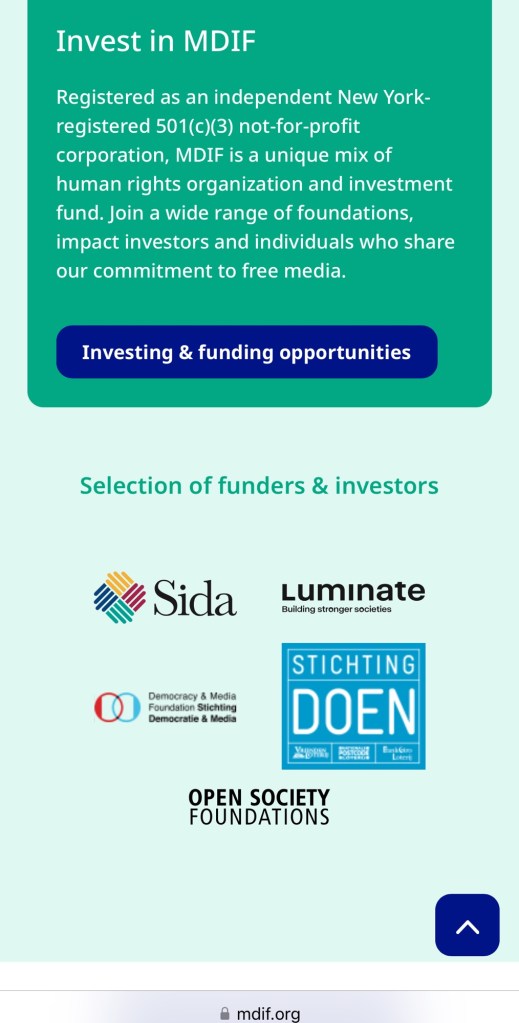
MDIF funders and impact investors
Luminate (Pierre Omidyar), Open Society Foundations (George Soros), Stichting DOEN (DOEN Foundation), MacArthur Foundation, Oak Foundation, Swedish International Development Cooperation Agency (Sida), Swiss Agency for Development and Cooperation, Reva and David Logan Foundation (Chicago)
Reva and David Logan:
Reva and David Logan were a couple who supported the arts and journalism, and were involved in many community activities.
Logan family support:
- Helped establish the Center for Investigative Reporting
- Supported the PBS program “Frontline”
- Sponsors the annual Logan Symposium at the University of California Berkeley
Journalism was another field where the Logans offered pivotal support. They helped establish the nonprofit Center for Investigative Reporting as a leader in its field. Their foundation has also provided significant support for the PBS program “Frontline” and sponsors the annual Logan Symposium, the leading international conference for investigative reporters and students at the University of California Berkeley.
The Center for Investigative Reporting:
A national nonprofit news organization that produces Mother Jones magazine and website, and the Reveal radio show and podcast.
CIJ Logan Symposium (Centre for Investigative Journalism):
The biennial CIJ Logan Symposium convenes a unique international community of investigative journalists, whistleblowers, hackers, documentarians and artists committed to defending press freedoms, challenging power and fighting for freedom and democracy.

Hyde Park is the heart of the Culture Coast, with neighboring Bronzeville and Woodlawn adding to the region’s diverse cultural offerings. It is home to the Museum of Science and Industry, the Western hemisphere’s largest science museum, and the Hyde Park Art Center, the city’s oldest alternative exhibition space.
…
The lakefront area has evolved into an eclectic architectural landscape since the mid-1800s, featuring Frank Lloyd Wright’s Prairie-style homes, the Hyde Park-Kenwood Historic District, and the University of Chicago’s Collegiate Gothic quadrangles and modern constructions, such as the Joe and Rika Mansueto Library and the Reva and David Logan Center for the Arts.
The Barack Obama Presidential Center is currently under construction in Jackson Park, on its border with Hyde Park.
The Obama Presidential Center: A Beacon or a Burden for Chicago’s South Side?
Yet in neighborhoods like Woodlawn, South Shore, and even Hyde Park, residents fear that this revitalization might just be the latest chapter in a long history of gentrification. Groups like the Obama Library South Side Community Benefits Agreement (CBA) Coalition continue to press for measures to protect local residents, pushing for rent control and affordable housing to offset the influx of investors and rising property values. In response to these concerns, the city has recently committed $40 million toward comprehensive school renovations and affordable housing initiatives. This substantial investment aims to upgrade educational facilities to better serve the community’s youth and to increase the stock of affordable housing units to help maintain economic diversity. The funds are allocated for modernizing school infrastructure, enhancing educational programs, and constructing new affordable housing projects, as well as preserving existing affordable units through subsidies and incentives for landlords.
In the Shadow of the Obama Center, Chicago Residents Fight Displacement
Lately, Clay says, the community has been changing around her. Nearby residents have reported rents being hiked by as much as 60%. During 2022, investors bought up nearly a third of for-sale homes in South Shore, the highest rate of investor purchases in the city. Clay and other South Shore residents fear that those investors are now waiting for the opportune time to sell at prices current neighbors cannot afford.
“It seems like developers are coming in here and taking over,” Clay says. But she is determined to stay.
To an outsider, the South Shore neighborhood may not appear to be an obvious candidate for gentrification. Three-quarters of the residents are renters, and the neighborhood population is 92% Black. A third of the population makes less than $25,000 per year and almost one in every six houses is vacant. What’s more, South Shore has often topped the list of neighborhoods with the city’s highest eviction rates, according to available data. But the history of Chicago and other urban centers shows that vacancies and evictions can set the stage for rapid gentrification.
Obama Presidential Center – Home – Institute for Housing Studies – DePaul University
 Ms. Cat’s Chronicles
You must be logged in to post a comment.