Western Media Finally Admits Tariffs Aimed at Isolating China, Not “Reindustrialization”
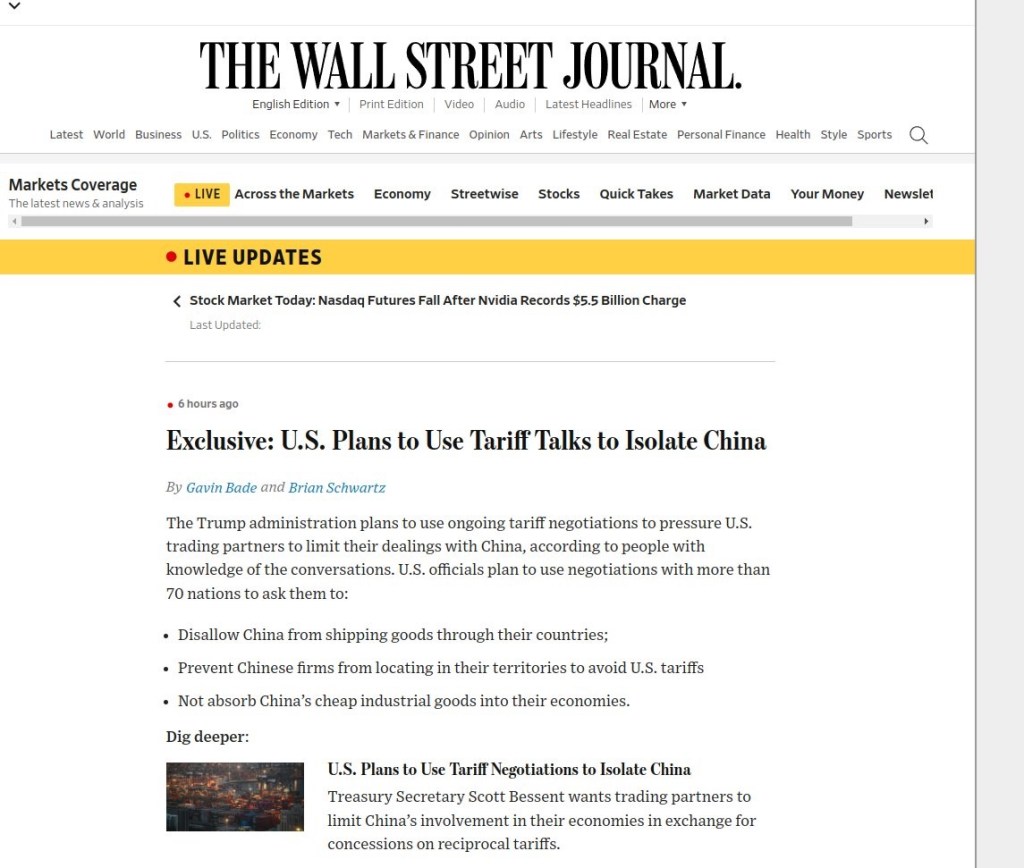
As warned, the US predicated tariffs on “reindustrialization” to sell to a gullible public, but was always aimed as preparations for isolating and eventually warring with China;
None of the actual measures needed to reindustrialize were even proposed let alone implemented (education reform, nationalizing industry, infrastructure investments);
Nations the US has politically captured obediently accepted the tariffs and are now going to be organized into a united front a la Biden vs. Russia but against China – all as Trump dishonestly “seeks peace” with Russia;
Recall US Sec. of State Rubio began ramping up pressure on China’s island province of Taiwan, rewriting the State Dept’s website, erasing admissions the US does NOT recognize Taiwan “independence;”
Americans voted for Trump to end Biden policies – but got a super-sized continuity of agenda instead;
Bessent pitched the idea to Trump during an April 6 meeting in Mar-a-Lago, said people familiar with the discussion, saying that extracting concessions from U.S. trading partners could prevent Beijing and its firms from avoiding U.S. tariffs, export controls and other economic measures, the people said.
The tactic is part of a larger strategy being pushed by Bessent to isolate the Chinese economy, which has gained traction among Trump officials recently. Debates over the scope and severity of U.S. tariffs are ongoing, but officials largely appear to agree with Bessent’s China plan.
It involves cutting China off from the U.S. economy with tariffs and potentially even cutting Chinese stocks out of U.S. exchanges. Bessent didn’t rule out the administration trying to delist Chinese stocks in a recent interview with Fox Business.
…
Bessent has shown his desire for anti-China pledges from U.S. trading partners before. In late February, he said that Mexico had offered to match U.S. tariffs on China as part of negotiations over Trump’s tariffs on Mexico imposed because of the fentanyl trade. Bessent called Mexico’s offer a “nice gesture,” but the idea didn’t find much traction with the administration.
Since then, Bessent has taken a more central role in trade negotiations, assuming a lead in talks over reciprocal tariffs after Trump announced his 90-day pause on April 9. The Treasury secretary is slated to meet with Japan’s economic revitalization minister as soon as Wednesday and has laid out a list of nations he believes could soon reach deals with the U.S., including Japan, the U.K., Australia, South Korea and India.
My commentary: The tariffs imposed under the Trump administration are not genuinely aimed at revitalizing American industry. Rather, they function as a tool to destabilize China’s economic growth and position the U.S. to provoke a potential military confrontation. These punitive measures are designed to persist unless nations acquiesce to the administration’s demands, effectively coercing them into aligning with its confrontational economic agenda against China.

 Ms. Cat’s Chronicles
You must be logged in to post a comment.