
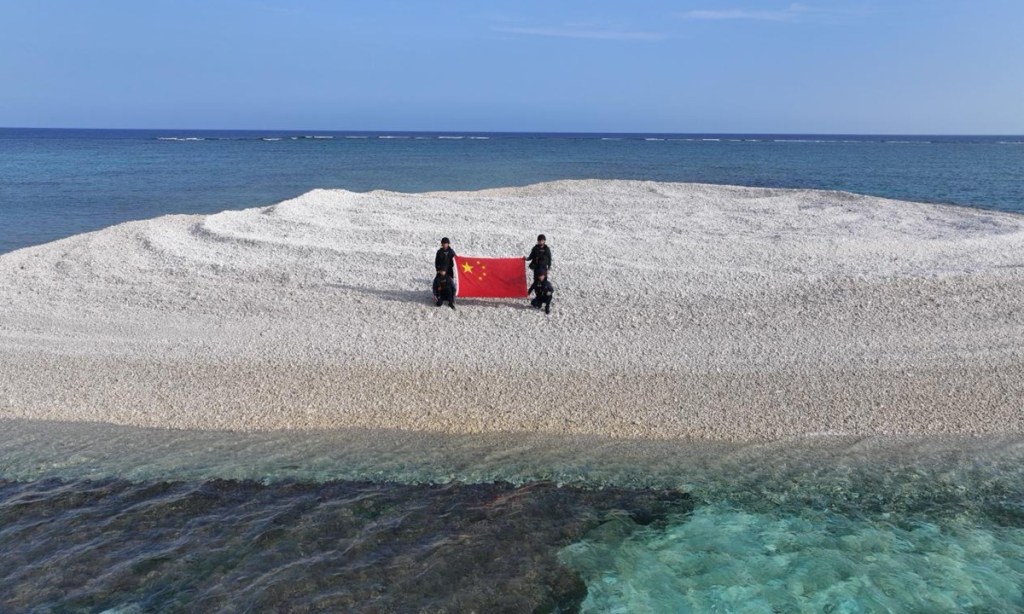
Financial Times: China seizes disputed reef in the South China Sea (archived)
It comes as the Philippines and its ally the US are conducting Balikatan, their largest annual military exercise, which will include coastal defence and island seizure drills. They will be held from next week on the Philippine territory closest to the Spratlys.
Although just a sand bank measuring little more than 200 square metres, Sandy Cay has strategic value for China because international law grants it a territorial sea. That 12-nautical-mile radius overlaps with Thitu Island, the South China Sea reef the Philippines uses to track Chinese moves in the area.
The White House said the reports of China seizing Sandy Cay were “deeply concerning if true”.
…
There is so far no sign of a permanent Chinese occupation of Sandy Cay or construction on it. A Philippine maritime security official said on Saturday that the Chinese coastguard had left after unfurling the flag.
…
The Philippine coastguard has been operating a monitoring base on Thitu since late 2023, but Manila is now upgrading a runway and other infrastructure on the island. The building is part of efforts to make its South China Sea reefs more habitable and push back against increasingly aggressive Chinese activity.
Related:
Agence France-Presse reprint: PH, US test air defenses as China says it has seized Sandy Cay
Global Times: China Coast Guard enforces sovereignty, cleans up waste at Tiexian Jiao in South China Sea
The Global Times learned from a source close to the matter that a group of CCG officers landed on Tiexian Jiao [Sandy Cay Reef] to conduct on-reef inspection and video-recording of illegal activity. Meanwhile, the CCG officers also displayed the Chinese national flag to assert sovereignty, cleaned up plastic bottles, wooden sticks, and other debris scattered across the reef flat.
China Daily: Philippines’ illegal activities damage South China Sea reefs, report says
The survey identified four cays on the reef flat of Tiexian Reef [Sandy Cay Reef] and Niu’e Reef [Whitsun Reef], with their formation attributed to normal physical geographic processes as confirmed by cay formation and evolution analysis, refuting “the false remarks by the Philippines that China dumped coral debris at Tiexian Reef, and the rumors spread by relevant countries that the formation of the cays is due to China’s ‘sea reclamation’.”
 Ms. Cat’s Chronicles
You must be logged in to post a comment.