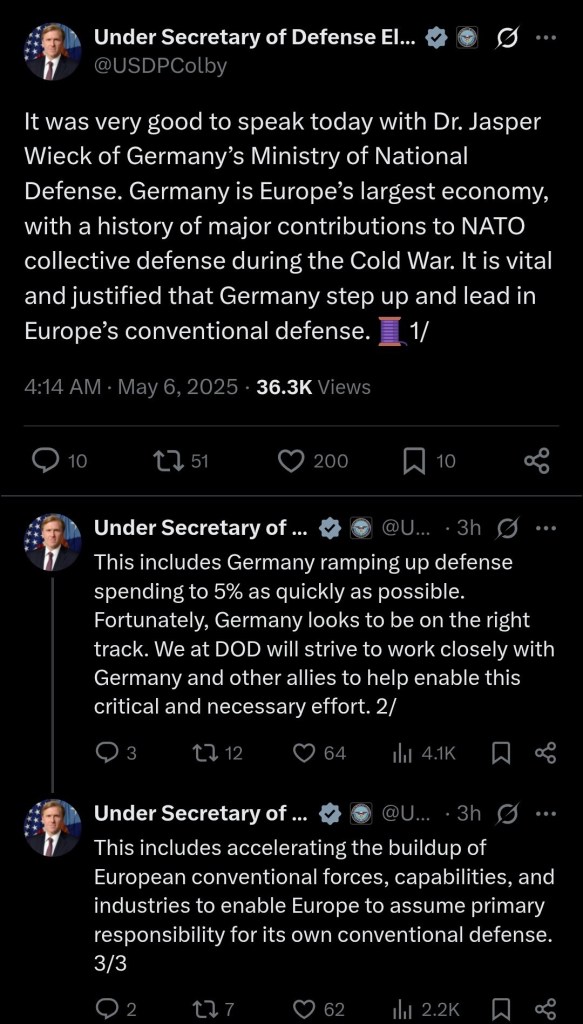
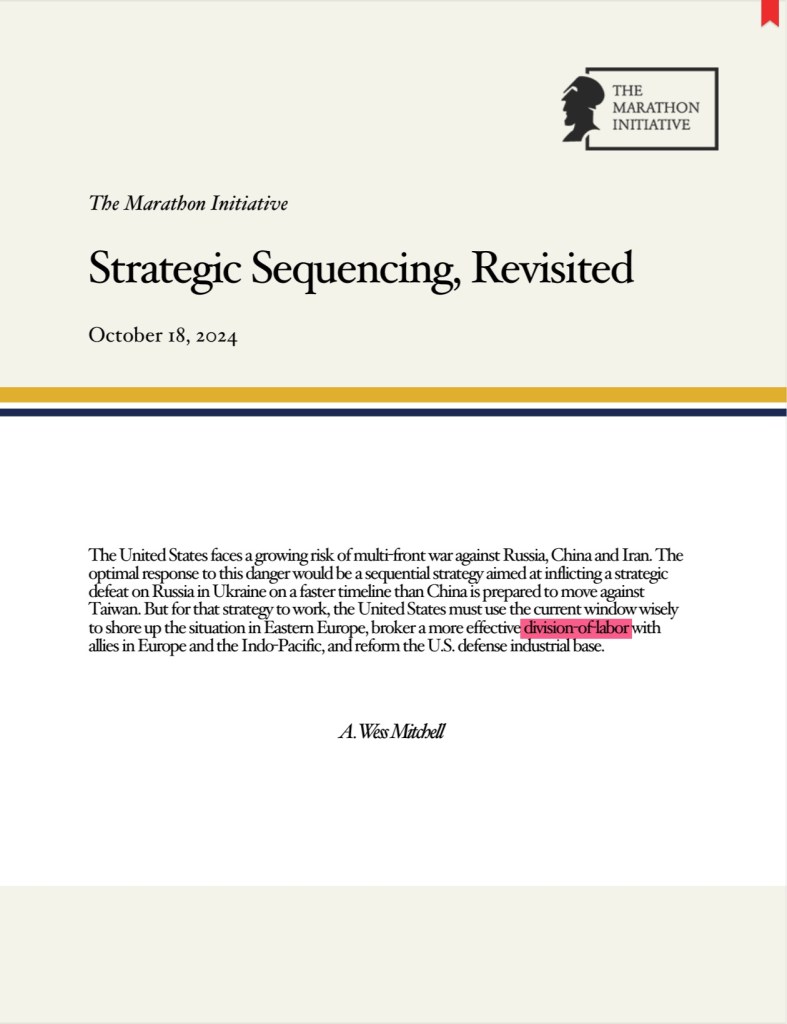
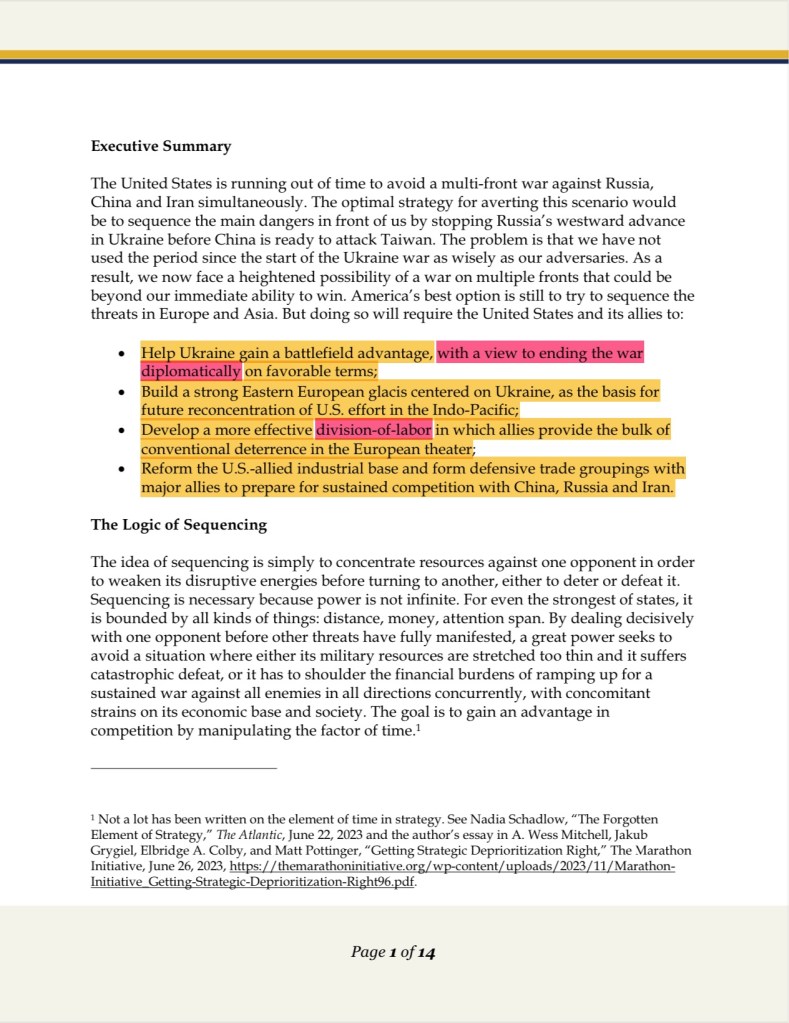
Trump appointed neocon warmonger Elbridge Colby on the “division of labor” between the US and Europe regarding Washington and Wall Street’s 2 front confrontation with Russia and China…
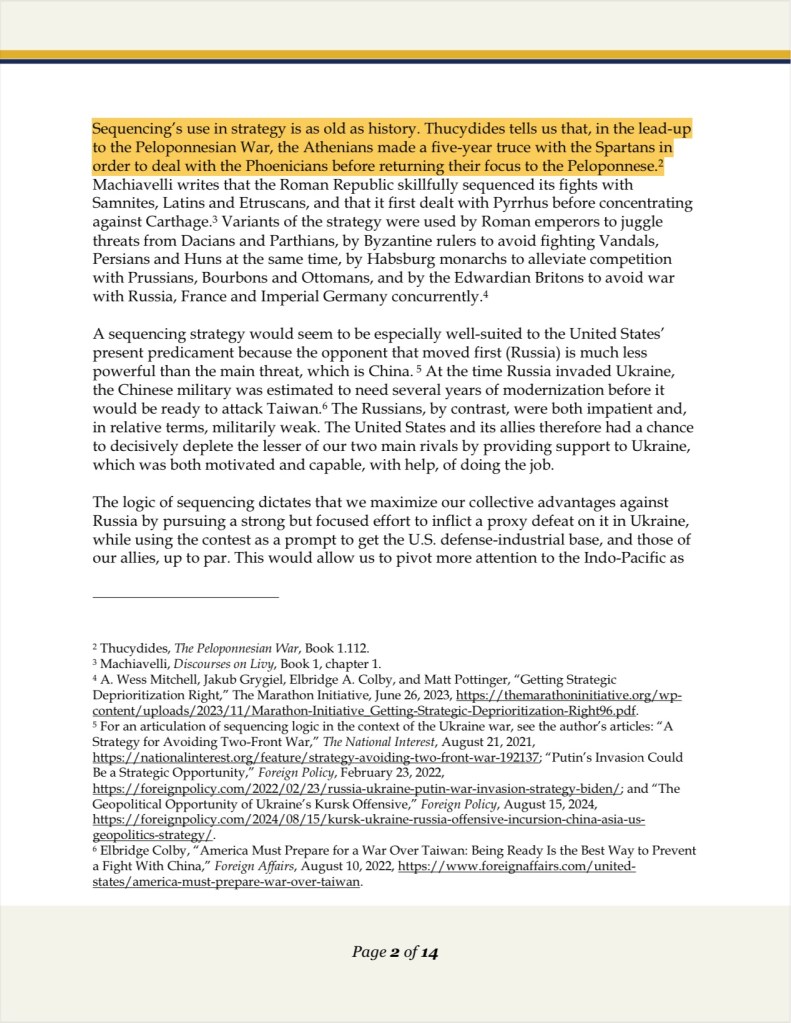
The reference to Thucydides highlights a connection between historical strategies and contemporary geopolitics. For instance, during the Peloponnesian War, the Athenians momentarily redirected their attention to counter a significant threat from the Phoenicians before resuming their primary engagement with the Spartans in the Peloponnese. This indicates a thoughtful prioritization of challenges to manage multiple threats effectively.
In the context of the Russo-Ukraine war, this suggests that the U.S. and its allies might temporarily divert their focus to address other strategic issues, such as those in the Indo-Pacific, but would ultimately refocus on the situation in Ukraine. This concept aligns with the broader idea of “strategic sequencing,” where resources and efforts are allocated in phases to prevent overextension.
The interim guidance is nine pages. Several passages throughout are similar to a longer 2024 report by the Heritage Foundation, some of which are nearly identical, according to The Washington Post’s analysis of both documents. One of the Heritage report’s co-authors, Alexander Velez-Green, is now in an interim role as the Pentagon’s top policy official.
On March 13, 2025, Pete Hegseth announced the closure of the office, citing the need for reorganization to align with new priorities. Staff members were reassigned, and existing contracts were terminated. The Pentagon intends to establish a new framework for strategic analysis, potentially collaborating with external research organizations to continue addressing critical defense issues.
In The Grand Strategy of the Hapsburg Empire, A. Wess Mitchell examines how the Habsburgs successfully sustained their empire for centuries despite being surrounded by formidable rivals and lacking many traditional advantages of great powers, such as a unified population or strong finances. The book emphasizes their strategic adaptability, particularly through four key areas: first, their geopolitical positioning allowed them to leverage their central location in Europe, using natural frontiers and alliances to manage threats from multiple fronts. Second, by sequencing conflicts, they avoided engaging all enemies simultaneously, thereby conserving resources and focusing on the most immediate threats. Third, their diplomatic skill was evident in their ability to form alliances and treaties, often transforming former enemies into partners to maintain stability. Finally, their long-term thinking, which prioritized survival and stability over short-term victories, enabled them to outlast stronger adversaries like Napoleon and Frederick the Great. Mitchell uses this historical case to impart lessons on statecraft, illustrating how strategic patience and resourcefulness can effectively navigate complex geopolitical challenges.
Elbridge Colby (who served as assistant secretary of defense for strategy and force development from 2017-2018) and A. Wess Mitchell (who served as assistant secretary of state for European and Eurasian affairs from 2017-2019), are both employed by institutions that receive considerable funding from weapons manufacturers.
The Marathon Initiative shares an address with the Center for European Policy Analysis (CEPA) where Mitchell serves as vice chairman and received $227,500 in compensation in 2017. Donors to CEPA include a defense industry who’s who: Lockheed Martin, Raytheon, Bell Helicopter, and BAE Systems.
…
Colby is a senior adviser at WestExec Advisors, which does not disclose its client list. But one of the company’s co-founders, Obama Defense Department appointee Michèle Flournoy, told The Intercept back in 2018 that ‘we help tech firms who are trying to figure out how to sell in the public sector space, to navigate the DOD, the intel community, law enforcement.
And from 2014 to 2017 and 2018 to 2019 Colby worked at the Center for a New American Security (CNAS) which counts Northrop Grumman as one of its biggest donors (contributing more than $500,000 between October 1, 2018 to September 30, 2019) as well as contributions from Lockheed Martin, Raytheon, Bell Helicopter, BAE Systems, General Dynamics, Boeing and DynCorp.
Quincy Institute for Responsible Statecraft’s donors.

 Ms. Cat’s Chronicles
You must be logged in to post a comment.