
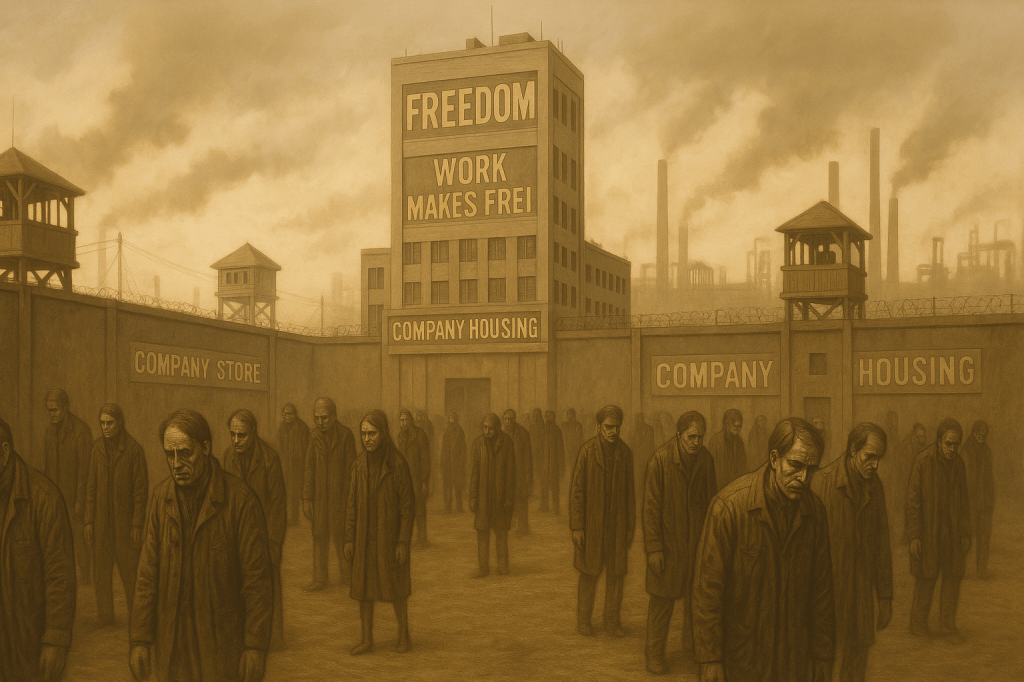
They sell the dream of autonomy—self-governing, tech-powered havens untethered from old institutions. But look closer, and you’ll see that Network States aren’t a rebellion against centralized power. They’re a rebrand, a more sophisticated, digitally optimized iteration of company towns, where the people inside serve the system without ever realizing they were locked in from the start.
Internationally, they function as soft power assets—positioned in geopolitically strategic areas, offering influence without direct intervention. The locations aren’t random: Honduras, Venezuela, Africa, places already tangled in foreign interests. The promise? A free-market oasis. The reality? A foothold for regime change, waiting for activation.
And then there’s Guantanamo Bay, where Palmer Luckey’s vision for a Network State aligns almost too conveniently with U.S. military interests. Guantanamo isn’t just a controversial detention site—it’s a legal gray zone, a space where sovereignty is blurred, making it the perfect testing ground for a privatized, corporate-backed enclave. The logic is clear: under the guise of freedom, Network States in places like Gitmo create controlled economic zones, where influence can be exerted without the complications of traditional governance.
Domestically, in places like the U.S., they won’t offer freedom for the working class. Instead, they’ll manufacture dependence, turning deregulated zones into corporate fiefdoms, where labor rights dissolve and participation isn’t voluntary—it’s necessary for survival. Crypto-backed economies will bypass traditional protections, leaving workers in a pay-to-play existence, where wages, housing, even movement are dictated by those at the top.
It’s eerily similar to Jonestown, where an idealistic vision morphed into total control. The cult’s settlement in Guyana was not just about isolation—it was geopolitical leverage, a population boost in a disputed territory. But once inside, members had no escape, locked into a system where dependency became coercion, and autonomy was a façade. Like Jonestown, Network States promise sovereignty, but what they deliver is containment.
They’ll tell you it’s innovation. They’ll tell you it’s a choice. But history has seen this blueprint before, and it never ends with freedom for the people inside.
More sources: Network States’ document
 Ms. Cat’s Chronicles
You must be logged in to post a comment.