
Who would’ve thought that an AI-generated voice of Jordan Peterson would inspire me? At least, I think it’s AI—there are several videos of him discussing attachment theory, just like there are of Mel Robbins. I haven’t listened to him in years, not since I followed the alt-right. And yet, here I am, drawn back, not by ideology, but by something deeper—an idea that resonated.
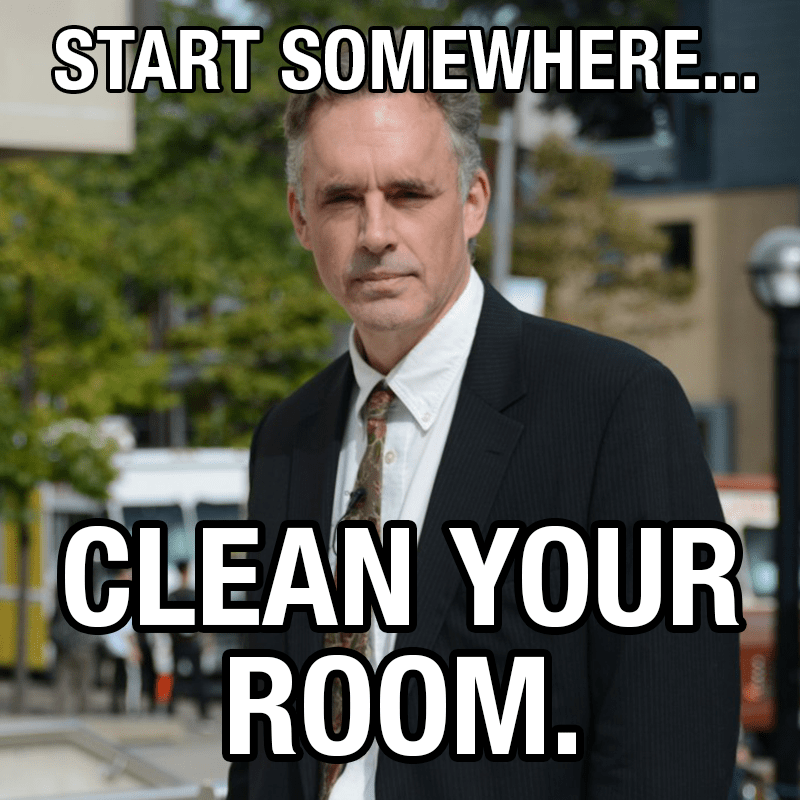
Jordan Peterson famously uses the metaphor “clean your room” to promote personal responsibility and self-improvement. The often-cited quote—“If you can’t even clean up your own room, who the hell are you to give advice to the world?”—captures his belief that before attempting to fix external problems, individuals should first address their own shortcomings. While he initially framed this idea in response to millennials seeking economic change, its application is far broader.
Cleaning one’s room, in this metaphor, represents taking control of one’s immediate environment—a small but tangible act that can foster a sense of accomplishment and mental clarity. Peterson also leverages this idea as a critique of those who advocate for sweeping societal changes without first demonstrating personal discipline. While I understand skepticism of empty activism, I don’t fully subscribe to the idea that success is purely a matter of individual effort. The “pull yourself up by the bootstraps” mentality assumes individual effort alone determines success, ignoring systemic forces that shape people’s realities.
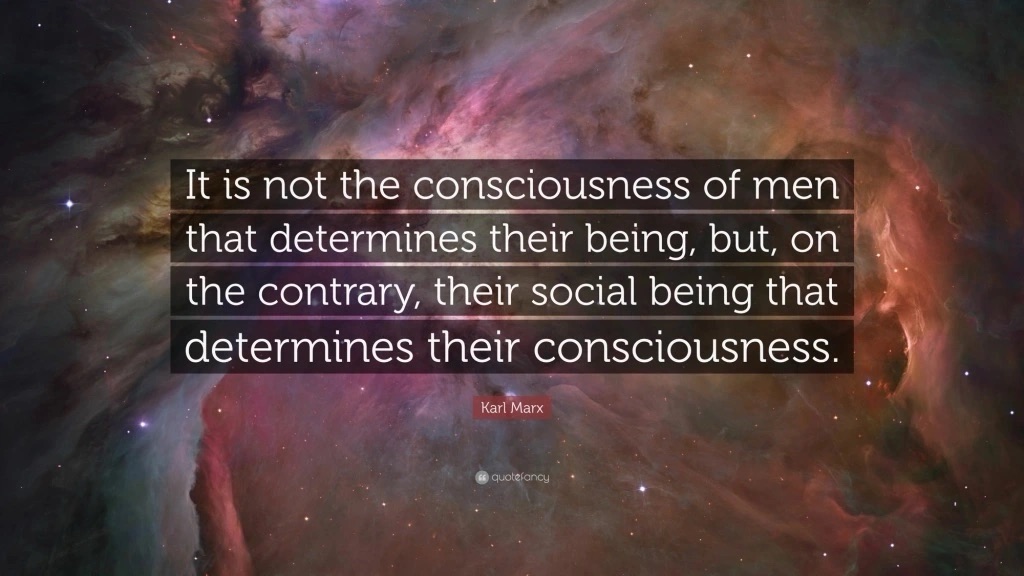
But is it really that simple? Marx offers a different perspective. “It is not the consciousness of men that determines their being, but, on the contrary, their social being that determines their consciousness.” If someone struggles to maintain stability, is it because they lack discipline, or because their environment imposes instability upon them? If a person struggles to organize their space or build order in their life, perhaps the issue isn’t personal failure but the material constraints imposed by their environment—economic instability, social pressures, systemic barriers. Peterson frames disorder as an individual challenge; Marx suggests it may be a reflection of the world itself.

Yet, what if the solution isn’t rigid discipline but clarity, patience, and strategic preparation? Taoism offers another perspective—not one of control, but of waiting for the right moment to act. Lao Tzu wrote, “Do you have the patience to wait until your mud settles and the water is clear?” While Peterson urges individuals to impose structure on disorder, Taoism suggests that clarity emerges when we stop trying to force it. The mud settles on its own—not through brute effort, but through time and reflection.
Yet if external disorder mirrors internal conflict, perhaps the solution isn’t simply self-discipline but the patience to form a plan—waiting not in resignation, but in readiness. The Taoist idea of waiting for the mud to settle speaks to the need for clarity before decisive action. Rather than imposing control prematurely or surrendering to chaos, the focus shifts to strategic preparation—ensuring that when movement happens, it is deliberate, purposeful, and aligned with real transformation.
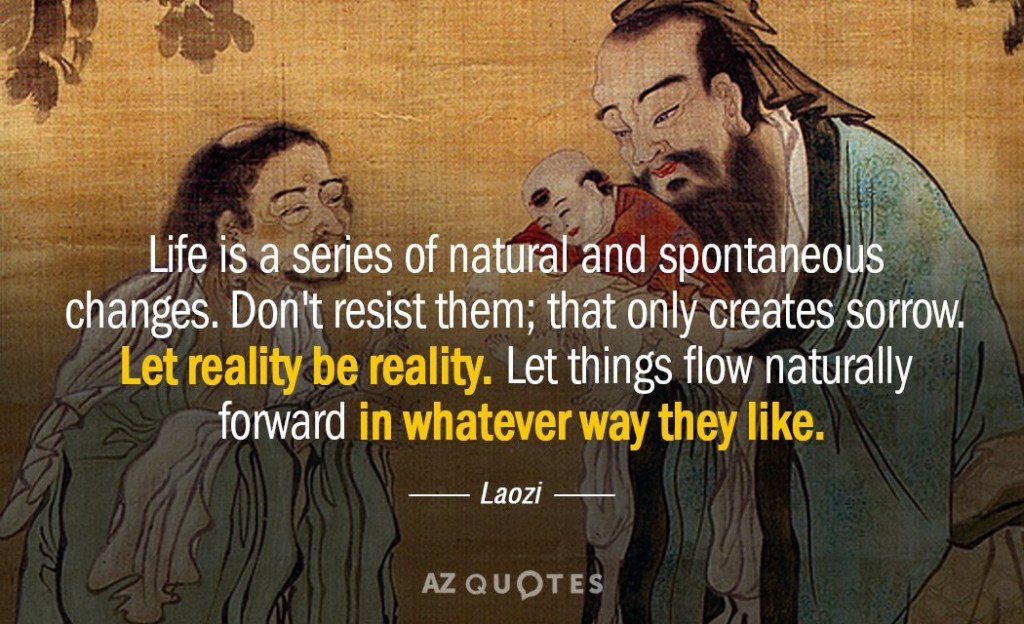
Similarly, “Life is a series of natural and spontaneous changes. Don’t resist them; that only creates sorrow. Let reality be reality.” But accepting reality doesn’t mean surrendering to disorder—it means acknowledging what is, then planning for what can be. If external chaos mirrors internal conflict, the solution isn’t brute discipline, but careful preparation. The Taoist idea of waiting for the mud to settle isn’t about complacency—it’s about ensuring that when action is taken, it is deliberate, intentional, and aligned with meaningful change.
Perhaps the disorder Peterson urges individuals to fix isn’t about their own shortcomings—at least, as he sees it. Rather than focusing solely on personal transformation, real change requires acknowledging both personal responsibility and the forces shaping instability—and responding with patience, strategy, and collective awareness. But these forces don’t just shape economies or governments—they shape the way we see ourselves and our relationships
This applies not only to systemic barriers but to personal situations as well. Leaving a toxic relationship, for example, is rarely as simple as walking away—it requires preparation. Before making a big move, organizing thoughts, resources, and a support system becomes the equivalent of ‘cleaning your room.’ It’s not about just pulling yourself together; it’s about mentally, emotionally, and logistically laying the groundwork for lasting change. The Taoist idea of waiting for the mud to settle speaks to this need for clarity before decisive action. Patience isn’t passivity; it’s ensuring that when the time comes to move forward, the decision is deliberate, intentional, and rooted in self-worth rather than desperation or fear.
This also extends beyond material conditions to how we perceive ourselves in relationships. If I am constantly seeking validation, is that a reflection of personal inadequacy—or the result of an environment that taught me my worth was something to be earned, rather than inherently recognized? The Taoist idea of waiting for the mud to settle reminds me that clarity comes not from forcing control, but from allowing my full self to emerge—unapologetically. I am not meant to shrink for approval or piece myself into fragments for someone else’s convenience. If someone can’t embrace me wholly, they don’t deserve me. My worth isn’t conditional—it exists, whole and unwavering, whether or not they recognize it.
Recognizing my worth isn’t about seeking approval—it’s about understanding that I am whole, with or without someone else’s validation. Strength isn’t just found in the polished surface but in the cracks, the struggles, the moments of doubt that shape resilience. If someone can’t hold space for all of me—the joy and the sorrow, the triumphs and the wounds—then they don’t deserve any part of me at all. I am not meant to be trimmed down for convenience or accepted only in fragments. And that’s exactly what the following poem speaks to—taking the whole, unshaken, and unapologetic.

Worth the Whole
If you can’t stand the storm, the thunder’s roar,
When shadows stretch and skies turn gray,
If you can’t love the cracks, the fractured core,
Then walk away, don’t ask to stay.
For I am more than just the light,
The polished shine, the flawless crest.
I am the dark, the endless night,
The battles fought, the wounds confessed.
If you can’t hold me when I fall,
When tears like rivers carve their course,
You’ll never see me rise, stand tall,
Or feel the strength behind my force.
So take the whole, the raw, the true,
The highs, the lows, the wild, the rest.
If you can’t handle all I do,
You’ll never earn my very best.
 Ms. Cat’s Chronicles
You must be logged in to post a comment.