Choreographed Dissent

How Reform Rebrands Power Without Redistributing It

Notice: This is not an endorsement of Mr. Reagan. What strikes me is how long it’s taken some folks to catch on—Alexandria Ocasio-Cortez was never the political outsider she was marketed to be. I remember watching these videos years ago. Even then, it was clear her role was never to disrupt the machinery, but to redirect dissent—to shepherd disillusioned voters back into the Democratic fold. The Justice Democrats weren’t a rupture; they were a renovation.

You can’t change the system from within.

Read More »

Syrian Kurdish official rejects Turkish calls to lay down arms, says SDF seeks integration instead +

A top Syrian Kurdish official has rejected Turkish calls for the Syrian Democratic Forces (SDF) to give up their weapons as part of Ankara’s broader peace efforts with Kurdish militants, saying the situation in Syria requires integration, not the laying down of arms.

Ilham Ahmed, co-chair of the Foreign Relations Committee of the Autonomous Administration of North and East Syria (Rojava), told BBC’s Turkish service that the SDF’s continued armed presence is necessary due to ongoing security threats, particularly from Islamic State in Iraq and the Levant (ISIL) remnants and the lack of a permanent Syrian constitution.

Syrian Kurdish official rejects Turkish calls to lay down arms, says SDF seeks integration instead

The U.S. continues to back the Syrian Democratic Forces (SDF)—a coalition dominated by the YPG, which Turkey sees as indistinguishable from the PKK. Despite the PKK’s recent disarmament announcement, Washington has resuscitated funding and military coordination with the SDF—a coalition whose very name was crafted to obscure its PKK lineage. This comes even as the U.S. consolidates its military presence to a single base in Hasakah, signaling a shift from occupation to strategic entrenchment.

In 2019, as Trump was weighing a withdrawal of U.S. troops from Syria during his first term, Tulsi Gabbard brought Ilham Ahmed—the then-head of the Syrian Democratic Council, political wing of the U.S.-backed Syrian Democratic Forces in Rojava—as her guest to Trump’s second State of the Union. The message was clear: autonomy should have air support. Ahmed currently serves as Co-Chair of the Foreign Affairs Department of Rojava, also known as the Democratic Autonomous Administration of North and East Syria.

Related:

Trump should be convinced of US pullout from Syria- but… (Disarmament, dissolution of YPG)

The SDF equals the YPG/PKK/Kurds: A timeline of the PKK’s war on Türkiye

🕊️💣 Artillery Diplomacy: Trump Sells “Peace” One Missile at a Time

Trump announces novel plan to send weapons to Ukraine and gives Russia new deadline to make peace

Whitaker, the US NATO envoy, said the immediate focus on shipping weapons to Ukraine was on defensive systems, like the Patriot batteries that can intercept Russian ballistic missiles. But he didn’t rule out providing offensive weapons.

By selling weapons to European nations, rather than transferring them to Ukraine itself, Trump hopes to insulate himself from political criticism that he is reversing a campaign pledge to reduce the US role in the years-long war.

Related:

US officials say they are still reviewing Ukraine’s weaponry wish list

U.S. officials say they are still sorting through Ukraine’s wish list of weaponry that it would like to receive from NATO members to determine what can be most quickly replaced after President Donald Trump announced an agreement for Europe to supply Ukraine with defensive munitions from existing stocks.

The officials, who spoke on condition of anonymity to discuss arms transfers that have not yet been approved or completed, said Ukraine’s requests for materiel are roughly the same as they have been since the start of Russia’s invasion more than three years ago. Those include air defenses like Patriot missiles and Advanced Precision Kill Weapon Systems, long range missile known as ATACMS and short- to medium-range ground-to-air missiles known as NASAMs, and assorted artillery, according to the officials.

Under the terms of the very rough agreement sketched out by Trump and NATO chief Mark Rutte on Monday, NATO members would ship billions of dollars of these weapons to Ukraine and then purchase replacements for them from the United States.

One official said some of the larger items — such as Patriots— could take up to five years to produce to deliver to the European donors, while smaller munitions like 155mm artillery shells can be produced on a much shorter timeline

If U.S. Gives Ukraine Long-Range Missiles, What Besides JASSM-ER Could Hit moscow

According to numerous insider reports published by Western media, this package is likely to include some form of long-range weaponry. The new military aid package that Ukraine hopes to receive from the United States may include air-launched missiles, aerial bombs, and high-precision ground-launched missiles. The primary criterion for these weapons could be their ability to strike deep into the territory of the Russian Federation.

The specifics remain unknown. Some sources mention “offensive missiles,” others claim these weapons will have the range to strike targets as far as Moscow. Still others explicitly state that they will be JASSM cruise missiles. All of these reports point to one clear requirement: the missiles must have a range of at least 500 km to reach Moscow from the Ukrainian border.

Ukraine Is Getting a New Way to Receive U.S. Weapons. Here’s What We Know.

How much money will this earn the United States?

Generally, a single Patriot battery costs about $1 billion to build, depending on the model, and interceptor missiles cost about $3.7 million each. JASSMs sell for about $1.5 million each. And ATACMS cost at least $1 million or more per missile.
“This is billions of dollars’ worth of military equipment that’s going to be purchased from the United States, going to NATO,” Mr. Trump said. “And that’s going to be quickly distributed to the battlefield.”

Capes, Cameras, and the Cult of Visibility

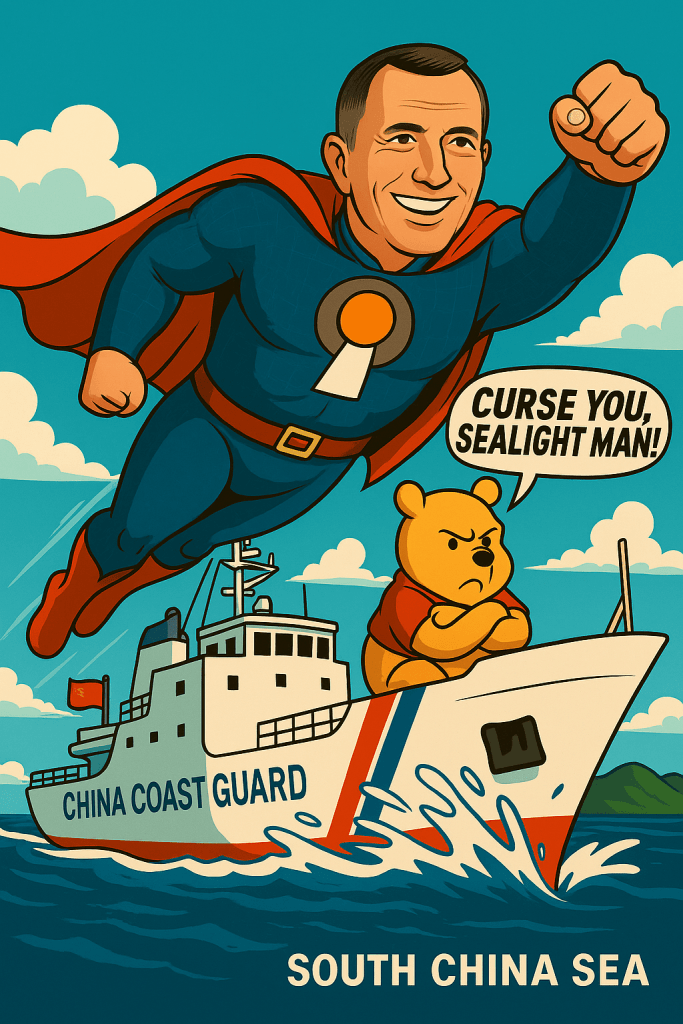
Capes, Cameras, and the Cult of Visibility: The SeaLight Crusade as White Savior Theater

By Tina Antonis

The South China Sea is more than a maritime dispute—it’s a theater of narrative warfare. While headlines focus on Chinese aggression and Philippine resistance, a quieter campaign unfolds in the background: one of satellite feeds, curated imagery, and Pentagon-backed storytelling. At the center of this effort is SeaLight, a project that claims to illuminate truth but often casts shadows of its own.

As explored in my article at Antiwar.com, SeaLight doesn’t just document—it performs. It reframes geopolitical tension through moral spectacle, positioning its creators as heroic arbiters of transparency. But when the messenger wears a cape and the funding flows from defense budgets, we must ask: is this clarity, or choreography?

Stage Left: The White Savior Enters

In the comic-strip cosmology of Ray Powell’s SeaLight project, transparency wears a cape. Clad in heroic postures and backed by satellite imagery, Powell casts himself as the guardian of maritime morality—unarmed, except with satellite feeds, theatrical flair, and strategic messaging. 

Yet beneath the cartoon and Pentagon-funded optics lies a familiar archetype: the white savior, rebranded for the South China Sea.

China Is Imperialist? Says Who?

Calling China a “maritime occupier,” Powell positions himself as a bulwark against aggression. But that moral pose collapses under scrutiny. He speaks for a country with over 800 foreign military installations and a documented history of over 250 military interventions since 1991—wars in Iraq, Afghanistan, Libya, Syria, Somalia, and dozens more, all under the banner of peace, freedom, or preemption.

By comparison, China’s post–Cold War footprint includes no sustained foreign occupations and only scattered border conflicts and peacekeeping missions. The imbalance is staggering. And Powell’s framing doesn’t just ignore it—it performs around it.

As David Vine argues in The United States of War, this vast base empire is not a passive network—it’s an architecture of perpetual war. These outposts make military engagement not an exception but a structural habit, cloaked in strategic necessity and sold as global stewardship.

Powell’s cartoon rhetoric—calling China an occupier—obscures the scale of U.S. militarism. The term “occupation” is deployed not to analyze, but to project. When adversaries hold territory, it’s a crisis; when the U.S. spans the globe with armed installations, it’s policy.

Framing Conflict: The Optics of Consent

This isn’t irony. It’s performance. Powell’s language manufactures a moral frame for confrontation—costumed in transparency, but driven by escalation. The cape is literal. The conditioning is deliberate. And the stage is set for war.

SeaLight’s mission is not just visual documentation—it’s narrative warfare. As the Japan Times openly notes, its “chief weapon is photography, applied purposefully, generously and consistently over time.” These images—enhanced, curated, and distributed across media—are not neutral. They’re constructed to shape public perception, sway international opinion, and ultimately manufacture consent for confrontation.

Assertive transparency becomes a kind of ideological scaffolding—a stage on which geopolitical tension is dramatized, simplified, and morally polarized. The goal isn’t simply to reveal conflict; it’s to condition audiences for escalation.

And when the messenger dons a superhero’s cape, the spectacle transforms into something deeper: a story of rescue, of virtue, of intervention. This is not analysis—it’s soft propaganda dressed in heroic metaphor.

Consent for war doesn’t begin with missiles. It begins with mythmaking.

From Bromance to Bombshells: Trump & Graham’s Russia Ultimatum

Sources: YouTube / Dasha Burns: Trump WH Working With Lindsey Graham On Language Giving President “The Ultimate Say” On Putin

He’s still repeating the lie about Ukraine’s nuclear weapons. They never had operational control of them!

Related:

Graham, Blumenthal hail Trump’s new Russia sanctions plan

The Truth About Ukraine’s Decision to Give Up Its Nukes in the ’90s

NordStream

FAIR USE STATEMENT:

This video may contain copyrighted material the use of which has not been specifically authorized by the copyright owner. This material is being made available within this transformative or derivative work for the purpose of education, commentary and criticism, is being distributed without profit, and is believed to be “fair use” in accordance with Title 17 U.S.C. Section 107.

Friedrich Engels ‐ On Authority

Red Ant

Works of Frederick Engels 1872: On Authority

A number of Socialists have latterly launched a regular crusade against what they call the principle of authority. It suffices to tell them that this or that act is authoritarian for it to be condemned. This summary mode of procedure is being abused to such an extent that it has become necessary to look into the matter somewhat more closely.

Therefore, either one of two things: either the anti-authoritarians don’t know what they’re talking about, in which case they are creating nothing but confusion; or they do know, and in that case they are betraying the movement of the proletariat. In either case they serve the reaction.

Jeffrey Epstein timeline: How the Palm Beach County case led to 15 more years of sex abuse

Jeffrey Epstein timeline: How the Palm Beach County case led to 15 more years of sex abuse

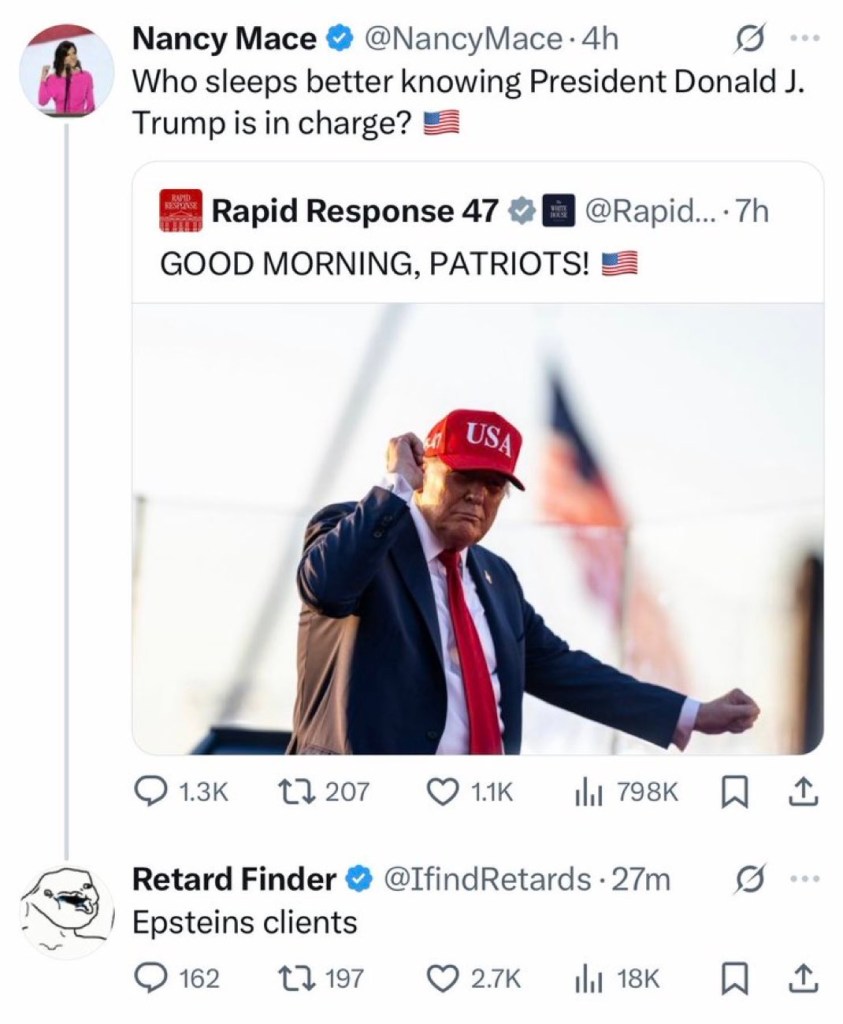
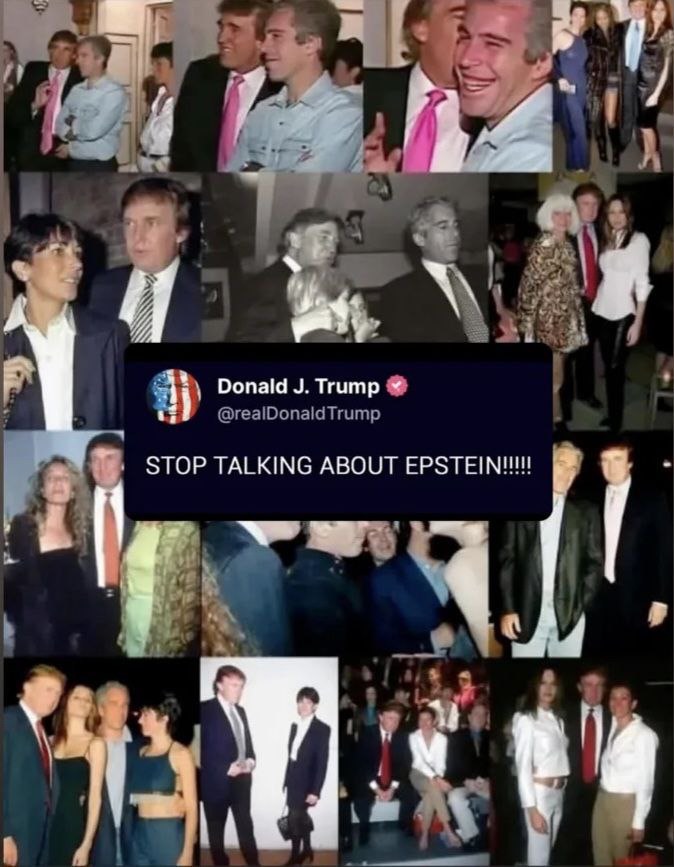
Trumps dismissal of this case via his social media ranting is not surprising- given the connection early on the Mar-a- Lago. His decades of friendship with Mr Epstein- Trump campaigned on peace and accountability, particularly regarding the Epstein case. He’s now resorting to gaslighting MAGAThis case isn’t fake. Nor was it concocted by the Democrats

Newsweek

Including Trump’s ranting.

Do I believe Trump is in the files and on those lists? And in those videos?

Yes, I do.

Previously:

Are the Epstein Files being kept hidden because of Ghislaine Maxwell’s Scientology connections?