
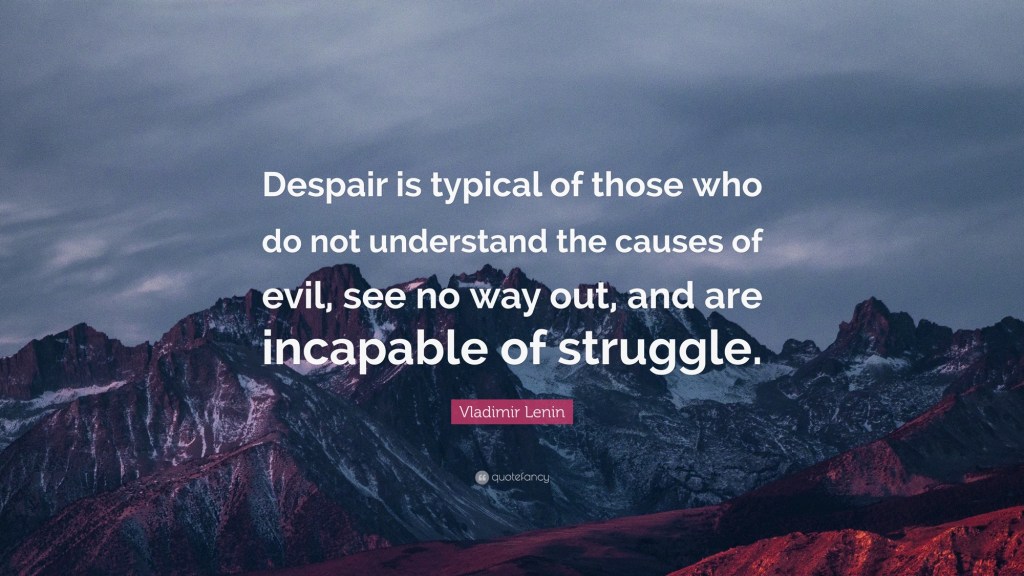
Despair is a house with no windows,
where the walls hum with questions
but no one answers.
It is the silence after the sirens,
the stillness that mimics peace
but tastes like surrender.
They say evil is a shadow—
but shadows need light to exist.
What if it’s not a shadow,
but the architecture itself?
The blueprint etched in centuries,
the scaffolding of profit and power
draped in velvet myths.
I sat in that house for years,
thinking the rot was mine.
That the cracks in the ceiling
were symptoms of my softness.
But then I learned to name the mold,
to trace the fault lines
back to hands I never shook.
Struggle is not a war cry.
It is the quiet refusal
to mistake the cage for the sky.
It is patience sharpened into blade,
waiting not for rescue,
but for the moment the hinges loosen.
And when the door gives way—
not with glory, but with grit—
I will not run.
I will walk,
carrying the map I drew
in the dark.
—Tina Marie
Author’s Note:
Lenin’s words suggest that despair is not a personal failing, but a symptom of disconnection—from history, from clarity, from struggle itself. Fault Lines is my attempt to trace that disconnection, not as a descent into hopelessness, but as a quiet reckoning. What if despair isn’t the absence of light, but the architecture we’ve inherited? And what if struggle begins not with noise, but with naming?
 Ms. Cat’s Chronicles
You must be logged in to post a comment.