
A first step towards diplomacy (original)
Posted by @nsanzo
Joint Base Elmendorf-Richardson in Anchorage, Alaska, experienced its most media-intensive day yesterday. Surrounded by a pro-Ukrainian mobilization prepared throughout the week, the Russian delegation arrived in the territory it sold to the United States in the 19th century for the first Russian-American summit in three years. The images of the large “Alaska 2025” sign with the red carpet from the airplane steps awaiting the delegation led by Donald Trump and the one headed by Vladimir Putin, the US president receiving his Russian counterpart, posing next to him, and both leaving the venue in the same vehicle on the way to the meeting were the perfect representation of the failure of the European policy of isolating Russia. Hence, headlines such as the one published by El País, which stated that “the most disturbing thing about the Alaska summit is that something could come out of it,” should not be surprising. This was the main fear of European countries and Ukraine, for whom, as the Danish Prime Minister declared a few months ago, “peace can be more dangerous than war.” Absent from the summit, despite having outlined their red lines in a joint conference call with Donald Trump, the European countries hoped to avoid a scenario in which the two presidents agreed on a framework for resolving the war. Faced with this scenario, the most negative for Europe and Ukraine, which would have to resign themselves to obtaining as much as possible within pre-established guidelines, the hope was that Donald Trump would emerge from the meeting affirming what he has said in the past: his frustration at having had a good conversation but not being able to get Vladimir Putin to budge on his demands.
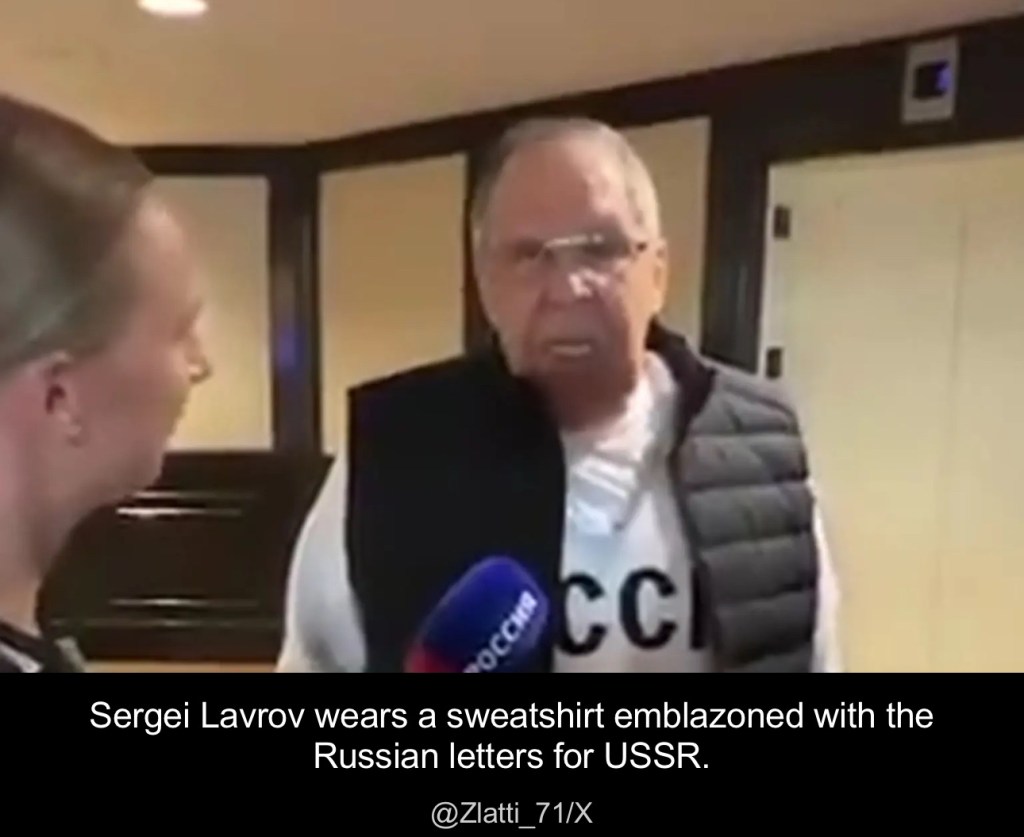
As expected, the press has analyzed every detail, real or imagined, to understand them as hidden messages. Throughout the day, outlets like The Telegraph spent their energy analyzing the sweatshirt Russian Foreign Minister Sergey Lavrov wore when he landed in Alaska. “It is surprising that Sergei Lavrov, Russia’s Foreign Minister since 2004, arrived in Alaska this morning wearing a CCCP (the Cyrillic acronym for the USSR) sweater. Surprising for two reasons,” the outlet explained in its live coverage of the summit. “First, because Lavrov shares the same remarkable characteristic as Gromyko: longevity. In every other respect, he is a truly despicable man: dishonesty is his modus vivendi, serving a regime based on theft, corruption, lies, and force,” the outlet wrote, adding as a second reason that “with his USSR sweater, Lavrov is simply rubbing in our faces what should already be clear to anyone not in Russia’s pay. In other words, he is making it clear that Russia is determined to recreate the Soviet Union.” In yet another example of the press’s historical manipulation, the article was titled “The image that proves Putin wants to recreate the Russian Empire.”
History is also relevant when analyzing the location where yesterday’s much-discussed summit took place. The base perfectly encapsulates both the attitudes and the contradictions of the moment. The military base, where a top-level US delegation is hosting, represents the state of relations between Russia and the United States as well as the message on Lavrov’s sweatshirt. Although it was always clear that Moscow would emphasize the positive side, the location represents much more than the collaboration between them. The base is not only one of the places from which the United States sent supplies to its Soviet ally during World War II, but also bears the name of one of the visible faces of the US intervention in the Russian Civil War as part of the counterrevolutionary violence that sought to destroy the Soviet Union even before its birth. The anecdote is representative of the attitude with which Donald Trump’s team approached the meeting, a carrot and stick with which the American president hoped to achieve his two clear objectives: to force Vladimir Putin to accept the ceasefire he proposed in March and ordered Zelensky to accept, and to get the Kremlin to agree to an immediate meeting with the Ukrainian leader.
In contrast to the manipulation carried out throughout the week to exaggerate both the possibilities and the risks of the meeting, the summit was never intended to “divide Ukraine,” “cede territory,” or “offer Russia the exploitation of minerals and rare earths from Ukrainian territories under Moscow’s control,” but rather to force Vladimir Putin, in person, to accept US tutelage in the process of resolving the Russo-Ukrainian war. Although absent, Ukraine appeared at the summit with the clear objective of its US patron ensuring that Kyiv avoids the worst-case scenario of negotiations from a position of weakness against a Russia that has imposed its narrative and, based on a predetermined framework, vetoed NATO membership, and assumed that kyiv must cede territory—that is, renounce the military recovery of what has already been lost—as a prerequisite for diplomacy.
The warm reception given to the Russian president, who was even honored with a US aircraft flyover, should not be misleading. Praise and warnings have been mixed in every detail of this summit. The four F-35s that greeted Putin were escorting a B2 bomber, like the ones the United States used to bomb Russia’s only ally in the Middle East, Iran, which Donald Trump imposed an ultimatum demanding surrender in negotiations and attacked when it decided that diplomacy would not yield the desired result. The threatening message is evident, as have the US president’s words throughout the week, promising negative consequences for Russia—and possibly for its allies and clients in the Russian energy sector—if Vladimir Putin did not accept the US proposal. As he had announced the day before, Trump’s objective was none other than to secure Vladimir Putin’s commitment to an immediate meeting with Volodymyr Zelensky, something that could possibly only be achieved after declaring a ceasefire. This was also the dream of European countries and Ukraine, aware that, in a negotiation process, halting the movement at the front means reducing the difference in strength between the parties. When it comes to flexing its muscles at the negotiating table and trying to impose wills, Russia’s strength is based on its position in the battle, its obvious progress in the face of Ukraine’s growing difficulties, which, despite a multi-billion-dollar influx of weapons and ammunition, has made it clear that it will not be able to militarily defeat Russia. Ukraine’s strength, on the other hand, lies in its allies, capable, due to their position of political hegemony, of imposing their will using force in a different way. This way of neutralizing Russian strength without undermining Ukrainian strength is the only reason why European countries demand a ceasefire as a prerequisite for long-term political negotiations, in which they are aware that, given Trump’s lack of interest, they would have the upper hand.
The fact that, according to what has emerged from the conversations held during the two meetings—the first of three, attended by the presidents, foreign ministers, and advisors, and the second with the entire delegation—no decisions have been announced on security issues or territorial exchanges, is not a victory for the European positions that the press will present from now on, but rather the logic of the type of meeting Donald Trump had called for. The fact that the ceasefire demanded by European countries and Ukraine has not been announced is also not a sign that the Russian position has completely prevailed. In the press conference following the presidential meeting, Donald Trump addressed Vladimir Putin, stating that they would meet again soon, something that can be seen as a sign that the meeting that the American leader has been demanding for some time, a meeting between the Russian and Ukrainian leaders, is about to take place. However, while we await the information that is passed on to European partners, there is still no information available to speculate on the “understanding” that Vladimir Putin claimed was reached at the meeting.
Despite the pompous receptions and the insistence on the historic nature of the meeting, yesterday’s summit was not supposed to be the culmination of the diplomatic process, but simply the beginning of a dialogue aimed at achieving peace, something that can only be achieved through political negotiations with the active participation of Russia and Ukraine. The shuttle diplomacy carried out by the United States to establish pre-established terms of negotiations was merely the preliminary phase of what must now begin: a difficult process in which both sides will have to make concessions, in which contradictions will arise between the red lines and the possibilities of achieving the primary objectives, and in which certainties do not exist.
 Ms. Cat’s Chronicles
You must be logged in to post a comment.