
Hegseth restores, downgrades Pentagon’s Office of Net Assessment
Defense Secretary Pete Hegseth has restored but downgraded an independent, internal Pentagon think tank focused on future wars, seven months after dismantling the agency in the name of accountability and efficiency, according to a memo obtained by The Washington Post and people familiar with the matter.
Hegseth ordered the reestablishment of the Office of Net Assessment (ONA) in an Oct. 16 memo to senior Pentagon leaders, saying it will be reinstated though no longer report to him directly. Instead, the office will be placed under the charge of the Pentagon’s director of administration and management, Robert G. Salesses, with Deputy Defense Secretary Stephen Feinberg entrusted to “functionally manage” the office’s top official, the director of net assessment, “as appropriate.”
…
The office will also receive an increase in funding, three people familiar with the matter said, though they couldn’t provide an exact figure. One of the people cautioned that ONA’s annual budget matters less than the attention of senior Pentagon leaders.
…
The office’s revival follows a months-long lobbying effort by some other Republican lawmakers who support its work, arguing to Pentagon leadership that the outfit is low-cost and has helped identify pressing national security challenges — such as China’s growing military power — decades early.
Feinberg and the Pentagon’s policy chief Elbridge Colby, who has done research on behalf of Net Assessment in the past, were crucial to the effort to bring ONA back online, two people said.
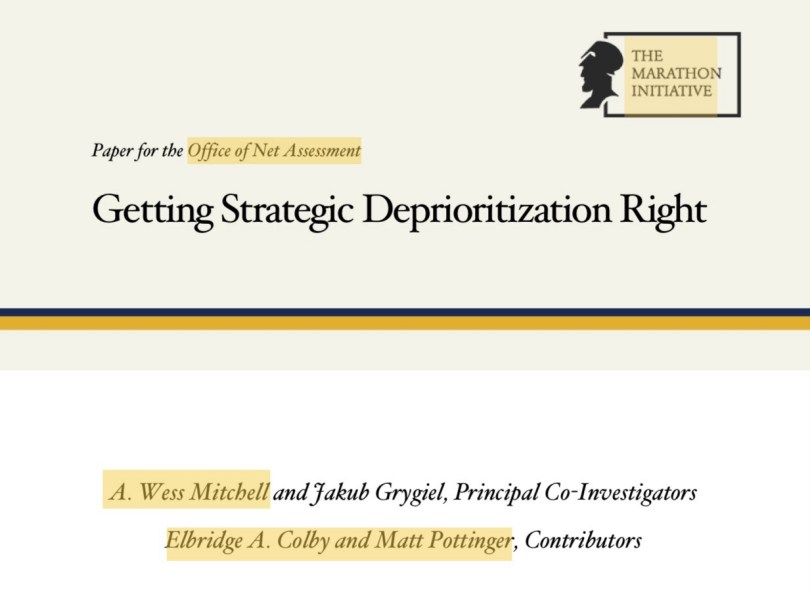
The Washington Post references a paper titled “Getting Strategic Deprioritization Right,” authored by A. Wes Mitchell, Jakub Grygiel, Elbridge A. Colby, and Matt Pottinger, all associated with the Marathon Initiative. This front organization is also responsible for the earlier work, “Strategic Sequencing, Revisited.”
Previously:
Elbridge Colby’s “Division of Labor” (“Strategic Sequencing, Revisited”)
The Heritage Foundation report cites Mitchell’s book The Grand Strategy of the Hapsburg Empire, along with the papers “Strategic Sequencing: How Great Powers Avoid Multi-Front War,” “Mastering the Multi-Front Challenge: The Diplomatic Strategies of Metternich and Bismarck,” and “Getting Strategic Deprioritization Right.” These papers were written for the Office of Net Assessment, a division within the Department of Defense that specialized in long-term strategic planning. The office assessed how the U.S. military compared to other nations and examined potential future threats and opportunities to inform defense strategies. Essentially, it functioned as the Pentagon’s think tank for overarching strategic considerations.
More information: Marathon Initiative (Elbridge Colby & Matt Pottinger)
 Ms. Cat’s Chronicles