
TALKS AT THE YENAN FORUM ON LITERATURE AND ART
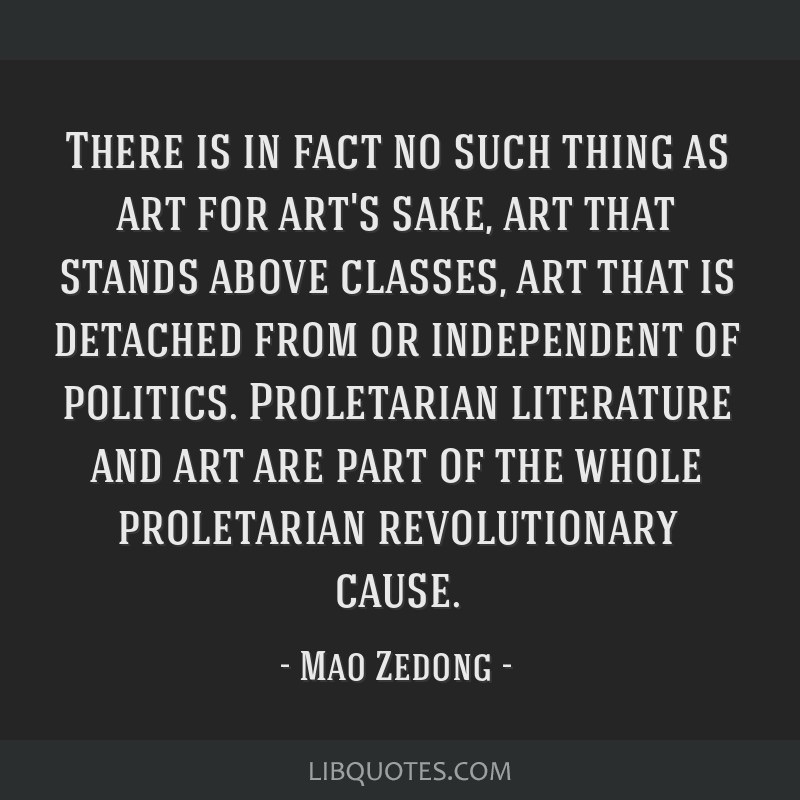
Let us consider the first problem. In the world today all culture, all literature and art belong to definite classes and are geared to definite political lines. There is in fact no such thing as art for art’s sake, art that stands above classes or art that is detached from or independent of politics. Proletarian literature and art are part of the whole proletarian revolutionary cause; they are, as Lenin said, cogs and wheels [9] in the whole revolutionary machine. Therefore, Party work in literature and art occupies a definite and assigned position in Party revolutionary work as a whole and is subordinated to the revolutionary tasks set by the Party in a given revolutionary period. Opposition to this arrangement is certain to lead to dualism or pluralism, and in essence amounts to “politics–Marxist, art–bourgeois”, as with Trotsky. We do not favour overstressing the importance of literature and art, but neither do we favour underestimating their importance. Literature and art are subordinate to politics, but in their turn exert a great influence on politics. Revolutionary literature and art are part of the whole revolutionary cause, they are cogs and wheels in it, and though in comparison with certain other and more important parts they may be less significant and less urgent and may occupy a secondary position, nevertheless, they are indispensable cogs and wheels in the whole machine, an indispensable part of the entire revolutionary cause. If we had no literature and art even in the broadest and most ordinary sense, we could not carry on the revolutionary movement and win victory. Failure to recognize this is wrong. Furthermore, when we say that literature and art are subordinate to politics, we mean class politics, the politics of the masses, not the politics of a few so-called statesmen. Politics, whether revolutionary or counter-revolutionary, is the struggle of class against class, not the activity of a few individuals. The revolutionary struggle on the ideological and artistic fronts must be subordinate to the political struggle because only through politics can the needs of the class and the masses find expression in concentrated form. Revolutionary statesmen, the political specialists who know the science or art of revolutionary politics, are simply the leaders of millions upon millions of statesmen–the masses. Their task is to collect the opinions of these mass statesmen, sift and refine them, and return them to the masses, who then take them and put them into practice. They are therefore not the kind of aristocratic “statesmen” who work behind closed doors and fancy they have a monopoly of wisdom. Herein lies the difference in principle between proletarian statesmen and decadent bourgeois statesmen. This is precisely why there can be complete unity between the political character of our literary and artistic works and their truthfulness. It would be wrong to fail to realize this and to debase the politics and the statesmen of the proletariat.
Previously:
 Ms. Cat’s Chronicles
You must be logged in to post a comment.