
Wikipedia’s entry on the 2002 attempted coup is just as flawed as Grokipedia’s.
Grokipedia: 2002 Venezuelan coup attempt
Extent of US Foreknowledge and Support
Declassified Central Intelligence Agency documents indicate that the US government possessed advance knowledge of coup plotting against Venezuelan President Hugo Chávez in early 2002. A Senior Executive Intelligence Brief dated April 6, 2002, explicitly warned that “dissident military factions…are stepping up efforts to organize a coup against President Chávez, possibly as early as this month,” citing contacts between military officers and opposition leaders planning to exploit opposition demonstrations and military unrest.[9] Similarly, other declassified intelligence reports from March and April 2002 detailed mounting opposition to Chávez, including polls showing majority support for his resignation and military dissatisfaction, though these assessments framed the situation as internally driven instability rather than externally directed action.[10] This foreknowledge stemmed from standard intelligence monitoring of Venezuelan dissidents, but no declassified materials reveal US directives to initiate or facilitate the plot.[6]
Allegations of active US orchestration, including funding or training for coup participants, remain speculative and unsupported by primary evidence. Bush administration officials acknowledged meetings with Venezuelan opposition figures and business leaders in the months prior to April 11, 2002, but described these as routine diplomatic engagements rather than coup coordination; Otto Reich, Assistant Secretary of State for Western Hemisphere Affairs, denied any US advice to military or business elites on seizing power.[82] Claims of deeper involvement, such as direct ties between the administration and Venezuelan exiles, lack corroborating documents and often originate from partisan interpretations rather than verifiable records. Causally, even if US contacts provided passive encouragement, the coup’s execution relied on domestic Venezuelan actors—military defectors and civilian protesters—whose actions aligned with pre-existing internal fractures, not imported operational blueprints. No evidence from declassified sources substantiates material US support that could have materially altered the plot’s independent momentum or outcome.
The Bush administration’s initial recognition of Pedro Carmona’s interim government on April 12, 2002, reflected a pragmatic assessment of on-the-ground realities following Chávez’s detention, but this stance shifted rapidly amid the coup’s collapse. By April 13, the US aligned with the Organization of American States (OAS), which had condemned the “abrupt interruption of the democratic and constitutional order” in Venezuela as early as April 11, invoking principles against unconstitutional power seizures.[1] This quick reversal underscores limited US influence: the coup failed due to Venezuelan military loyalists’ refusal to sustain Carmona’s regime and widespread pro-Chávez counter-mobilization, factors independent of Washington policy. Declassified post-coup analyses noted the region’s “quick rejection” of the putsch as a deterrent to similar efforts elsewhere, highlighting multilateral norms over unilateral US leverage in determining the event’s brevity and reversal.[83]
Related:
[2002] Venezuela coup linked to Bush team (archived)
The visits by Venezuelans plotting a coup, including Carmona himself, began, say sources, ‘several months ago’, and continued until weeks before the putsch last weekend. The visitors were received at the White House by the man President George Bush tasked to be his key policy-maker for Latin America, Otto Reich.
Reich is a right-wing Cuban-American who, under Reagan, ran the Office for Public Diplomacy. It reported in theory to the State Department, but Reich was shown by congressional investigations to report directly to Reagan’s National Security Aide, Colonel Oliver North, in the White House.
…
Reich also has close ties to Venezuela, having been made ambassador to Caracas in 1986. His appointment was contested both by Democrats in Washington and political leaders in the Latin American country. The objections were overridden as Venezuela sought access to the US oil market.
Reich is said by OAS sources to have had ‘a number of meetings with Carmona and other leaders of the coup’ over several months. The coup was discussed in some detail, right down to its timing and chances of success, which were deemed to be excellent.
On the day Carmona claimed power, Reich summoned ambassadors from Latin America and the Caribbean to his office. He said the removal of Chavez was not a rupture of democratic rule, as he had resigned and was ‘responsible for his fate’. He said the US would support the Carmona government.
But the crucial figure around the coup was Abrams, who operates in the White House as senior director of the National Security Council for ‘democracy, human rights and international operations’. He was a leading theoretician of the school known as ‘Hemispherism’, which put a priority on combating Marxism in the Americas.
…
A third member of the Latin American triangle in US policy-making is John Negroponte, now ambassador to the United Nations. He was Reagan’s ambassador to Honduras from 1981 to 1985 when a US-trained death squad, Battalion 3-16, tortured and murdered scores of activists. A diplomatic source said Negroponte had been ‘informed that there might be some movement in Venezuela on Chavez’ at the beginning of the year.
The Office of Public Diplomacy for Latin America and the Caribbean (S/LPD or ARA/LPD) was an intra-agency propaganda organization[1][2] established in the United States during the administration of Ronald Reagan. It was founded and managed by the Cuban-American Otto Reich, an ardent opponent of Fidel Castro.
[2002] U.S. Bankrolling Is Under Scrutiny for Ties to Chávez Ouster
WASHINGTON, April 24 — In the past year, the United States channeled hundreds of thousands of dollars in grants to American and Venezuelan groups opposed to President Hugo Chávez, including the labor group whose protests led to the Venezuelan president’s brief ouster this month.
The funds were provided by the National Endowment for Democracy, a nonprofit agency created and financed by Congress. As conditions deteriorated in Venezuela and Mr. Chávez clashed with various business, labor and media groups, the endowment stepped up its assistance, quadrupling its budget for Venezuela to more than $877,000.
…
Of particular concern is $154,377 given by the endowment to the American Center for International Labor Solidarity [Solidarity Center], the international arm of the A.F.L.-C.I.O., to assist the main Venezuelan labor union in advancing labor rights.
The Venezuelan union, the Confederation of Venezuelan Workers, led the work stoppages that galvanized the opposition to Mr. Chávez. The union’s leader, Carlos Ortega, worked closely with Pedro Carmona Estanga, the businessman who briefly took over from Mr. Chávez, in challenging the government.
…
The endowment also provided significant resources to the foreign policy wings of the Republican and Democratic parties for work in Venezuela, which sponsored trips to Washington by Chávez critics.
The National Democratic Institute for International Affairs was given a $210,500 grant to promote the accountability of local government. The International Republican Institute, which has an office in Venezuela, received a grant of $339,998 for political party building. On April 12, the day of the takeover, the group hailed Mr. Chávez’s ouster. “The Venezuelan people rose up to defend democracy in their country,” the institute’s president, George A. Folsom, said in a statement. “Venezuelans were provoked into action as a result of systematic repression by the government of Hugo Chávez.”
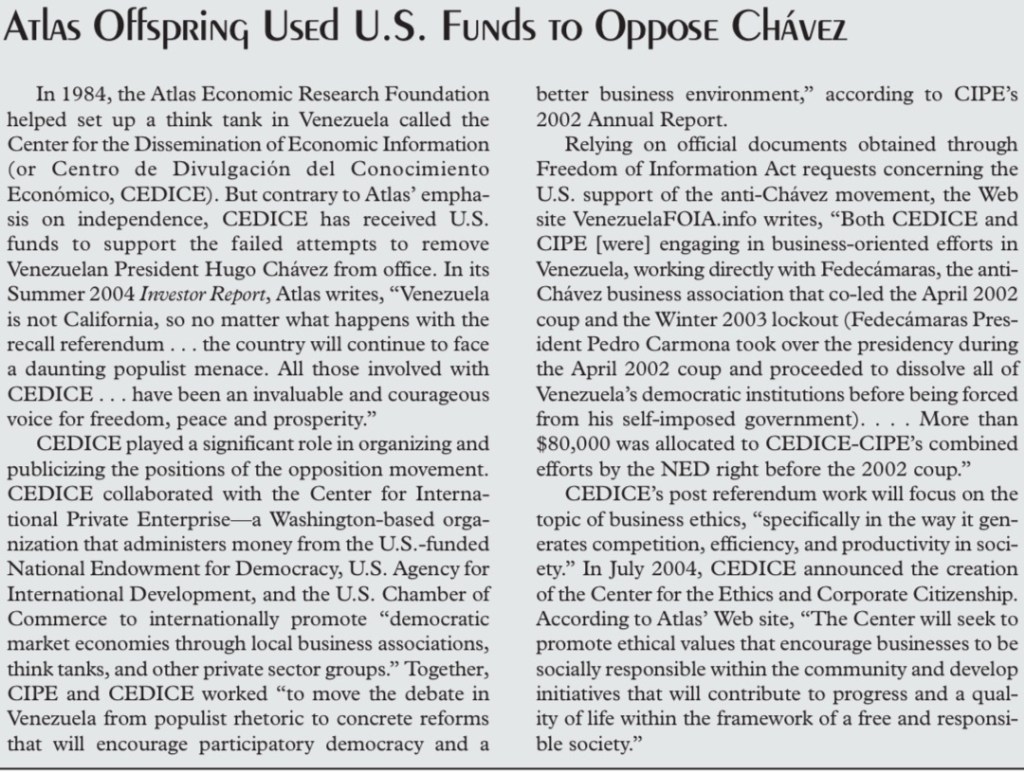
Center for the Dissemination of Economic Information
María Corina Machado is the female Javier Milei (aka US Puppet)
The US government funds election observers and exit polls for regime change
 Ms. Cat’s Chronicles
You must be logged in to post a comment.