“President Trump ran on an agenda of ‘America First,’” one Trump ally who has been working on Latin American–policy issues told us. “Unfortunately, people in his administration are more focused on a ‘South Florida First’ agenda.”
With a U.S. armada floating off Venezuela’s shores, Maduro now faces the choice of whether to stay and suffer the potential consequences or to flee. And the United States faces the prospect that Trump, who has criticized America’s past “forever wars” and spent much of this year focused on ending major foreign conflicts, might be about to start one in his own backyard.
Since his first term as president, Trump has considered Venezuela a problem: a close ally of Communist Cuba run by a leftist demagogue with support from Russia and China in a hemisphere dominated by the United States. “If the goal is increasingly to have U.S.-aligned leaders, or at a minimum leaders that are not actively aligned with China, Russia, and Iran, then Venezuela sticks out like a sore thumb,” a senior administration official told us.
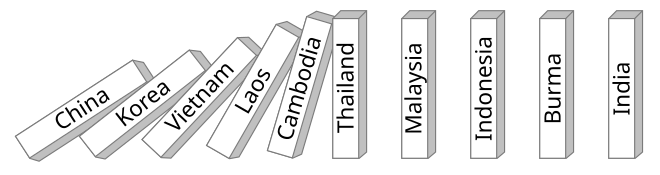
Speaking to Miami’s Venezuelan American community in early 2019, Trump suggested that the fall of the regime in Caracas could topple a chain of dominoes: “When Venezuela is free, and Cuba is free, and Nicaragua is free, this will become the first free hemisphere in all of human history,” he said. [see domino theory]
Ryan Berg, a Latin America expert at the Center for Strategic and International Studies, in Washington, D.C., told us that Trump and his advisers are united in their desire to beat back Chinese encroachment in the U.S.’s sphere of influence, much as the Monroe Doctrine of the 1820s sought to end European interference in Latin America. Hence Trump’s threats to annex Panama, Greenland, and Canada. “Trump instinctively understands that if the U.S. is not the top dog in the Western Hemisphere, it can’t be an effective global power,” Berg said.
Trump has consistently urged his advisers to ensure future U.S. access to the extractive riches of Venezuela, home to immense mineral supplies and the world’s largest proven oil reserves. But getting rid of Maduro, who has stayed in power since 2013 through a combination of corruption, repression, and electoral fraud, has proved difficult.
…
Rubio’s elevation to the dual roles of secretary of state and interim national security adviser gave him a White House perch from which to promote what he has called a “mature, realistic” foreign policy that elevates hard-nosed American interests. In Rubio’s telling, Maduro, like Fidel Castro before him, has used mass migration northward to try to destabilize the United States. And, like his allies in Cuba and Nicaragua, Maduro has given China and Russia an economic foothold that might someday become a military threat. “They would love nothing more than to encircle the United States,” Rubio said in 2022.
…
Early on, the second Trump administration named a clutch of Latin American criminal groups as foreign terrorist organizations, including Venezuela’s Tren de Aragua. Rubio and others assert that Maduro and his lieutenants direct the organizations. A U.S.-intelligence assessment disputed that, leading to the firing of the head of the National Intelligence Council. But tying a gang known for violent crimes in the U.S. to the head of a pariah state gave Rubio a formula to push for a military buildup predicated on curbing the supply of illegal drugs. Trump favored Rubio’s argument and used it to up the pressure on Maduro. This summer, the State Department increased the reward to $50 million for information that would lead to his arrest or conviction. Last month, Trump took the highly unusual step of confirming that he had authorized the CIA to conduct potentially lethal activities within Venezuela. On social media, the president has posted videos of drug boats and their crews being incinerated by U.S. missiles.
“These are certainly the type of assets you don’t really need to go after fishing boats,” Jimmy Story, the U.S. ambassador to Venezuela from 2018 to 2023, told us. “It comes back to the premise of: ‘What is this force for in the region?’ And I think it’s more about regime change in Venezuela than it is about counter-narcotics.”
…
But very little of the illicit drugs entering the United States—and none of the deadly fentanyl—originates in Venezuela. Its neighbor Colombia is the world’s largest producer of cocaine, a drug derived from the coca plant. Because relatively large quantities of the bulky leaves are needed to make cocaine, traffickers process the crop in crude laboratories close to the coca fields. Those laboratories are almost all in Colombia, not Venezuela. Coast Guard seizure records show that maritime traffickers bring most U.S.-bound cocaine through the Pacific, not the Caribbean, where Venezuela’s only coastline lies. Colombian President Gustavo Petro last month said the U.S. strikes had opened “a new theater of war” in the Caribbean and alleged that Colombian citizens were on one of the targeted boats—a claim the White House denied. Later, the Treasury Department imposed sanctions on Petro, along with his wife, son, and close associates, accusing them of allowing drug cartels to flourish.
Maduro has denied the charge that he is a drug lord and, suggesting that he remains open to a deal, made his case directly to Trump. “In recent weeks, the false accusations of links with Mafias and drug-trafficking gangs by high-ranking Venezuelan authorities have dominated the news,” Maduro wrote to Trump on September 6, days after the first strikes in the Caribbean. “This is the most egregious instance of disinformation against our nation, intended to justify an escalation to armed conflict that would inflict catastrophic damage across the entire continent.”
Trump appears in no great hurry to bring the confrontation with Maduro to a head, instead sending mixed messages to close allies about whether the pressure campaign is a prelude to an attempted ouster by military force or an elaborate bluff, current and former officials told us.
…
The varied objectives of drug interdiction, regime change, and tapping Venezuela’s riches can co-exist as long as Trump waits. But ultimately, the president will have to choose. If he backs Grenell and the quest for a deal, it could turn off Latin American exiles in the United States. If the president sides with Rubio to pursue a forced ouster, it could unleash chaos and infuriate his “America First” supporters.
Trump has a history of deploying deception in his dealings with foreign adversaries. In June, the White House announced that he would give Tehran two additional weeks to engage in diplomacy about its nuclear program; three days later, Trump sent warplanes far into Iranian airspace to bomb atomic facilities. He may be employing a similar tactic with Venezuela.
The domino theory is a geopolitical theory which posits that changes in the political structure of one country tend to spread to neighboring countries in a domino effect. It was prominent in the United States from the 1950s to the 1980s in the context of the Cold War, suggesting that if one country in a region came under the influence of communism, then the surrounding countries would follow. It was used by successive United States administrations during the Cold War as justification for American intervention around the world. U.S. President Dwight D. Eisenhower described the theory during a news conference on April 7, 1954, when referring to communism in Indochina as follows:
Domino theory presents a metaphor of falling dominoes: that a rise or fall in communist influence in a country will have the same knock-on effect in neighboring countries, and so on.
Finally, you have broader considerations that might follow what you would call the “falling domino” principle. You have a row of dominoes set up, you knock over the first one, and what will happen to the last one is the certainty that it will go over very quickly. So you could have a beginning of a disintegration that would have the most profound influences.
[…] is not only about a territorial dispute; it is also about China. China has established Venezuela as its primary “All-Weather Strategic Partner” in South […]

 Ms. Cat’s Chronicles
[…] is not only about a territorial dispute; it is also about China. China has established Venezuela as its primary “All-Weather Strategic Partner” in South […]
LikeLiked by 1 person