

The following quotes are from an article I’m currently working on for Venezuela.
Sir Walter Raleigh, a leading figure in early English colonization, once declared, “For whosoever commands the sea commands the trade; whosoever commands the trade of the world commands the riches of the world, and consequently the world itself.“
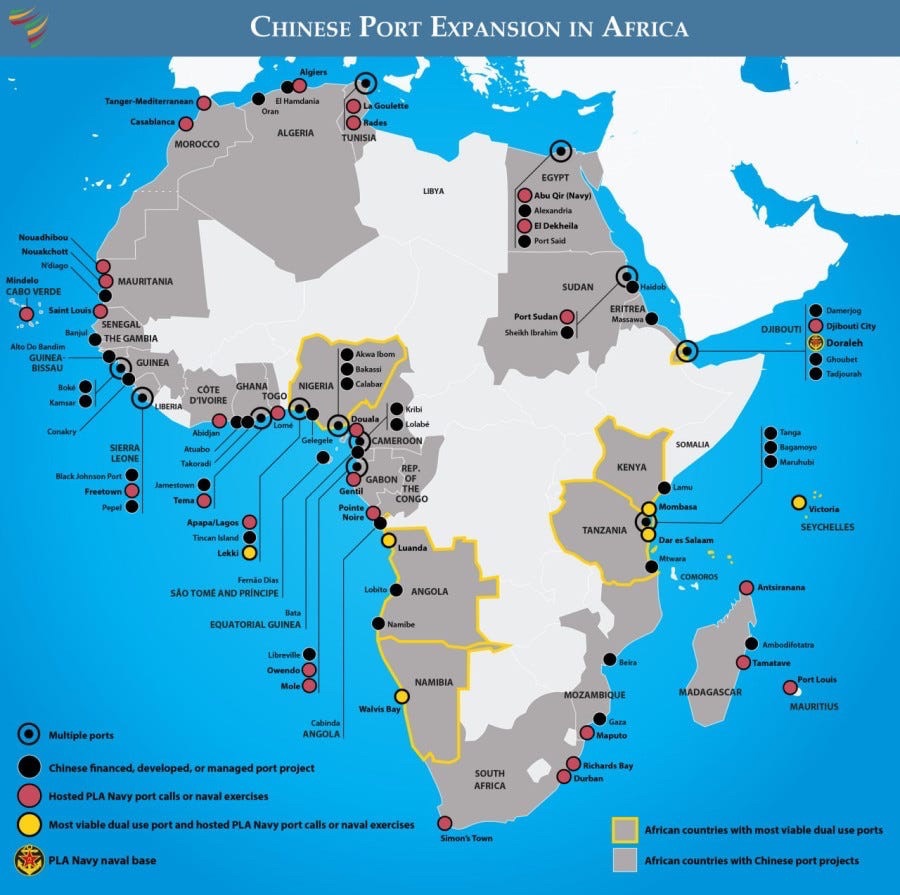
CSIS’ Ryan Berg’s 2025 statement before the House Homeland Security Committee Subcommittee on Transportation and Maritime Security warned that Chinese port projects in adversarial states could offer a “permissive environment” for future PLA Navy operations.
Google AI Overview:
China’s engagement in the Gulf of Guinea involves expanding its military presence, building infrastructure, and securing resources through strategic partnerships. Key aspects include a growing military presence through joint drills and port calls, investment in infrastructure like ports under the Belt and Road Initiative, and addressing security concerns like piracy to protect Chinese interests and test its naval capabilities.
Military and security
- China’s military engagement includes port calls by the People’s Liberation Army Navy (PLAN), joint anti-piracy drills, and providing military training and scholarships to regional countries.
- It is also a key participant in multilateral security exercises with regional and other international partners like Russia and South Africa.
- Some experts suggest China is exploring the possibility of establishing a naval base in the region, potentially in Equatorial Guinea or Gabon.
Economic and infrastructural
- China is a major investor in the region’s infrastructure, particularly ports, as part of its Belt and Road Initiative.
- Chinese companies have constructed military housing and infrastructure for the armed forces of Gulf of Guinea countries.
- China’s involvement also extends to the fishing industry, where its distant water fishing fleet has faced allegations of illegal, unreported, and unregulated (IUU) fishing.
Strategic motivations
- Resource protection: The Gulf of Guinea is rich in oil and other natural resources, and China seeks to protect its economic interests and citizens in the region.
- Naval expansion: China’s increasing activities help it test and develop its expeditionary capabilities and expand its naval reach beyond its home waters.
- Security concerns: The high rates of piracy and kidnapping in the region provide China with a pretext to increase its military presence and engagement.
Sources:
The New Battleground: Competing International Interests in the Gulf of Guinea
There have been reports in recent years that China has been making concerted efforts to establish a military presence in West and Central Africa to allow it access to the Gulf of Guinea and the Atlantic Ocean. The United States (US) has been said to be putting up efforts to contain China in the region, and various joint naval exercises by various international actors in the Gulf of Guinea are being carried out in cooperation with the region’s countries. Indian Prime Minister Narendra Modi also recently visited Nigeria. One of this visit’s goals was to deepen cooperation in the field of maritime security.
These developments and reports point to the increasing international interests in the Gulf of Guinea, and indicate that the region has become a new battleground for the “great powers” competing to secure their economic, security and strategic interests.
Gulf of Guinea and Regional Influence in West Africa
The Gulf of Guinea is the north easternmost portion of the tropical Atlantic Ocean. It extends along the western African coast, encompassing 17 countries: Benin, Cameroon, Equatorial Guinea, Ghana, Gabon, Côte d’Ivoire, Nigeria, Togo, Sao Tome and Principe, the Gambia, Senegal, Angola, Republic of Congo, Liberia, Sierra Leone, Guinea (Conakry) and Guinea-Bissau. (1) The region is strategically close to the Sahel through countries bordering Mali, Burkina Faso and Niger, and links its countries to the other African countries and the rest of the world (2). It enables international trade and maritime transportation to and from major world markets, accounting for up to 25% of Africa’s maritime trade. The region’s vast natural resources, such as oil and lucrative fishing, and its strategic maritime advantages, along with its colonial legacy, have led to a number of languages, systems of governance, and frameworks that sometimes lead to tension between some of its countries, especially with regard to their reprioritisation efforts with international powers operating in the area or aspiring to establish their presence there. (3)
In Africa’s Gulf of Guinea, China is proving it is master of the sea
China boosts cooperation for Gulf of Guinea security
At a seminar in Shanghai on Wednesday, China reaffirmed its commitment to collaborating with Gulf of Guinea countries to advance peace, security, stability, and development in the region.
Hosted by the Chinese People’s Liberation Army (PLA) Navy, the event gathered maritime armed force leaders and defense attachés from 18 nations, including Cameroon, the Republic of Congo, Gabon, Côte d’Ivoire, and Nigeria, for discussions on regional security.
…
As Africa’s largest and the world’s third-largest gulf, the Gulf of Guinea is rich in natural resources but faces persistent security challenges despite its relatively stable overall security situation.
Deep waters: the maritime security landscape in the Gulf of Guinea
The Gulf of Guinea (GoG) spans over 6 000 km of coastline and 19 states. The region is rich in natural resources: it holds significant reserves of gas (2.7% of total world reserves) and oil (4.5%), as well as other valuable minerals including diamonds, tin, bauxite, manganese and cobalt.
…
Global navies, including those from India, Brazil, EU Member States, China and Russia, have expanded their presence in the region. While piracy incidents have declined due to increased patrols, challenges such as illegal fishing and various forms of trafficking persist, exploiting weaknesses in deterrence and enforcement mechanisms. Estimates indicate that IUU fishing may represent up to 40% or even 65% of total catches, while cocaine seizures in West Africa amounted to approximately 16 442 kg in 2022 (4).
…
Partners: cooperation, competition and co-existence…
2021, CSIS: Is China Building a New String of Pearls in the Atlantic Ocean?
Trump extortion to choke off China’s maritime commerce
Chokepoints Are The Focus Of A New Cold War
Boko Haram Insurgency
Nigeria says US help against Islamist insurgents must respect its sovereignty
Islamist insurgents such as Boko Haram and Islamic State West Africa Province have wrought havoc in the country for more than 15 years, killing thousands of people, but their attacks have been largely confined to the northeast of the country, which is majority Muslim.
While Christians have been killed, the vast majority of the victims have been Muslims, analysts say.
Rep. Perry reveals what some of us already knew about USAID (Boko Haram, Al-Qaeda, Taliban, & ISIS Funded by Shipments of Cash Funds, $697 Million Annually from USAID)
China’s Response
China Defends Nigeria: 4 Reasons Beijing Attacks Trump over Plans to Strike Africa’s Biggest Economy
 Ms. Cat’s Chronicles
You must be logged in to post a comment.