
From my previous post: “‘Gen Z’ Mobs Strike Again – Target Mexico”
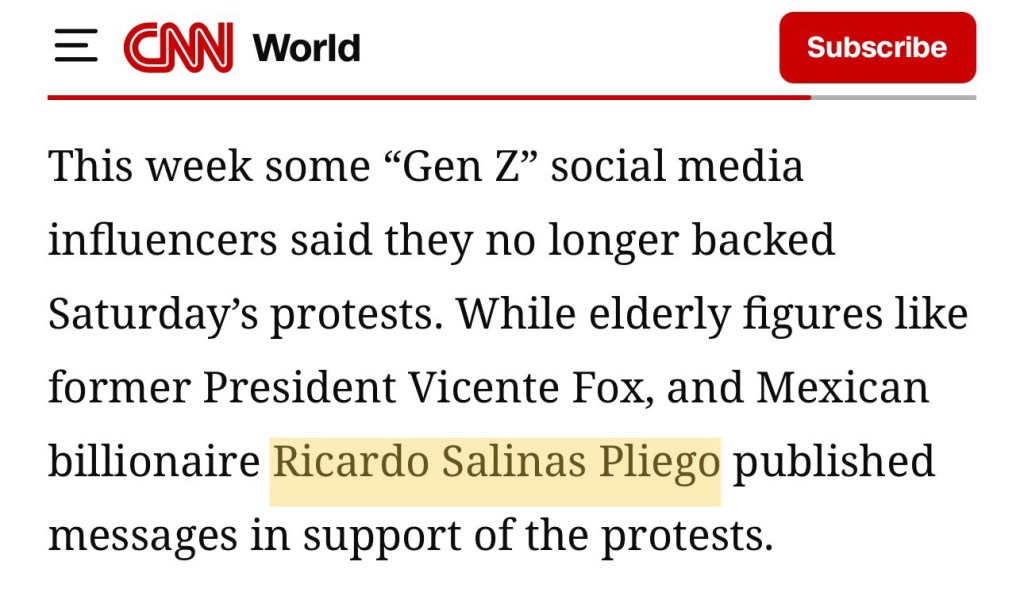
This week some “Gen Z” social media influencers said they no longer backed Saturday’s protests. While elderly figures like former President Vicente Fox, and Mexican billionaire Ricardo Salinas Pliego published messages in support of the protests.
H/T: TFIGlobal
Related:
Atlas Network linked to conservative dirty war; They coordinate attacks
Mexico City.- During the Lie Detector section, it was revealed that Atlas Network an ultra-conservative network based in Washington DC and allegedly linked to the businessman Ricardo Salinas Pliego is behind an unprecedented digital campaign against the Fourth Transformation government.
…
In Mexico, it [Atlas Network] operates through México Evalúa, IMCO, the Vargas Llosa Chair and National Conscience for Religious Freedom, among others. Its financing comes from corporations such as Shell, ExxonMobil, Pfizer and the Koch Foundation, as well as foundations and business groups linked to Ricardo Salinas Pliego’s Grupo Salinas.
Journalistic investigations have documented the indirect participation of Atlas Network in disinformation and dirty war campaigns against progressive governments in Latin America, including those of Mexico, Bolivia, Argentina and Colombia.
Gen Z-led Mexico protests challenge government amid claims of billionaire-backed agitation
At the rallies that day, protesters likened the slain Mayor Manso to President Nayib Bukele of El Salvador, who succeeded in eradicating gangs, and called him the “Mexican Bukele.” By contrast, they criticized current President Claudia Sheinbaum’s “security through inclusion” strategy as “flawed and ineffective.” Sheinbaum has said that hard-line crackdowns like the past attempts at a “war on drugs” triggered the current violence, and she maintains a social approach known as “hugs instead of bullets.”
…
The Sheinbaum administration in Mexico analyzed that the rallies were not a pure civic movement to honor Mayor Manso, but a 90 million-peso (about 7 billion won) “digital strategy campaign” linked to the opposition, the business community, and even overseas forces.
Those named in the government’s special report as being behind the rallies are Mexican billionaire Ricardo Salinas Pliego and the U.S.-based conservative group “Atlas Network.” Pliego is one of Mexico’s leading media tycoons and the owner of “Televisa.” The Atlas Network is an association of nonprofit organizations that promote global conservative liberalism, small government, and a market-centered economy.
Atlas Network:
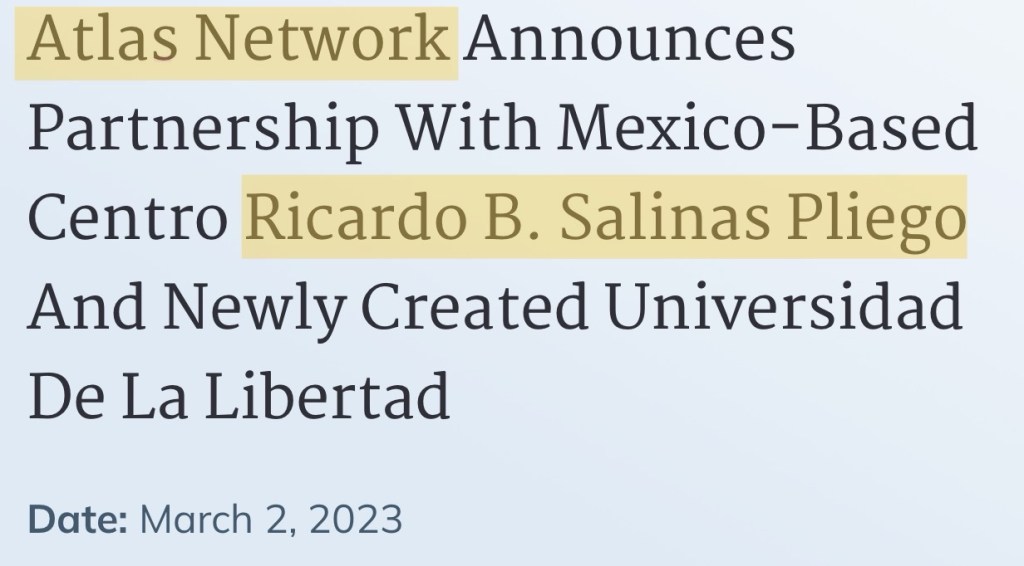
I’m A Latin American Influencer, Pro-Freedom Think Tanks Should Be Influencers Too (archived)
Consider Atlas Network’s new partnership with the Mexico-Based Centro Ricardo B. Salinas Pliego and Universidad de la Libertad, a new academic institution that will educate people about classical liberal values and teach them how to best communicate those values to others.
Argentina & Venezuela: (from my forthcoming article):
2002 and Beyond: The Coup, the Network, and the Blueprint for Regime Change
In April 2002, Venezuela’s elected president Hugo Chávez was ousted in a military coup backed by business elites, opposition leaders, and a constellation of foreign-aligned civil society groups. The U.S. government, through the International Republican Institute (IRI) and other proxies, provided funding and political cover to key actors. The Bush administration initially welcomed the coup, only to retreat when Chávez was reinstated by mass mobilization and loyal military ranks.
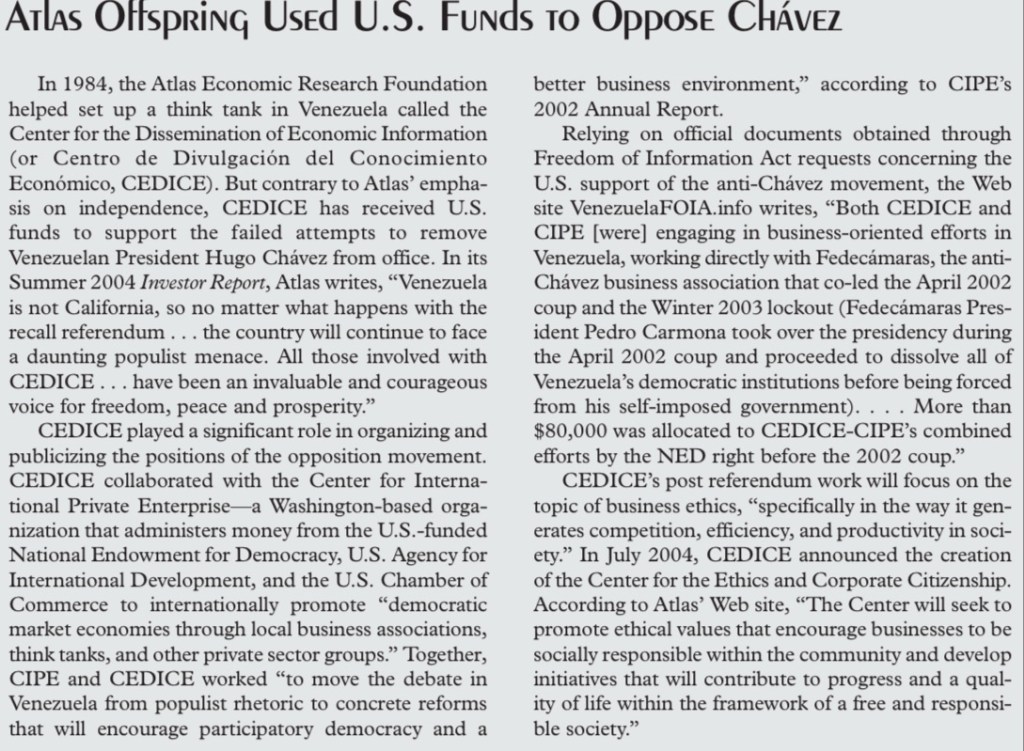
Among the lesser-known yet pivotal forces at play was the Atlas Network, a libertarian web of think tanks backed by corporate interests and U.S. foundations. Its Venezuelan affiliate, CEDICE Libertad, helped shape the ideological narrative against Chávez, promoting neoliberal reforms and packaging elite restoration in the language of “civil society.” Investigations published by PR Watch revealed that Atlas-aligned groups—many also supported by NED, USAID, and similar funders—coordinated media campaigns, mobilized opposition, and legitimized the coup under the banner of “democracy promotion.”
Atlas’s influence extended well beyond Caracas: its affiliates supported business elites, military dissidents, and foreign-backed NGOs—laying the scaffolding for soft coups masquerading as civic resistance. That 2002 playbook didn’t vanish—it evolved.
Now, in 2025, we witness its resurrection. Opposition leader María Corina Machado’s party, Vente Venezuela, is embedded within a constellation of U.S.-funded front organizations. Its membership in Liberal International and RELIAL (the Liberal Network for Latin America) places it in an organizational orbit shared by the National Democratic Institute (one of the four core institutes of the National Endowment for Democracy) and the Atlas Network, which is funded by the Koch Network and coordinates its regional strategy through RELIAL.
Her ascent is scaffolded by Koch-backed networks—mirroring the playbook used in Argentina to elevate Javier Milei through Atlas-linked libertarian fronts. Edmundo González, her strategic proxy and now a figure operating from exile in Spain after an arrest warrant was issued, fronts a movement whose foundations rest on the same transnational soft-power scaffolding that helped orchestrate the 2002 destabilization. The actors have changed, but the architecture remains.
The coup failed—but the blueprint endured.
Nayib Bukele, Network States, and the Atlas Network on page two:
 Ms. Cat’s Chronicles
[…] Update: The Atlas Network and Mexico’s “Gen Z” Protests (Ricardo Salinas Pliego) […]
LikeLike