
In my research on how billionaires influence education, I’ve primarily focused on Beloit College, a place I once considered attending. A key area of interest is the complex ways in which billionaires have shaped the college’s curriculum—an extensive topic that requires significant time and exploration. Interestingly, despite its location in a relatively small city compared to major metropolitan areas like New York or Chicago, Beloit has seen its share of high-profile alumni (including the problematic Judith Miller). Fun fact: I used to handle after-hours phone calls for Beloit College, and occasionally, Paul Newman would call the President of the College, as his first wife was an actress from Beloit. Additionally, I discovered an unexpected historical aspect: the college’s collaboration with the U.S. government on various initiatives, particularly the Student Association for the Study of Hallucinogens (STASH). However, finding detailed information about STASH online has proven challenging, indicating that further investigation may necessitate a visit to the college’s archives. This collection of insights points to a surprisingly rich and intriguing history for the institution.
“Social Structure and the Wealth and Well-Bring of Nations” with Mark Granovetter
This June and Edgar Martin Memorial Lecture was the keynote of the 17th Annual Miller Upton Forum (2025) at Beloit College.
The 2025 Upton Scholar, Mark Granovetter, is Professor of Sociology and Joan Butler Ford Professor in the School of Humanities and Sciences at Stanford University. He received a B.A. from Princeton in modern American and European history, and a Ph.D. from Harvard in Sociology.
Professor Granovetter is the author of the widely cited 1973 paper “The Strength of Weak Ties,” which showed how weak rather than strong ties bridge cliques that might otherwise be disconnected, thus conveying information to individuals about jobs, rumors and discoveries about which they might otherwise be unaware. He followed this paper with a (2nd ed. 1995) book, Getting a Job, where he explores the role of social networks in labor markets.
His recent book, Society and Economy, explores how trust, social norms, power and the details of networks accumulate into macro-level institutions that then in turn shape what individuals do.
Related:
Beloit College: Mark Granovetter
Beloit College Press: The Annual Proceedings of the Wealth and Well-Being of Nations, 2013-2014.
Charles G. Koch Student Research Colloquium and Speaker Series:
With generous support from the Charles G. Koch Charitable Foundation, the department has initiated a research colloquium that gives students the opportunity to read and discuss seminal articles aimed at deepening their understanding of the market process. Students also develop original analysis that applies economic ideas to novel contexts. Colloquium participants receive close mentoring as they craft an article with the eventual goal of publication in a newspaper, magazine, or academic journal. The themes of the research colloquium and annual forum are supported with a speaker series featuring the next generation of scholars working on questions central to our understanding of the nature and causes of wealth and well-being.
University Programs Supported by the Charles G. Koch Charitable Foundation, August 2011
[2011] Campus Connection: Did Florida State sell academic soul for Koch money?
Similarly, the Charles Koch Charitable Foundation awarded $32,000 to Beloit College to fund the “Charles G. Koch Student Research Colloquium and Speaker Series.”
Joshua Hall, a Beloit College professor of economics and management, said those in the colloquium are students who are interested in graduate or law school, and who are “interested in becoming better economic writers and communicators. I choose the speakers to fit in with their interests, as well as to complement each year’s Upton Forum.”
When asked if the Koch Foundation had any influence on the colloquium or speaker series, he said “none whatsoever.”
“To be honest, there wouldn’t be a lot of value there for myself or our students if I didn’t have complete freedom to invite who I felt was appropriate,” says Hall.
[2017] Koch Support to Wisconsin Higher Ed Tops $1 Million
Beloit College has used its Koch grants for a student research and guest speaker program [Miller Upton Program] involving global wealth and economics.
Charles Koch Foundation (Charles Koch, David Koch, Koch Brothers, Koch Network, Kochtopus)
SourceWatch: Koch Universities
The Link Between Koch University Gifts and Political Ideology
In 1974, in his capacity as president and chairman of the Institute for Humane Studies (IHS), Charles Koch urged the IHS Board of Directors to avoid giving money to universities unless they would help advance business interests:
“[W]e have supported the very institutions from which the attack on free markets emanate. Although much of our support has been involuntary through taxes, we have also contributed voluntarily to colleges and universities on the erroneous assumption that this assistance benefits businesses and the free enterprise system, even though these institutions encourage extreme hostility to American business. We should cease financing our own destruction and follow the counsel of David Packard, former Deputy Secretary of Defense, by supporting only those programs, departments or schools that ‘contribute in some way to our individual companies or to the general welfare of our free enterprise system.
…
Koch University Spending and Academic Freedom
Individual university faculty members, organizations such as the American Association of University Professors (AAUP), and numerous independent observers have criticized the gifts given by Koch-related entities to universities for the conditions and restrictions they apply for severely limited academic freedom. With multimillion-dollar gifts to universities, administrators and faculty are compelled to hire faculty, shape curricula and organize student activity in a way that supports the Koch political agenda of free-market economics.
Wikipedia: Institute for Humane Studies
The current president and CEO, Emily Chamlee-Wright, served as provost and dean at Washington College from 2012 to 2016 and was previously the Elbert H. Neese Professor of Economics and associate dean at Beloit College.
Miller Upton, Innovative Head of Beloit College, Dies at 88
In 1963, Dr. Upton won a $1.6 million grant from the Ford Foundation to carry out the Beloit Plan. In 1971, he set up a sliding scale of tuition fees, with students paying different amounts based on their ability to pay.
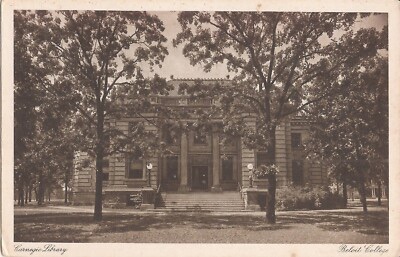
Andrew Carnegie is noted for his gifts for the construction of public library buildings. However, he also gave gifts to help build 108 academic libraries in the United States. In addition to the Carnegie grants for 63 public library buildings in Wisconsin, there were two academic institutions that received Carnegie grants for library buildings – Beloit College and Lawrence University. The Lawrence University Carnegie building was razed in 1974, but the Beloit College Carnegie building still survives. In 1962 it became home to the Pettibone Center for World Affairs. Check out the “Carnegie Libraries” link on the right to find out more about Carnegie library buildings in Wisconsin.
Google AI overview:
Beloit, Wisconsin has two prominent examples of Carnegie libraries: the Beloit Public Library and the Beloit College Carnegie Library. The Beloit Public Library, funded with a grant from Andrew Carnegie, was established in 1903. Beloit College also received a Carnegie grant for its library building, which opened in 1904 and is now known as the World Affairs Center. [1, 2, 3, 4]
Beloit Public Library:
- Andrew Carnegie provided $25,000 for the construction of the Beloit Public Library, which opened in 1903.
- The city agreed to provide $2,500 annually for maintenance.
- The library was deemed outdated by 1961 and a new building was planned. [1, 2]
Beloit College Carnegie Library (now World Affairs Center):
- Groundbreaking for the Beloit College Carnegie Library took place in December 1903, with completion in May 1904. [3]
- The library, now the World Affairs Center, was designed by Patton & Miller of Chicago in a Renaissance style and cost $50,000. [3]
- It became a prominent library for Beloit College, but was eventually superseded by Morse Library. [3, 5]
Carnegie’s Impact:
- Andrew Carnegie is known for his philanthropy, donating millions for the construction of public libraries in the United States. [1, 1, 2, 2]
- Wisconsin Library Heritage Center says that Carnegie also funded libraries at 108 academic institutions, including Beloit College and Lawrence University. [4, 4]
- The Beloit College Carnegie Library is one of the 20 Wisconsin Carnegie buildings still used as libraries. [4, 6]
AI responses may include mistakes.
[1] Wikipedia
[3] Beloit College, WISCONSIN – Carnegie Library
[4] Carnegie Was Also Academic
[5] Future Facing
 Ms. Cat’s Chronicles
You must be logged in to post a comment.