“Europe is beginning to accept that Ukraine will have to sacrifice territory if it wants to end the war,” reads the headline of the El País article addressing the concern of European capitals regarding the US stance of prioritizing the end of the war over the continent’s desire to achieve its strategic objectives. Published yesterday, the new US National Security Strategy also confirms this position. The plan, which, as expected, prioritizes the Monroe Doctrine and the “Trump Corollary” to achieve complete hegemony in the Americas, even above containing China, presents a world in line with the theory of *Strategy of Denial*, the book published in 2018 by Elbridge Colby, now the Pentagon’s number three official. The US objective in strategic regions is to prevent the existence of “counter-hegemonic” blocs—groups of countries capable of challenging Washington’s power. Fostering favorable alliances, preventing potential rivals from creating such axes, and intervening only when strictly necessary are the basis of a form of interference that does not necessarily imply a continuous presence, which is why the actions of Trumpism, deeply interventionist in both political and military matters, have been described as isolationist.
Although the section dedicated to Europe deserves further analysis, the references to the war in Ukraine are limited and merely confirm European fears. In just two paragraphs, one of them dedicated to the relationship between European countries and Russia, Ukraine receives only four mentions. “The Trump administration finds itself at odds with European officials who have unrealistic expectations regarding the war, supported by unstable minority governments, many of which trample on basic democratic principles to suppress the opposition,” states the document, which reaffirms what has been the official policy of the Trump administration since it came to power. The priority is to end the violence to avoid greater evils, restore economic relations with Russia, and proceed to “make Europe great again,” a plan consistent with JD Vance’s speech in Munich and the United States’ support for far-right and white nationalist movements aligned with Trumpism. The document states that “a large majority of Europeans want peace, but this desire is not translating into policies, largely due to the subversion of democratic processes by these governments. This is strategically important for the United States precisely because European states cannot reform themselves if they are trapped in a political crisis,” it adds, with a veiled endorsement of parties like the AfD.
“It is in the fundamental interest of the United States to negotiate a swift cessation of hostilities in Ukraine, in order to stabilize European economies, prevent an escalation or unintended expansion of the war, and restore strategic stability with Russia, as well as enable the reconstruction of Ukraine after the hostilities so that it can survive as a viable state,” states the only part of the document that actually addresses the future of Ukraine, for whom expectations are considerably more limited than those aspired to in 2022 by European countries and the Biden administration. Peace and the viability of the state are the only aspirations mentioned by Trumpism.
Beyond the European narrative, which claims that Russia’s objective was and remains the destruction of the Ukrainian state and nation, Ukraine’s viability today depends on consolidating peace, stabilizing the border—predictably de facto —with Russia, preserving regions like Odessa (something that has always seemed guaranteed), initiating reconstruction, and recovering its economic potential. To all this must be added an essential aspect: the population. Like Russia, Ukraine has suffered for three decades from the demographic consequences of the end of socialism, the rampant liberalization, the widespread impoverishment of the 1990s, and the resulting population loss. This is one of the reasons why Zelensky has so strongly resisted lowering the conscription age. Few things have been more important to the Ukrainian government than replenishing its depleted ranks and recruiting a large army to continue the war. Protecting the small generation of young people has been one of them, since Ukraine’s future depends in part on this generation.
To the demographic consequences of independence must be added those of the years of conflict. With the loss of Crimea first and Donbas later, Ukraine not only lost a strategic territory on the Black Sea peninsula and the natural resources of the Donetsk and Luhansk mining region, but also a significant portion of its population. The 2014 war and the economic crisis that has plagued Ukraine for the last decade also triggered a significant emigration trend, further exacerbating an economic crisis that Kyiv has never been willing to quantify. Hence, without any recent census, the Ukrainian authorities have preferred the fiction of claiming a population of 46 million rather than admitting reality. Over the years, intellectuals like the Ukrainian sociologist—now in Germany and openly hated by nationalists—Volodymyr Ishchenko, have recalled with a certain nostalgia one of the proclamations of the Ukrainian Soviet Socialist Republic, which celebrated that “we are now 50 million!”
The massive casualties of the war and the population flight that occurred in 2022 in both directions—although the European Union emphasizes the millions of Ukrainians hosted by the EU, Russia remains one of the countries that has received the most people—have further worsened an already complicated situation. The impoverishment caused by the war in a country that rivaled only Moldova for the title of poorest country in Europe has also had demographic consequences.
As Reuters headlined yesterday, “Ukraine faces demographic collapse,” not only because of the deaths caused by the war, but also because of the question of “who will be left to pick up the pieces after the war.” The article offers a concrete example: the city of Hoshcha, in the Rivne Oblast of western Ukraine, a place extremely far from the front lines where the danger of the war is limited to drone attacks. However, the consequences of the war extend throughout the entire country. “The hospital in Hoshcha has only registered 139 births so far this year, compared to 164 in 2014, and a far cry from the more than 400 babies born annually just over a decade ago, according to local authorities. ‘Many young people have died,’ lamented gynecologist Yevhen Hekkel in his office. ‘Young people who, to put it bluntly, were supposed to replenish Ukraine’s gene pool,’” Reuters reports, describing a situation that, judging by the data, could be extrapolated to the rest of the country.
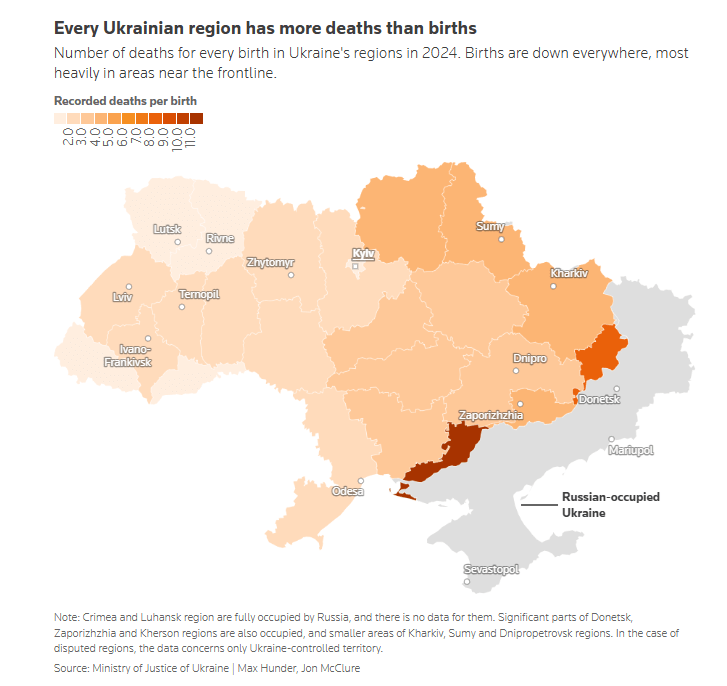
“According to government estimates, the average life expectancy for men in Ukraine has fallen from 65.2 years before the war to 57.3 years in 2024. For women, the figure has dropped from 74.4 to 70.9,” the article states, adding that in every single region of Ukraine, even those hundreds of kilometers away, deaths outnumber births. Death, poverty, emigration of working-age people, lack of future prospects, uncertainty about the future, and the shortage of men resulting from the continuous mass conscription that has been in place for over three and a half years are causing this situation. The outcome worries the government, not so much because of its capacity to continue conscripting—an aspect Ukraine prefers not to acknowledge—but because of future labor needs. “Ukraine will need millions of people to rebuild its devastated economy, experts and politicians say, and to defend itself in a post-war future should Moscow attack again, as many Ukrainians fear. The government in Kyiv tried to address the crisis last year when it outlined a demographic strategy through 2040. The document warned that Ukraine faced a labor shortage of 4.5 million workers over the next decade. The sectors most in need of labor would be construction, technology, and administrative services,” Reuters reports.
Like economic and demographic problems, the false hopes of future wealth in Ukraine and the United States often precede war by many years. “In five years we will live like in France,” Leonid Kravchuk declared in 1991. “In ten years we will live like in Poland,” Viktor Yushchenko predicted in 2004. “In twenty years we will live like under Yanukovych,” Mikheil Saakashvili, then governor of Odessa, lamented in 2015. This week, Marco Rubio made a similar statement in an interview with Fox News. “What they are literally fighting over now is a space of between 30 and 50 kilometers and the remaining 20% of the Donetsk region. Therefore, what we have tried to do—and I believe we have made some progress—is to find out what Ukrainians could accept that would give them security guarantees for the future, that they would never be invaded again, that would allow them not only to rebuild their economy, but also to prosper as a country, to be a country with a growing economy,” he stated, reflecting the same vision embodied in the National Security Strategy, before adding that “theoretically, if things are done right, in ten years Ukraine’s GDP could be larger than Russia’s.”
Exaggerated expectations are not limited to countries that wish to use Ukraine to wage their war against Russia, further worsening the already dire situation of the country they claim to defend, but extend to the United States, which also prefers to ignore reality in order to embellish future prospects. “Ukraine’s population, which stood at 42 million before the full-scale invasion in February 2022, has already fallen to less than 36 million, including several million in areas captured by Russia, according to the demography institute of the National Academy of Sciences of Ukraine,” Reuters reports, citing figures that were already considered a pipe dream. The Academy “estimates that the figure will fall to 25 million by 2051,” the article continues, providing this alarming figure, which represents half the population of Soviet Ukraine. “The collapse is progressing,” he adds, stating that “the country has the highest mortality rates and the lowest birth rates in the world, according to 2024 estimates from the CIA World Factbook: for every birth there are about three deaths.”
Ukraine’s survival depends not only on the borders that will result from the war, on security guarantees to prevent another aggression, or on the economic and political interests of its European and North American allies, but also on its ability to reverse its demographic trend once peace is achieved.

 Ms. Cat’s Chronicles
You must be logged in to post a comment.