
I’m not really a fan of Stoicism, but I haven’t really given it a fair chance, so I decided to download Meditations by Marcus Aurelius and Seneca’s Letters on Ethics. I have a tendency to cherry pick quotes for inspiration though, so I looked up some from Seneca.
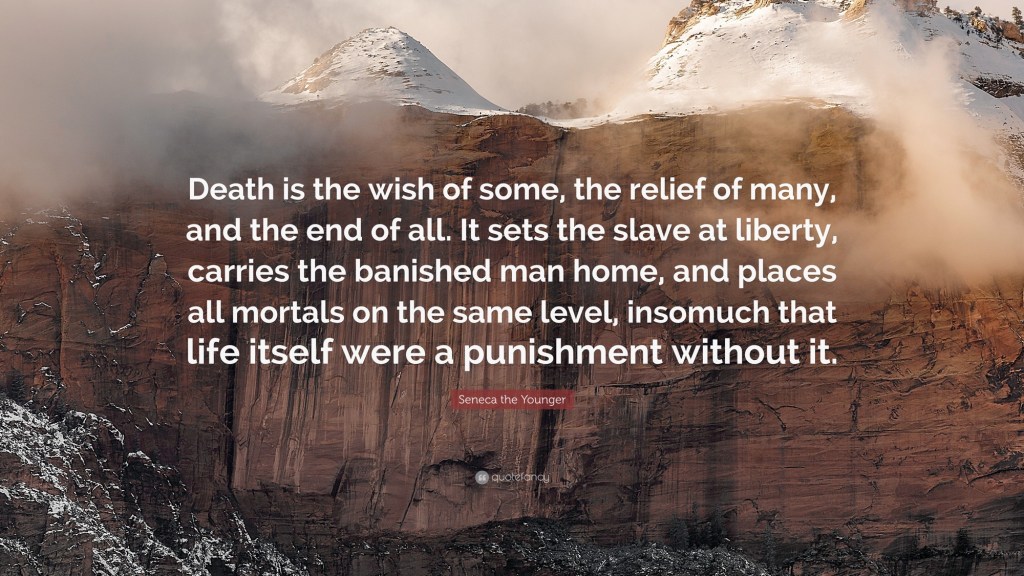
Out of all the Seneca quotes I found, that’s the one that hit me the hardest. At first it felt like permission to give up — something I struggle with more than I like to admit. Recently, I’ve been feeling like I’m standing at a crossroads where my only choices are do or die. But the more I sit with it, the more I realize Seneca wasn’t handing out an escape hatch. The quote encourages living a meaningful life now, as death is unavoidable, and what truly matters is how one lives before it arrives. That isn’t surrender. It’s a way of taking fear out of the picture so you can act without being held hostage by it. It’s not “give up.” It’s “stop letting the fear of endings distort the way you live.” And for me, that includes the fear of what might happen if I choose to act instead of freeze.
That’s the part I keep circling back to — not death itself, but the way fear narrows my choices until everything feels like an ultimatum. Seneca isn’t telling me to stop fighting; he’s telling me to stop letting fear decide what the fight even is. There’s a difference. A big one. And once I see that, the crossroads I keep imagining doesn’t look quite as absolute. It’s still hard, but it’s not the do‑or‑die binary my brain tries to make it. That shift — from fear to perspective — makes me think about how I used to understand life before everything became either/or.
One of my favorite TV shows from my childhood was The Facts of Life. I loved the theme song. My favorite lyrics were, “You take the good, you take the bad, you take them both and there you have the facts of life”.
Somewhere along the line, I went from accepting that there is both good and bad in life, to either/or. The false dilemma of George W. Bush and the majority of The Blob in Washington, D.C., “You are either with us, or against us.” In psychology it’s called splitting, a characteristic of the borderline personality disorder that I’ve been diagnosed with. I struggle with it daily. Good or bad. Black or White. Vladimir Lenin or Trotsky (the Traitor).
In On Contradiction, Mao Zedong said, “in studying any complex process in which there are two or more contradictions, we must devote every effort to finding its principal contradiction. Once this principal contradiction is grasped, all problems can be readily solved. This is the method Marx taught us in his study of capitalist society.”
Lenin reminds me to step back and think before reacting, with his quote, though, “It is, of course, much easier to shout, abuse, and howl than to attempt to relate, to explain.”
Different traditions, same point: step back, find the real contradiction, and stop reacting to shadows.
It’s one reason why I’ve been studying Taoism. Balance. The concept of Yin and Yang is brought up in chapter 42 of the Tao Te Ching. Laozi says, “All things carry yin and embrace yang; they achieve harmony by combining these forces.”
In the end, I don’t think I’ll ever be able to find “nuance” in certain things, especially U.S. foreign policy. Bombing innocent people isn’t something I can balance out with a philosophical framework. As Mao puts it, the principal contradiction in those situations is “the contradiction between imperialism and the country concerned.” In plain terms, he meant that when a powerful nation is attacking or dominating a weaker one, that clash overrides every other issue — it becomes the defining conflict. That’s not something a shift in perspective can soften. And Taoism doesn’t ask me to soften it. Chapter 42 of the Tao Te Ching ends with Laozi’s warning: “A man of violence will come to a violent end.” That’s not yin‑yang. That’s cause and effect.
Karl Marx said, “The philosophers have only interpreted the world; the point, however, is to change it.” I’m trying to change myself first — the only part of the world I actually have any control over. I’m one person, and I’m doing the work. Some days that means catching myself when I start splitting everything into good or evil, friend or enemy, Lenin or Trotsky. Some days it means stepping back, like Lenin said, and choosing to explain instead of react. Some days it means remembering that yin and yang coexist, even when my brain insists on choosing sides.
If I’m going to critique the world, I have to be willing to confront the contradictions in myself. That’s the part I’m working on. Slowly. Stubbornly. On my own terms.
— T.A.
 Ms. Cat’s Chronicles
You must be logged in to post a comment.