
I had a dozen things I wanted to write about today, but most of them slipped my mind. My reading list is growing faster than I can keep up with. I’ve been struggling to find the motivation to finish The Rainbow by Wanda Wasilewska—I even ended up rereading Chapter Two by mistake—but in that “accident,” I found the heart of what I’ve been thinking about:
But without realizing it, the soldiers were teaching the peasants something else as well-teaching them what Soviet power had really given them. Fedosya was sure that in villages where the Germans had left their mark in streams of tears and blood even for a single day, there would never in all eternity, from generation to generation, be anyone dissatisfied with the Soviet government, anyone indifferent to it, anyone lazy or indolent.
Wanda Wasilewska, The Rainbow
This passage struck me. It’s about loyalty forged in fire. We hear so much about the ‘crimes’ of Communism, but there is a total silence—absolute crickets—about the 14-nation Allied invasion of Russia, U.S.-backed KMT, or the fact that after the Treaty of San Francisco, the U.S. effectively rehabilitated and backed the remnants of the Japanese imperial machine to serve as a front against the ‘Red Menace.’ Most of what we are taught is pure Cold War propaganda.
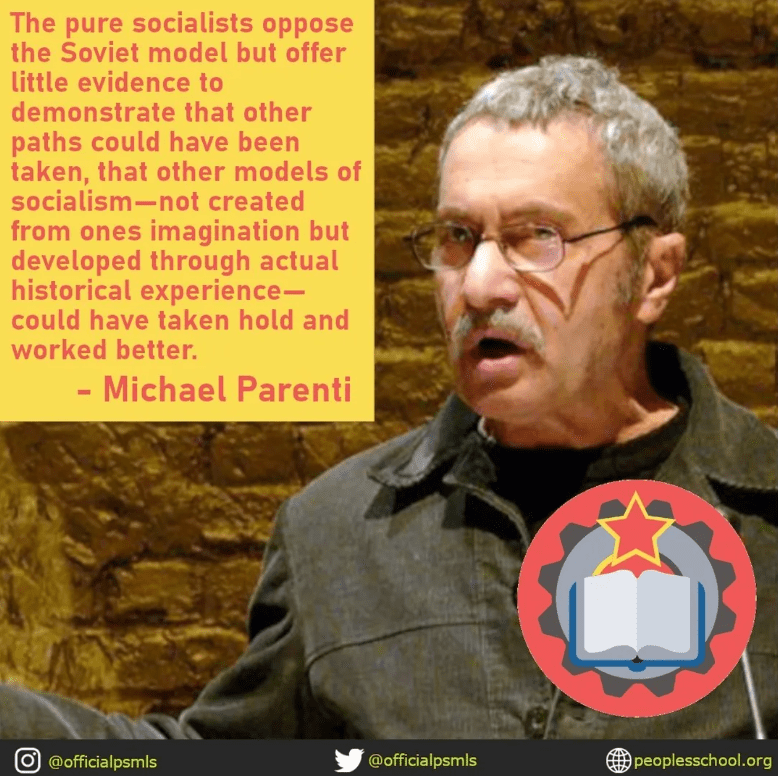
This brings me to Michael Parenti, who passed away on Saturday. He was my gateway to understanding this. In Blackshirts and Reds, he spoke about “Siege Socialism.” He argued that you can’t judge a revolutionary state as if it exists in a vacuum; it exists under a permanent state of siege from the capitalist world.
Parenti asked if Marx is still relevant. His answer is the only one that makes sense of our current mess:
Is Marx still relevant today? Only if you want to know why the media distort the news in a mostly mainstream direction; why more and more people at home and abroad face economic adversity while money continues to accumulate in the hands of relatively few; why there is so much private wealth and public poverty in this country and elsewhere; why U.S. forces find it necessary to intervene in so many regions of the world; why a rich and productive economy offers chronic recessions, underemployment, and neglect of social needs; and why many political officeholders are unwilling or unable to serve the public interest.
Michael Parenti, Blackshirts and Reds
But was the “siege” real, or just an excuse for paranoia?
Lately, I’ve been digging into the research of Joseph E. Davies, the U.S. Ambassador to Moscow. In his 1941 article, “How Russia blasted Hitler’s Spy Machine,” he admitted that the “purges” the West mocked were actually the reason Russia didn’t collapse like France or Norway. As Davies put it, there was no Fifth Column because “they had shot them.”
Modern research, like Grover Furr’s analysis of the Moscow Trials, backs this up with archival evidence. The “conspiracies” weren’t just fabrications; they were documented attempts to collaborate with the Axis powers.
When you put it all together—Parenti’s theory, Davies’ eyewitness account, and Furr’s evidence—the “Great Terror” starts to look less like madness and more like a desperate defense against a global siege.
As Wasilewska wrote, for the people who saw the “tears and blood” of the alternative, Soviet power wasn’t a choice—it was survival.
Paranoia is a fear of imaginary enemies. When 14 nations invade your borders and Hitler’s spies are in your backyard, it’s not paranoia—it’s a survival strategy.
And that brings us to today’s Russo-Ukrainian “war,” but that’s another story.
—T.A.
Previously:
 Ms. Cat’s Chronicles
You must be logged in to post a comment.