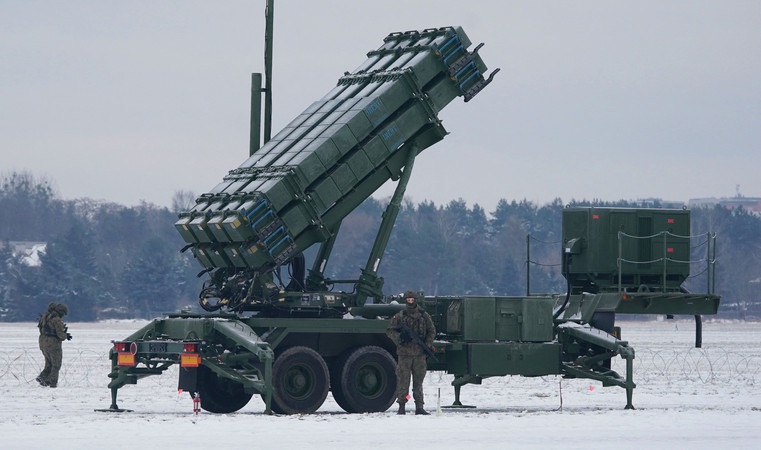
Industry has not been able to speed up production enough to meet Kyiv’s air defense needs. | Janek Skarzynski/AFP via Getty Images
When NATO established a process to speed delivery of military assistance to Ukraine last summer, it threw Ukraine a much needed lifeline as the U.S. was pulling back from sending weapons to Kyiv.
But seven months in, the Prioritized Ukraine Requirements List is dogged by the same challenges the U.S. and its partners have faced since Russia launched its full-scale invasion four years ago — industry has not been able to speed up production enough nor accelerate legacy approval processes to meet Kyiv’s critical need for air defense.
The PURL mechanism was designed to circumvent America’s political ambivalence to funding weapons for Ukraine by setting up a system in which European countries pay Washington for the weapons. That, in theory, would ensure that Kyiv could continue receiving weapons from American stockpiles. The system is also meant to better coordinate Ukraine’s needs by streamlining its demands through one single channel while sending a stronger demand signal to industry.
But Patriot interceptors that Ukraine needs to shoot down ballistic missiles and medium-range air defense systems like the NASAM to defeat Russian missile attacks remain in short supply. While European officials and Ukraine’s allies did not expect an overnight miracle, they lament that industry delays and the long life cycle of the American procurement process has continued to dog the effort.
“That’s everyone’s frustration. It does not bode well for the U.S. in a macro sense that we cannot seem to do this. We’ve got to wake up,” a Republican congressional aide familiar with the effort said. NatSec Daily granted the person anonymity to speak candidly about tensions between government and industry. “Industry has made some strides but still fundamentally relies on an outdated model.”
While Europe has begun to ponder life without the U.S., it is very much dependent on Washington for Ukraine’s key requirements for the foreseeable future.
“Now the challenge for the defense industry is how to build with speed and in a cost effective way,” Finland’s Defense Minister ANTTI HÄKKÄNEN told NatSec Daily. “No one wants to waste money or wait 10 years” for new weapons to arrive. “We don’t have 10 years.”
Air defense systems are particularly difficult to acquire because the U.S. doesn’t have much extra supply and Ukraine’s daily need for interceptors is extremely high.
The U.S. has significantly bumped up production of Patriots, but is far short of global demand.
European countries are trying to find ways to continue to protect and grow their national defense industries while expanding into new partnerships, out of sheer necessity and the need for speed. Some of the efforts involve a joining of U.S. and European manufacturing muscle. Patriot developer Raytheon has partnered with European missile maker MBDA to build a Patriot production plant in Germany, which aims to begin delivering more interceptors by 2027.
Such joint efforts may be the most immediate impact of PURL, even if they mean more of the most critical weapons don’t arrive on the battlefield anytime soon.
Romanian Foreign Minister OANA TOIU said that her government is investing heavily in its own defense industry and is working with other countries on joint projects that will “create financial resources to be able to increase defense spending.”
She pointed to collaboration with German investors to establish “the most modern ammunition factory in Europe” and to conversations with Ukraine on drone production.
European allies say they’re committed to the effort, as it remains the best — if still imperfect — way to get weapons into the hands of the Ukrainians as quickly as lumbering bureaucracies will allow.

 Ms. Cat’s Chronicles