
US columnist believes Wrangel Island belongs to United States + More

Source: Wikimedia Commons

Thomas E. Dans, a columnist for The Wall Street Journal (WSJ) and former Commissioner of the US Arctic Research Commission, believes that the United States should reclaim Wrangel Island from Russia.

US columnist believes Wrangel Island belongs to United States

Related:

Status of Wrangel and Other Arctic Islands

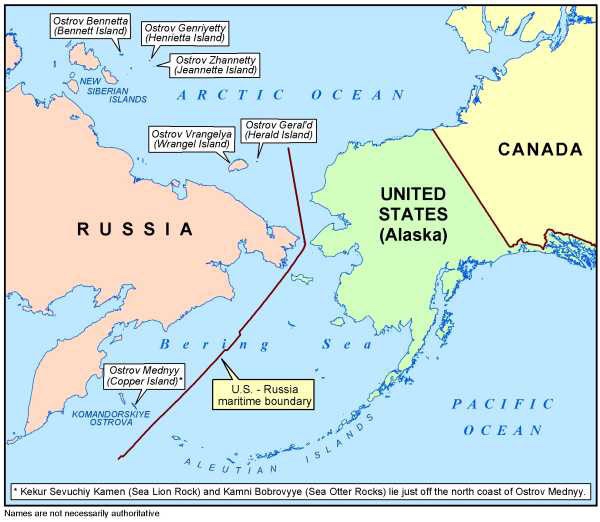
No negotiations regarding the U.S.-Russia maritime boundary have occurred since 1990, when the U.S.-USSR Maritime Boundary Agreement was signed. The negotiations that led to that agreement did not address the status of Wrangel Island, Herald Island, Bennett Island, Jeannette Island, or Henrietta Island, all of which lie off Russia’s Arctic coast, or Mednyy (Copper) Island or rocks off the coast of Mednyy Island in the Bering Sea. None of the islands or rocks above were included in the U.S. purchase of Alaska from Russia in 1867, and they have never been claimed by the United States, although Americans were involved in the discovery and exploration of some of them.

Ice Curtain: Why Is There a New Russian Military Facility 300 Miles from Alaska?

. . . whoever holds the Arctic, holds the world. I think it is the most important strategic place in the world.” These solemn words were uttered in 1935 before a House of Representatives Committee by a retired American general and aviator, Billy Mitchell, who presciently foresaw the Arctic as a vital region for early detection against missile and aviation threats to prevent an attack against the United States. But at the end of the Cold War, the Arctic ceased to be a strategically important place for either the United States or the Russian Federation. But by the 2007-2008 timeframe, Russia began to re-prioritize the Arctic both economically and militarily—in keeping with Vladimir Putin’s vision of restoring Russia’s status as a great power and harnessing the Arctic’s economic potential. Now more than a decade later, Russia has returned to the Arctic militarily with important strategic implications for the United States.

US to Appoint New Arctic Ambassador With Eye on Russia

US to Appoint New Arctic Ambassador With Eye on Russia

The US military is preparing for a future conflict in the Arctic with Russia, as well as China, by revamping its forces in the region. The US Army released a strategy document last year that said the Arctic has the “potential to become a contested space where United States’ great power rivals, Russia and China, seek to use military and economic power to gain and maintain access to the region at the expense of US interests.”

The US Navy released a similar strategy document in early 2021. Then-Navy Secretary Kenneth Braithwaite suggested that the US could start challenging Russian claims to the Arctic by sending warships near Russia’s northern coast, similar to how the US Navy makes provocative passages near Chinese-controlled islands in the South China Sea.

Related:

Melting ice will change the economics of extracting resources from the Arctic

Of the 90 billion barrels of oil and 1,700 trillion cubic feet of natural gas estimated to lie north of the Arctic Circle, 84% lies offshore. And while Arctic conditions can still be as harsh as they were on the Seabees, the infrastructure of oil and gas extraction has improved vastly. “If people aren’t drilling all over the Arctic now, I don’t think it’s because there’s a gap in technology,” said Stig-Mortean Knutsen, a petroleum geologist at the Arctic University of Norway. “It’s more to do with cost.”

These extractive ambitions rub against the urgency of our environmental moment: the need to cut down, rather than pursue, fossil fuel use. As part of their sustainability goals, banks claim they’re now making it difficult for oil firms to get funds for new Arctic projects. Knutsen calls this decision to withhold financing an easy one to make, “like kicking down an open door,” because the upfront expense of a project is so steep today. If those expenses shrink in a warming Arctic, banks might well step up once again, he said. One sustainability executive at a London-based bank, who asked not to be named, pointed out: “In any case, China and Russia will be happy to fund new projects.”

Ironically, to best transition away from carbon fuels, the Arctic may first have to yield up another kind of resource: metals. The batteries, electric vehicles, and fuel cells of the future will need huge quantities of copper, nickel, manganese, rare earths, and other metals, said Gerard Barron, the CEO of The Metals Company, which hopes to mine the sea floor once the International Seabed Authority, a body within the UN, finalizes an undersea mining code. Barron’s miners are most actively studying the Clarion Clipperton Zone, a region just south of Hawai’i, where there is, Barron believes, enough metal to build 280 million EV batteries.