Hegseth visits Manila: Washington prepares for war with China + More

Hegseth visits Manila: Washington prepares for war with China

The language of Hegseth’s press conference in Manila is indicative of the openly aggressive face of US imperialism under Trump. Gone was any reference to what had been the political shibboleth of Washington in the Asia Pacific region: the defense of “freedom of navigation.” Hegseth spoke rather of “preparing for war,” using the phrase more than once. Every time Hegseth mentioned China he termed it “Communist China,” and spoke of its “aggression.” Hegseth referred to US Seventh fleet commander Admiral Samuel Paparo “and his war plans. Real war plans.”

Read More »

EDSA1: The Snap Revolution

Off to the side was a more youthful Wolfowitz. He told me that this picture, which had pride of place in his office, was of exactly the moment when the Reaganites had narrowly voted to dump the Ferdinand Marcos dictatorship in the Philippines in 1986 and to recognize the election victory of his opponent Cory Aquino.* “It was the first argument I won,” said Wolfowitz proudly. “I said that if we supported a dictator to keep hold of a base, we would end up losing the base and also deserving to do so. Whereas,” he went on, “by joining the side of ‘people power’ in Manila that year, we helped democracy movements spread through Taiwan and South Korea and even I think into Tiananmen Square in 1989.

* See, for the best account of this upheaval in real time, James Fenton’s book The Snap Revolution.

Related:

*The Snap Revolution (Part One: The Snap Election) | James Fenton

*The Snap Revolution (Part Two: The Narrow Road to the Solid North)

*The Snap Revolution (Part Three: The Snap Revolution)

Previously: PH’s EDSA1 AKA People Power Revolution

Google Document: PH’s EDSA1 AKA People Power Revolution & Chile’s 1988 Plebiscite

Tiananmen Square

How to DOGE USAID: The Wall Street Consensus under Trump

How to DOGE USAID: The Wall Street Consensus under Trump

We often hear that the new Trump administration inaugurates the age of technofeudalism. Just look at Elon Musk, pontificating about so-called “Department of Government Efficiency” (DOGE) democracy from the Oval Office while undemocratically occupying the US Treasury payment system. But is the administration simply using bullying as a mode of power, as Adam Tooze recently diagnosed it, destroying institutions without measure or plan?

Read More »

PH: Stratbase, CIPE (NED), and the Belt and Road Initiative

07-31-2024: If it’s bad business, it’s bad for the Philippines (archived)

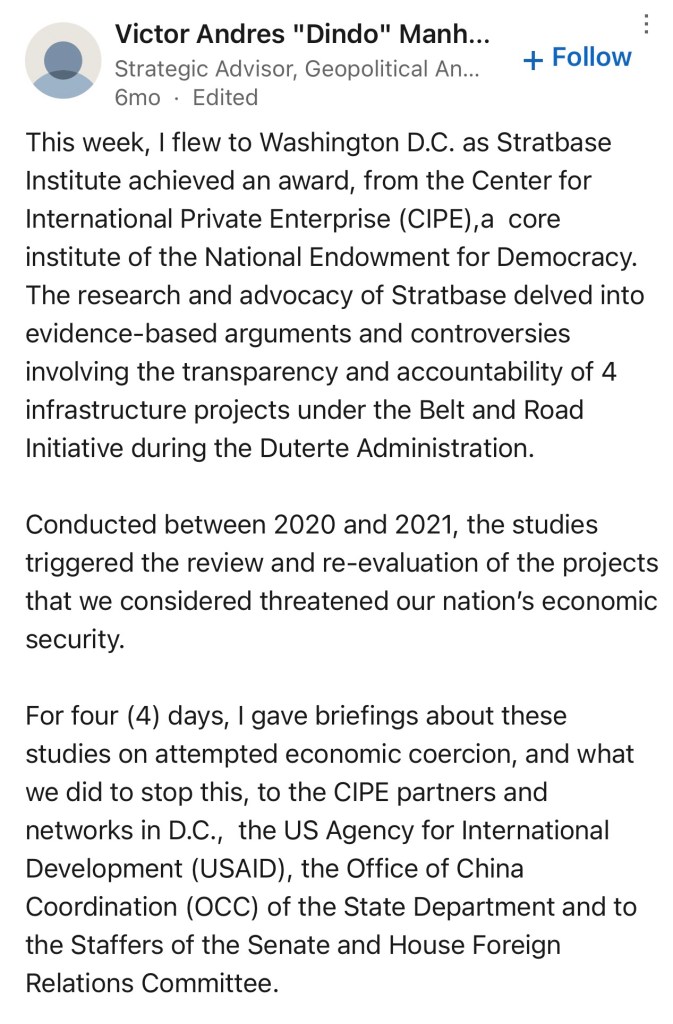
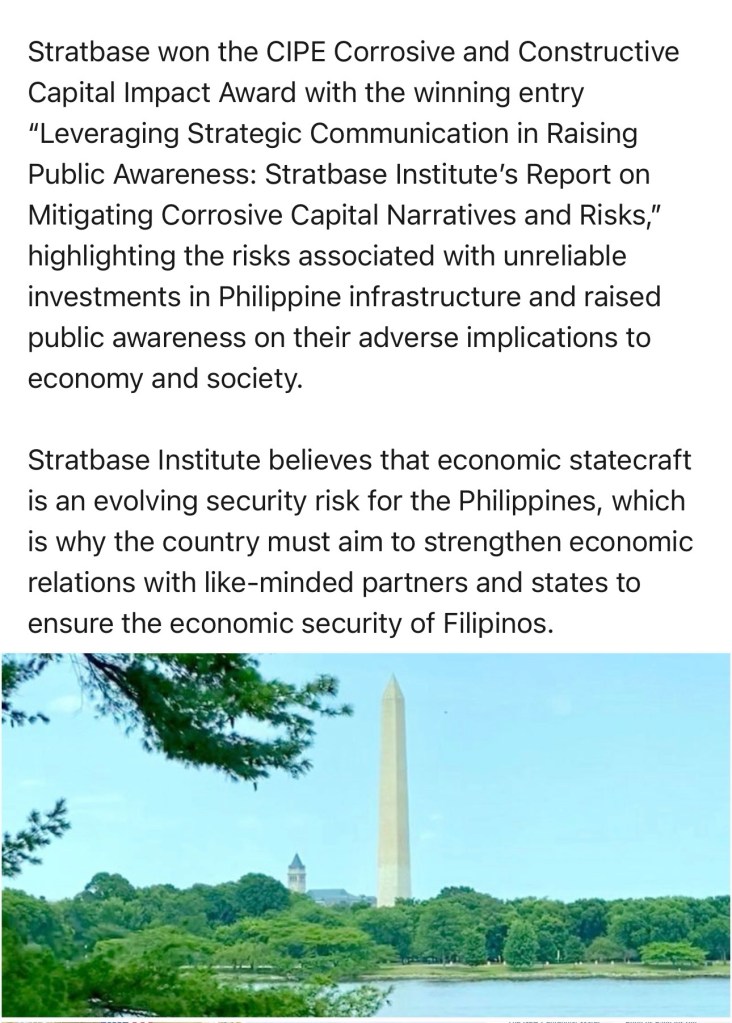
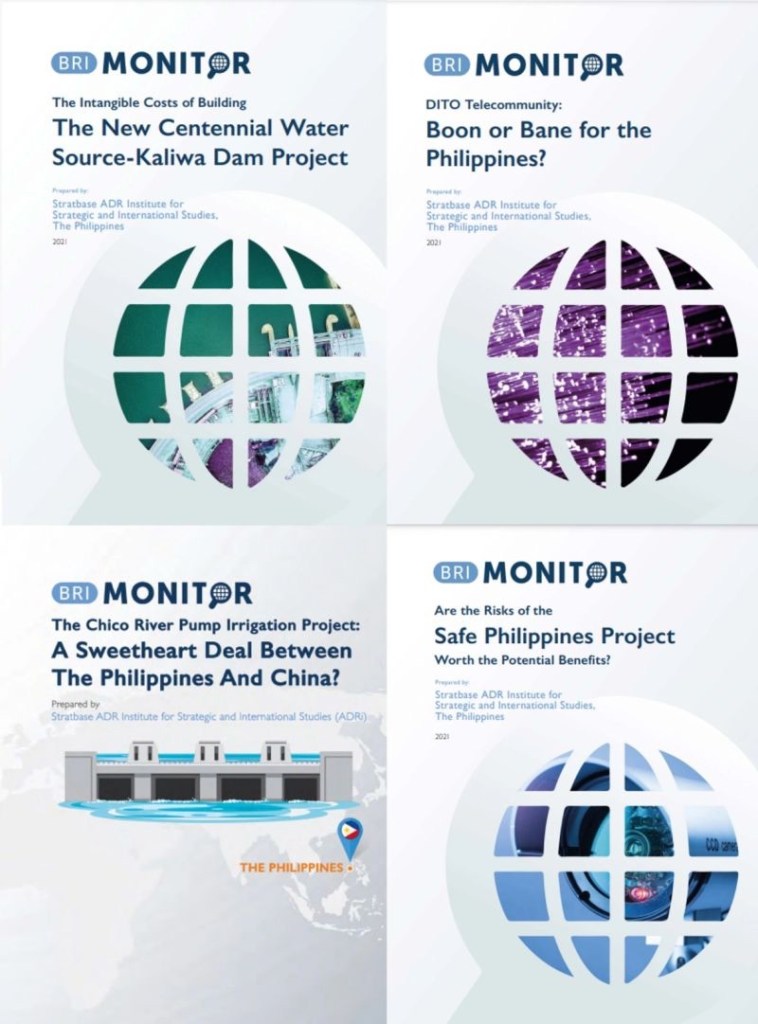
Our organization, the Stratbase ADR Institute, received an award from the prestigious Center for International Private Enterprise (CIPE), one of the four core institutes of the National Endowment for Democracy in Washington, DC. We were recognized for our research, advocacy, and strategic communication on four infrastructure projects entered into by the Philippines, during the administration of former President Rodrigo Duterte, under the Belt and Road Initiative of China.

The Philippines has currently withdrawn from the Belt and Road Initiative and the current administration has been careful to consider other partners aside from China.

Victor Andres “Dindo” C. Manhit is the president of the Stratbase ADR Institute.

Just like the National Endowment for Democracy, CIPE has been scrubbing their website. Search for the Philippines and click on the results. Most of the links are missing.

Related:

Read More »

RAND and SeaLight Part 3b: Four Ways China Is Growing Its Media Influence in Southeast Asia

05-10-2022: Four Ways China Is Growing Its Media Influence in Southeast Asia

China’s most straightforward method of media outreach is directly broadcasting or publishing its state media content in target ASEAN countries. Xinhua, China’s official state media agency, has print bureaus in every Southeast Asian country. TV news channels CCTV-4 and the English-language CGTN likewise operate in nearly every country in the region, while China Radio International airs multilingual content in Vietnam, Laos, Cambodia, Thailand, and Myanmar. Xinhua is a ministry-level agency directly under the State Council, while the other media organizations all operate under the Chinese Communist Party Publicity Department. 

Read More »

Don’t Deify Jimmy Carter

Jimmy Carter, out of office, had the courage to call out the “abominable oppression and persecution” and “strict segregation” of Palestinians in the West Bank and Gaza in his 2006 book “Palestine: Peace Not Apartheid.” He dedicated himself to monitoring elections, including his controversial defense of the 2006 election of Hugo Chavez in Venezuela, and championed human rights around the globe. He lambasted the American political process as an “oligarchy” in which “unlimited political bribery” created “a complete subversion of our political system as a payoff to major contributors.”

Don’t Deify Jimmy Carter

The Soviet Union was asked by the Democratic Republic of Afghanistan to intervene to help fight against the Afghan mujahideen that the US was arming: Soviet-Afghan War

Carter, Charter 77, and Solidarność (Solidarity):

Read More »

The marriage of RAND and SeaLight

A Caricature of Marxism and Imperialist Economism: Monism And Dualism

Slowly, but surely, I’m going through both of the following RAND publications. I just recently noticed that “Understanding and Countering China’s Maritime Gray Zone Operations” was posted over at SeaLight on the 12th of December. Ray Powell, from SeaLight, is quoted at least 14 times in the first publication. So far, I’ve seen RAND “recommend” the same tactics as they’ve deployed in the Philippines; civilian society organizations, embedded journalism, information warfare, influencers, and online trolls.

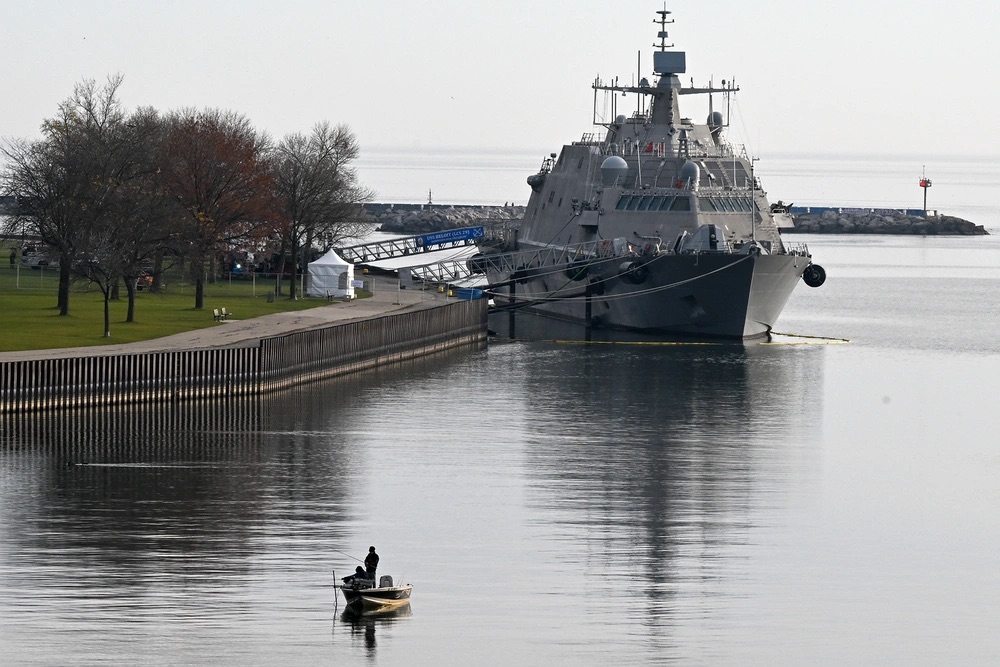
USS Beloit (LCS-29). Photo by EJ Hersom.

I’ve always known that they would try to expand their information operation to the other countries that are in ASEAN, just by following the SeaLight podcast. If not their information operation, regime change and terrorism (in Balochistan and Myanmar). I’ve also noticed that Powell has been referring to the Philippines’ “transparency initiative” as “non-violent resistance,” lately (RAND refers to it as “assertive transparency”). Ironic, considering that they’ve already succeeded in overthrowing the government of Bangladesh and are now attempting it in Cambodia, India and Pakistan. For those who don’t know about the regime change asset Gene Sharp and his neoliberal “nonviolence,” see the links on this page. Unfortunately, I don’t have as much time to dedicate to this right now due to other obligations.

Understanding and Countering China’s Maritime Gray Zone Operations | RAND

How the United States Can Support Allied and Partner Efforts to Counter China in the Gray Zone: Affirmative Engagement | RAND

RAND and SeaLight document (work in progress)

PART 2

Part 3a: RAND and SeaLight – Taiwan Relations Act

RAND and SeaLight Part 3b: Four Ways China Is Growing Its Media Influence in Southeast Asia