“The Biden administration’s decision to allow Ukraine to use longer-range ATACMS to launch strikes deep inside of Russia is strategically unwise and operationally unnecessary. The move will not meaningfully improve Ukraine’s military position, but it will intensify U.S. and NATO entanglement in the conflict and worsen the risk of Russian escalation—including possible retaliation on U.S. or European targets.
Leaked files show top UK military figures conspired to carry out the Kerch bridge bombing, covertly train “Gladio”-style stay-behind forces in Ukraine, and groom the British public for a drop in living standards caused by the proxy war against Russia.
…
Project Alchemy’s proposed schemes spanned every conceivable field of warfare, from cyber attacks to “discreet operations” to outright terrorism. The secret cell even put forward a plan to “aggressively pursue” and “dismantle” independent media outlets – including The Grayzone – through an aggressive campaign of legal harassment and online censorship, so they “would be forced to close.” The incendiary blueprints were fed to the highest levels of the British state and national security structure, where they were apparently well-received.
The WaPo report about a purported phone call “absolutely does not correspond to reality,” spokesman Dmitry Peskov has said
…
Russia, which currently has the advantage on the battlefield, has said that it will only accept an outcome that addresses the core causes of the Ukraine conflict. Those include NATO’s enlargement in Europe and Kiev’s discriminatory policies against ethnic Russians, according to Moscow.
The Washington Post reported a phone call between Trump and Putin based on accounts by sources “familiar with the matter,” who spoke on condition of anonymity.
Virtually forgotten due to the discourse of Ukrainian unity and the general lack of interest in analyzing the nuances of events, the racial and class question is going virtually unnoticed in this war. If the Donbass conflict had a proletarian aspect that the press mocked in the first weeks of the DPR due to those Soviet-looking press conferences of workers and academics, in the current context, there have not even been any such comments. Presented as a war of national liberation, no aspect other than nationalism has deserved much mention in the Western press or in academia. Volodymyr Ishchenko and Ilya Matveev, who have sought to study the class aspect in the outbreak of the conflict, are the rare exception. To Ischenko’s surprise, RFE/RL published an article last September that dealt, albeit in generalities and without great depth, with the increase in inequality that war implies, an aspect that is, on the other hand, perfectly evident. “As the war drags on, the gaps in Ukrainian society are widening,” the American media headlines.
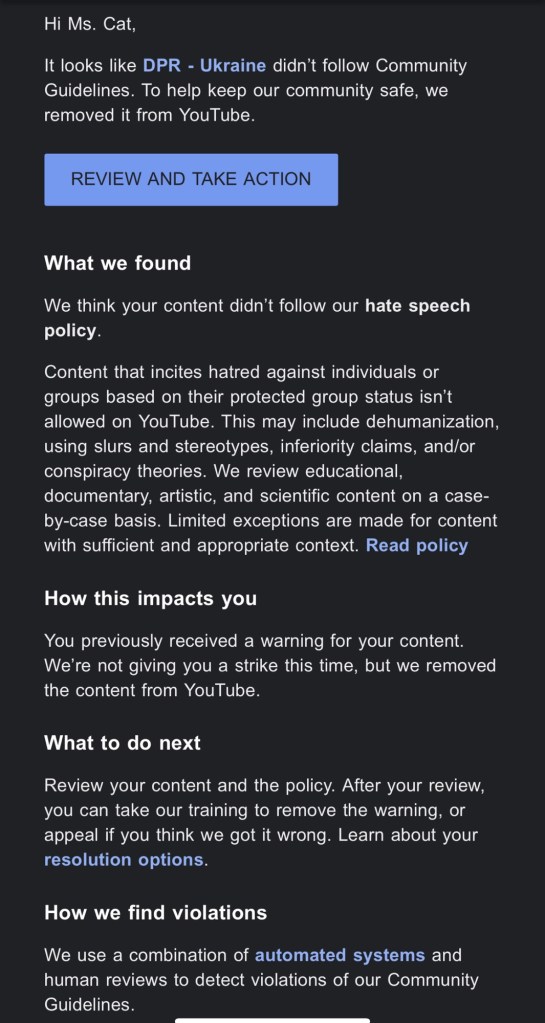
This is the second playlist that YouTube has deleted for hate speech. The first was my “Ukraine” playlist. I bet that they don’t do the same when someone calls Russians “Aliens” or “Klingons”!
After briefly presenting his Victory Plan at the seat of Ukraine’s national sovereignty, the Verkhovna Rada, Volodymyr Zelensky has continued his tour to try to win the support of the people and institutions that really matter – his foreign partners. In Brussels, the Ukrainian president sought to curry favour with one of his main suppliers, the current support of the Ukrainian state, the European Union, whose Parliament once again welcomed him as a hero. “The last time you were here,” wrote Roberta Metsola, “I promised you our unwavering support on your country’s path to EU membership. Today I am proud to welcome you to the House of European Democracy as the leader of a candidate country for EU membership.” “Ukraine is Europe,” she said, deliberately confusing the continent with the political bloc. However, with EU entry long understood as a decision that has been made and that it is simply a matter of time, Zelensky’s speech did not focus on the benefits of the Union or the enormous benefit that will be obtained by admitting Ukraine into the European family, but on the continuation of his campaign to formalize the Victory Plan as a possible way out of the war. Kiev is acting in the same way that in the last decade it has managed to institutionalize the nationalist discourse, previously only characteristic of a part of the country, as the only possible national discourse. Ukraine is working to achieve the same objective and to make its plan – in reality a wish list that its allies must help it to fulfill and not a roadmap to achieve them – appear as a path to a just peace.
“We hear the word negotiations from our partners, but the word justice is heard much less often,” Volodymyr Zelensky said yesterday in his speech to the Ukrainian Rada. “Ukraine is open to diplomacy, but honest diplomacy. That is why we have the Peace Formula. It is a guarantee of negotiating without forcing Ukraine to accept injustice. Ukrainians deserve a decent peace,” the Ukrainian president continued in his presentation of the Victory Plan to deputies and other authorities of the country’s political and security apparatus. Kiev’s intentions are clear: to achieve a position of strength in which Ukraine does not have to yield to Russian demands. Nothing indicates that there has been any change in the way of thinking of the Ukrainian leadership, which has always understood justice as something that only the part of the population under its control deserves, without those on the other side of the front and whose territories it aspires to recover having a say in the future of the country.
The United States is putting pressure on Zelensky to lower the age of conscription again, but for the moment the Ukrainian president is rejecting this possibility. This is what Ukrainian media such as Ukrainska Pravda reported this week, referring to the mobilization of men between 18 and 25 years old, a very small population group in which the country’s future cannot afford to lose. Even before the law on mobilization was approved, which is very unpopular despite not being as harsh as foreign allies demanded, prominent figures and self-proclaimed friends of Ukraine such as US Senator Lindsey Graham have publicly encouraged Ukraine to recruit those over 18 years old despite the demographic risk that this implies for the country they claim to defend. These suggestions seem to have become a demand that is confirmed even by people who belong to the state apparatus. “If this information has come to light, it may confirm that American politicians from both parties are putting pressure on President Zelensky on the question of why there is no mobilisation for those aged 18-25 in Ukraine,” said Serhiy Leshchenko, one of Andriy Yermak’s advisers and a figure who has gone from representing the third sector, civil society in Maidan Ukraine to all kinds of well-paid positions in government or in the few state-owned companies that Kiev has not yet privatised. The past ten years show a double standard between those who have been privileged and those who have been impoverished and marginalised thanks to the European and liberal reforms of the peacetime years. However, Ukraine’s refusal to recruit its most vulnerable population group strictly responds to the future needs of the state, which, if it hopes to rebuild itself, must maintain minimum levels of youth population.
Zelensky is going to give his “victory” speech on October 16 to Ukraine’s parliament, the Verkhovna Rada, but much of the speech will be secret. The secret part is about giving up territory to Russia.
…
The Rada has just passed new legislation that allows NATO officers to command Ukrainian units. So far, the Russians have been mostly quiet, probably because they do not believe NATO will supply field commanders for Ukraine’s military. But if it happens, and that is a big if, the Russians will see it as NATO sending combat troops and react accordingly.
Some speculate that Zelensky will hint at a desire to get some sort of ceasefire and establish a buffer zone patrolled by a kind of coalition of NATO-willing. This is being billed as a Zelensky “concession” to the reality of Russia occupying Ukrainian territory.
…
There also are rumors that Ukraine may try to attack Transnistria, the breakaway area of Moldova that includes a few thousand Russian troops – some of them on an agreed peace-keeping mission and others protecting a huge ammunition dump left over from the Soviet period.
…
The Russians also have been attacking dry cargo ships in the port of Odessa that are unloading weapons and military supplies from Turkey.
…
Moldova also has an important election on October 20. An attack on Transnistria could backfire and topple the current pro-NATO. pro-EU Moldovan government.
The Ukrainian government is considering options to end the war with Russia that would involve ceding territory, Der Spiegel reported on Sunday, citing a Ukrainian official.

 Ms. Cat’s Chronicles
You must be logged in to post a comment.