Within hours of the imposition of President Trump’s sweeping tariffs against the world, the impact was felt by autoworkers in North America, with the announcement of thousands of layoffs by Stellantis at plants in the United States, Canada and Mexico.
The background to the article reprinted here is the “long boom” of western capitalism during the 1950s and 1960s. It first appeared in International Socialism journal in Spring 1967. On the surface it appeared that the capitalist system had stabilised itself, had broken out of the boom-slump cycle and was now able to offer the workers of Western Europe and North America a steady increase in living standards.
This was a frustrating world for Marxists, who found themselves subject to two temptations. One was to surrender to the claims poured out by the system’s apologists that capitalism had solved its problems and that the path of gradual reform offered a sure road to socialism. The other was to deny the obvious signs of stability and prosperity and assert that capitalism was on the verge of imminent, catastrophic collapse. If these temptations were to be avoided, and Marx’s analysis of capitalism’s contradictions was to hold, then the long boom must be explained.
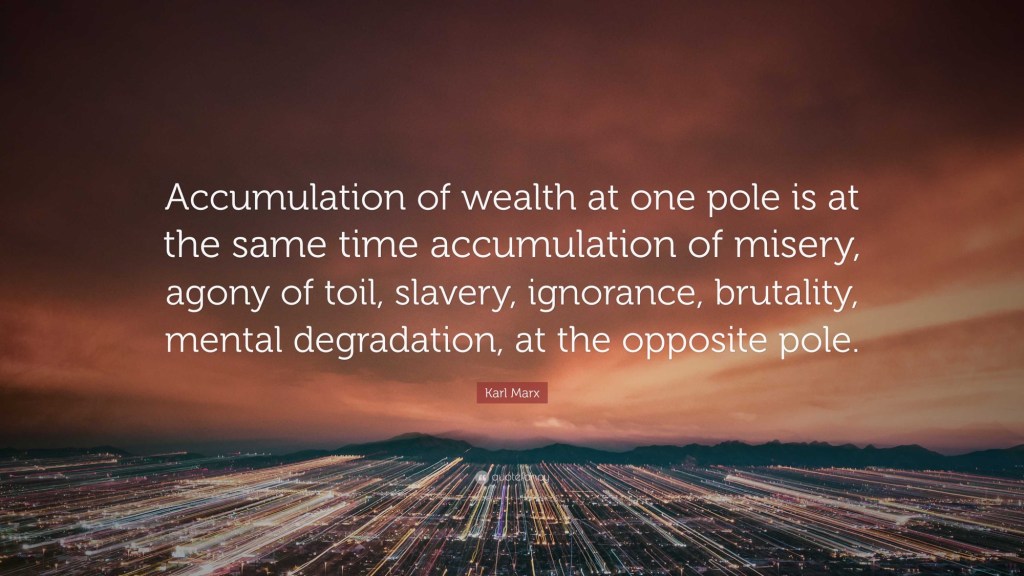
All these consequences are implied in the statement that the worker is related to the product of labor as to an alien object. For on this premise it is clear that the more the worker spends himself, the more powerful becomes the alien world of objects which he creates over and against himself, the poorer he himself – his inner world – becomes, the less belongs to him as his own. It is the same in religion. The more man puts into God, the less he retains in himself. The worker puts his life into the object; but now his life no longer belongs to him but to the object. Hence, the greater this activity, the more the worker lacks objects. Whatever the product of his labor is, he is not. Therefore, the greater this product, the less is he himself. The alienation of the worker in his product means not only that his labor becomes an object, an external existence, but that it exists outside him, independently, as something alien to him, and that it becomes a power on its own confronting him. It means that the life which he has conferred on the object confronts him as something hostile and alien.
Frontier of global anti-imperialist struggle: China’s perceptions of the Palestinian struggle from 1955 to 1976 China is probably one of few states which flipped its diplomatic stance on the “Palestinian-Israeli conflict” in the most dramatic manner from the 1950s to 1970s. In only 20 years, the People’s Republic of China (PRC)’s official foreign policy dramatically changed from almost establishing diplomatic relations with Israel in 1950 to denying any legitimacy of the Israeli state in the 1960s to 1970s. As I aim to demonstrate in this article, the Maoist era, especially from 1955 to 1976, established the foundation of China’s diplomatic support for the Palestinian liberation movement, and this legacy is still one of the main factors guiding China’s official stance on Palestine today.
As Mark Carney is installed into office, Johnny Vedmore explores his training at Harvard & Oxford, his secretive work on the collapse of the Russian economy, and his father’s relationship to the Canadian Catholic abuse scandal.
THE West Philippine Sea “cognitive warfare” narrative has been playing since Sept. 2012 when then President Noynoy Aquino signed Administrative Order 29 “Naming the West Philippine Sea of the Republic of the Philippines, and for other purposes.”
…
This has already caused massive real economic damage to Filipinos, like the loss of 1.5-million Chinese tourist arrivals and $1.5-billion (P90-billion) tourism revenues for our six million tourism workers.
Even worse, it can give the US the basis for creating a false flag operation blaming China for a human disaster and precipitating a major conflict – which is clearly what the US warmongers intend as evidenced by the US military bases in the country.
“Keep calm. Hasty emotions are unnecessary today,” wrote yesterday Mykhailo Podolyak, one of the most belligerent members of the Ukrainian government, reacting to the wave of pessimism and, at times, hysteria that spread across the European continent throughout the day yesterday, focusing on analyzing the implications of the telephone conversation between Vladimir Putin and Donald Trump and the subsequent statements by the president of the United States. “The Trump-Putin conversation reduces tension, but at the expense of Ukraine,” stated the British BBC before the political spin managed to create a continental crisis from an initial conversation whose only agreement is to continue talking. Because despite the adjectives that are being used to describe the contact between the two presidents or the way in which it occurred, the result of the call was the mutual reaffirmation of the importance of peace and the implementation of the mechanisms to schedule a meeting between the two leaders, which will presumably be in Saudi Arabia, and begin a negotiation process.




 Ms. Cat’s Chronicles
You must be logged in to post a comment.