Avoiding a climate lockdown 🧐💭

As the world faces three major threats, namely the COVID-19 induced public health and economic crises as well as the ongoing climate emergency, the business world is in a position to make real positive change.

Avoiding a climate lockdown (original)

H/T: Kim Iversen—The Next Agenda

Related:

A green economic renewal after the COVID-19 crisis (PDF)

WEF: Paris Is Planning To Become A ’15-minute City’

15-minute city:

A 15-minute city is a residential urban concept in which most daily necessities can be accomplished by either walking or cycling from residents’ homes. The concept (see also the New Urbanism of the 1980s) is present, among many, in D’Acci’s Isobenefit Urbanism since 2013 (“The Isobenefit Urbanism approach aims to create cities in which each dweller can do her/his usual main daily activities by walking or at maximum biking”) was popularized by Paris mayor Anne Hidalgo and inspired by French-Colombian scientist Carlos Moreno who in 2016 coined the term. 15-minute cities are built from a series of 5-minute neighborhoods, also known as complete communities or walkable neighborhoods. The concept has been described as a “return to a local way of life”.
Today’s Russia Is Upholding the Best of the Soviet Legacy

By Victoria Nikiforova – Dec 5, 2022

The following essay is written and published by a columnist at Russia’s main state media outlet, RIA Novosti. The essay provides an overview of the achievements and the lasting legacy of the Union of Soviet Socialist Republics (USSR) for today’s Russia and for the world. It is not a comprehensive history of the USSR; that is for historians to continue to write and debate. The essay’s most salient feature is the insight into the thinking of the people of the Russian Federation at this very turbulent turning point in their history.

The essay voices the wholesale loss of positive expectations of the Russian Federation people for the Western imperialist countries as the latter escalate their drive to isolate and weaken their country and its government. Many other such writings are appearing in Russian media. Altogether, they reflect a deepening understanding in Russian society that world imperialism—headed by the United States and including the major powers of Europe and Japan–is very much alive, dangerous, and, quite literally, out to get them. There is a profound upheaval taking place in the political thinking and the aspirations of the many peoples of the Russian Federation.

Today’s Russia Is Upholding the Best of the Soviet Legacy

Reciprocity: Zelensky Demanded Weapons from Netanyahu for Pro-Israel UN Vote

Reciprocity: Zelensky Demanded Weapons from Netanyahu for Pro-Israel UN Vote

In the previous anti-Israel UN vote (and most other UN votes), Ukraine voted against Israel. That did not go over well in Israel. Israel has also been a world leader in supplying Ukraine with humanitarian aid.

According to a report by Barak Ravid, Prime Minister Netanyahu spoke with Ukrainian President Volodymyr Zelenskyy on Friday evening asking Ukraine to vote against the UN resolution. Zelenskyy demanded reciprocity and a change in Israeli policy, asking Israel to supply defensive weapons to Ukraine, in particular, against Russian ballistic missiles and the Iranian suicide drones that Russia has been using to attack Ukraine.

Related:

PA Celebrating UN Resolution Asking ICC to Investigate Israel’s ‘Occupation’

The Foreign Ministry and Israel’s embassies lobbied some 100 countries. Prime Minister Benjamin Netanyahu, too, spoke with the leaders of several countries and managed to convince at least five leaders not to vote in favor of the decision – the leaders of Croatia, Togo, Greece, Romania, and Kenya. Former Prime Minister Yair Lapid also took part in the efforts, sending letters to more than 60 world leaders ahead of the vote.

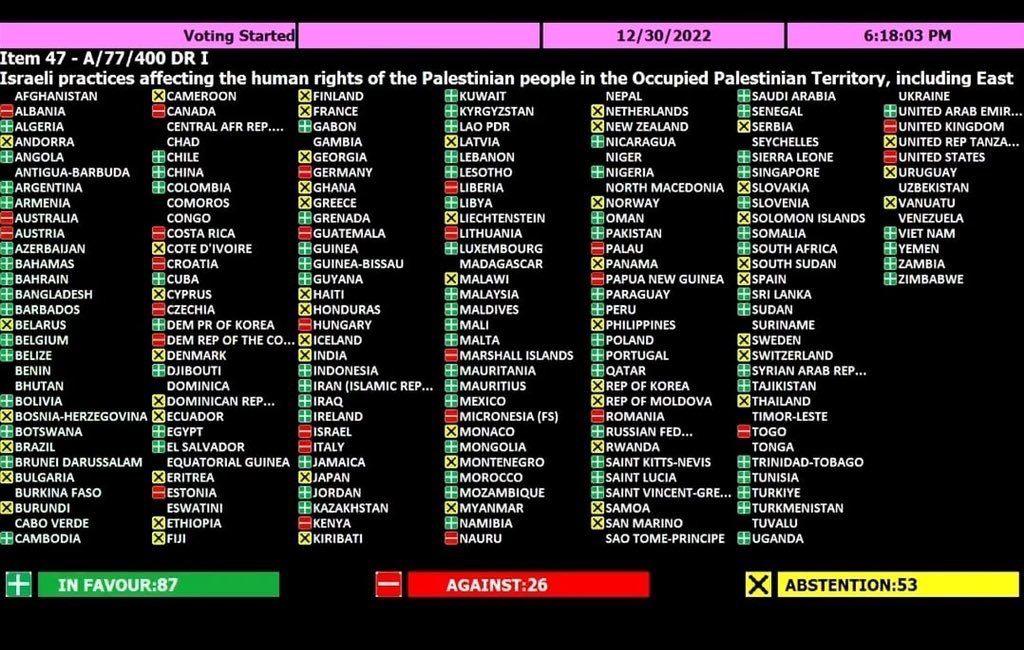
Israel, the US, and 24 other members––including the UK and Germany––voted against the resolution, while France was among the 53 nations that abstained. The US entered Israel’s nay vote since the resolution was passed on Shabbat, a move that UN Envoy Gilad Erdan called “shameful.”

[2018] The Wilson administration’s war on Russian Bolshevism

“The Time You Sent Troops to Quell the Revolution”

The United States invasion of Russia remains a hidden dimension of U.S. policy in the Great War, marking the beginning of a long Cold War. In August 1918, three months prior to the Armistice, the Wilson administration sent several platoons of U.S. soldiers into Russia to aid in the overthrow of the new Bolshevik government, which had come to power in the October Revolution of 1917. The operation was carried out alongside British, French, Canadian and Japanese forces in support of White Army counter-revolutionaries whose generals were implicated in wide-scale atrocities, including pogroms against Jews. This “Midnight War” was carried out illegally, without the consent of Congress. The Commanding General in Siberia, William S. Graves thought that his mission was to protect a delegation of Czech troops and the Trans-Siberian railway and to serve as a mediator. He was disappointed to learn that in fact the United States was enmeshed in another country’s civil war and came to oppose the whole operation. In his memoirs, he expressed “doubt if history will record in the past century a more flagrant case of flouting the well-known and approved practice in states in their international relations, and using instead of the accepted principles of international law, the principle of might makes right.”

The Wilson administration’s war on Russian Bolshevism

Rapidly Depleting Munitions Stockpiles Point to Necessary Changes in Policy

SUMMARY

U.S. munitions stockpiles are rapidly being depleted as the Ukraine war continues. Sufficient stockpiles of munitions are vital to the U.S. defense. Once the stockpiles are expended, the Department of Defense cannot simply buy more munitions—manufacturing takes years. Congress and the Department of Defense must ensure that the U.S. has sufficient stockpiles to meet the challenges of the modern era while working with manufacturers to make the industry as responsive as possible.

Rapidly Depleting Munitions Stockpiles Point to Necessary Changes in Policy

The alliance of MI6, the CIA and the Banderites

After having shown that the war in Ukraine was prepared by the Straussians and triggered on February 17 by Kiev’s attack on the Donbass, Thierry Meyssan returns to the secret history that links the Anglo-Saxons to the Banderites since the fall of the Third Reich. He sounds the alarm: we have not been able to see the resurgence of Nazi racialism in Ukraine and in the Baltic States for thirty years, nor do we see that many of the Ukrainian civilians we welcome are steeped in Banderites’ ideology. We are waiting for Nazi attacks to begin in Western Europe before we wake up.

The alliance of MI6, the CIA and the Banderites