The United States wants a multinational armed force in Haiti BUT…

The United States wants a multinational armed force in Haiti BUT…

The Biden administration is discussing with other nations to form a multinational armed intervention force, but the United States refuses to send its own troops. They supported a resolution in favor of a “rapid armed intervention force”, but the resolution is still not voted on at the UN Security Council, encountering reluctance from Russia and China.

Related:

Haiti Still Needs Foreign Strike Force to Confront Gangs, Official Says

How the NED has Sabotaged Haitian Democracy and Sovereignty

French ambassador: US ‘rules-based order’ means Western domination, violating international law

France’s ex US Ambassador Gérard Araud criticised Washington for frequently violating international law and said its so-called “rules-based order” is an unfair “Western order” based on “hegemony.” He condemned the new cold war on China, instead calling for mutual compromises.

French ambassador: US ‘rules-based order’ means Western domination, violating international law

Inside the Trilateral Commission: Power elites grapple with China’s rise

Inside the Trilateral Commission: Power elites grapple with China’s rise (original)

Each new candidate for Commission membership is carefully scrutinized before being allowed entry. As a rule, members who take up positions in their national governments — which is uncannily common — give up their Trilateral Commission membership while in public service. Those include U.S. Secretary of State Antony Blinken, Jake Sullivan, the U.S. national security adviser, Danish Prime Minister Mette Frederiksen and Indian External Affairs Minister Subrahmanyam Jaishankar.

This revolving door between the commission and senior government ranks has always been fodder for conspiracy theorists. Its first director in 1973, Zbigniew Brzezinski, later became U.S. President Jimmy Carter’s national security adviser. The very existence of the commission, meanwhile, seems predicated on the question of whether governing should be left to the people. It is a question the commission itself has tackled head-on since 1975: Is democracy functioning? Or does someone need to guide it?

That year, three scholars — Michel Crozier, Samuel Huntington and Joji Watanuki — wrote a report for The Trilateral Commission titled “The Crisis of Democracy.” In it, Huntington wrote that some of the problems of governance in the U.S. stem from an “excess of democracy.”

Related:

The Crisis of Democracy – Trilateral Commission – 1975

Third countries secretly arming Ukraine – Kiev

Third countries secretly arming Ukraine – Kiev

“Most of these third countries publicly say that they do not supply anything, but everything is happening behind the scenes,” he said without going into specifics about which nations are purportedly secretly bolstering Kiev during its conflict with Moscow.

[Dmytro] Kuleba’s comments come amid mounting reports that Ukraine’s backers, including a number of NATO countries, are experiencing shortages of weaponry due to their continuous support for Kiev.

According to a recent piece by the New York Times*, for instance, only “larger” NATO allies, such as France, Germany, Italy, and the Netherlands, still retain the capability to maintain or even potentially increase weapon shipments to Ukraine.

Previously:

*U.S. and NATO scramble to arm Ukraine and refill their own arsenals

Smaller countries have exhausted their potential, another NATO official said, with 20 of its 30 members “pretty tapped out.” But the remaining 10 can still provide more, he suggested, especially larger allies. That would include France, Germany, Italy and the Netherlands.

U.S. and NATO scramble to arm Ukraine and refill their own arsenals

Either this narrative about weapon stockpiles, being depleted, is part of the information war or Russia is demilitarizing NATO!?!

U.S. and NATO scramble to arm Ukraine and refill their own arsenals

In Ukraine, the kind of European war thought inconceivable is chewing up the modest stockpiles of artillery, ammunition and air defenses of what some in NATO call Europe’s “bonsai armies,” after the tiny Japanese trees. Even the mighty United States has only limited stocks of the weapons the Ukrainians want and need, and Washington is unwilling to divert key weapons from delicate regions like Taiwan and Korea, where China and North Korea are constantly testing the limits.

So the West is scrambling to find increasingly scarce Soviet-era equipment and ammunition that Ukraine can use now, including S-300 air defense missiles, T-72 tanks and especially Soviet-caliber artillery shells

There are even discussions about NATO investing in old factories in the Czech Republic, Slovakia and Bulgaria to restart the manufacturing of Soviet-caliber 152-mm and 122-mm shells for Ukraine’s still largely Soviet-era artillery armory.

The European Union has approved €3.1 billion ($3.2 billion) to repay member states for what they provide to Ukraine, but that fund, the [ironically-named] European Peace Facility, is nearly 90 percent depleted.

Smaller countries have exhausted their potential, another NATO official said, with 20 of its 30 members “pretty tapped out.” But the remaining 10 can still provide more, he suggested, especially larger allies. That would include France, Germany, Italy and the Netherlands.

NATO’s secretary general, Jens Stoltenberg, has advised the alliance — including, pointedly, Germany — that NATO guidelines requiring members to keep stockpiles should not be a pretext to limit arms exports to Ukraine. But it is also true that Germany and France, like the United States, want to calibrate the weapons Ukraine gets, to prevent escalation and direct attacks on Russia.

Washington is also looking at older, cheaper alternatives like giving Ukraine anti-tank TOW missiles, which are in plentiful supply, instead of Javelins, and Hawk surface-to-air missiles instead of newer versions. But officials are increasingly pushing Ukraine to be more efficient and not, for example, fire a missile that costs $150,000 at a drone that costs $20,000.

Colombia’s First Leftist President Charts a New Path on Venezuela + Government of Venezuela and Opposition Resume Mexico Talks

Colombia’s First Leftist President Charts a New Path on Venezuela

While critics derided the meeting as just another propaganda spectacle for Maduro, Petro has sent a signal to opposition parties in Colombia and the international community, particularly the United States, to rethink its approach if they hope to improve relations and achieve a successful political transition in Venezuela.

Related:

The recognition of Juan Guaidó as interim president of Venezuela will end in 2023, according to two sources close to the opposition

Guaidó’s possible change of status occurs just as the opposition coalition establishes the rules to select the unitary candidate who will compete in the next presidential elections in 2024.

So Biden can support a new interim president for Venezuela.

Government of Venezuela and Opposition Resume Mexico Talks: What Is on the Table? (+Alex Saab)

Still skeptical of Gustavo Petro.

Who are the Ukrainian integral nationalists?

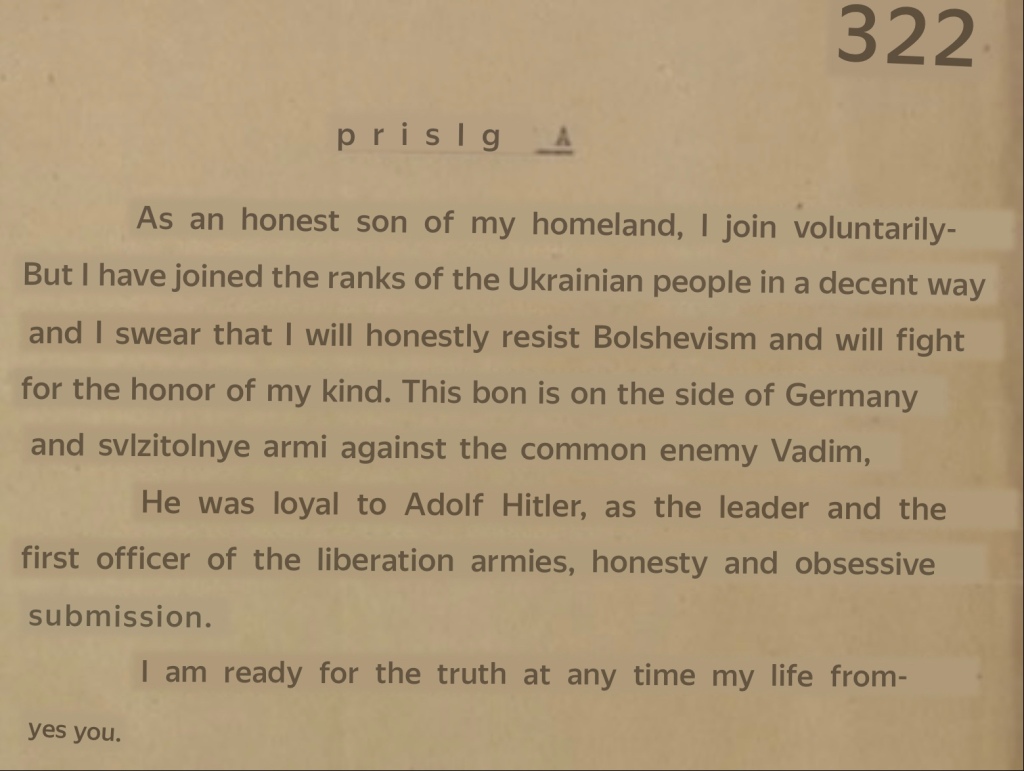
Who knows the history of the Ukrainian “integral nationalists”, “Nazis” according to the terminology of the Kremlin? It begins during the First World War, continues during the Second, the Cold War and continues today in modern Ukraine. Many documents have been destroyed and modern Ukraine forbids under penalty of imprisonment to mention their crimes. The fact remains that these people massacred at least four million of their compatriots and conceived the architecture of the Final Solution, that is, the murder of millions of people because of their real or supposed membership in the Jewish or Gypsy communities of Europe.

Who are the Ukrainian integral nationalists?
The oath of loyalty to Führer Adolf Hitler by members of the OUN.
Machine translation by Yandex.

H/T: THE NEW DARK AGE

Previously:

Nazism in eastern Europe (and the US)

Notes for self:

Read More »