


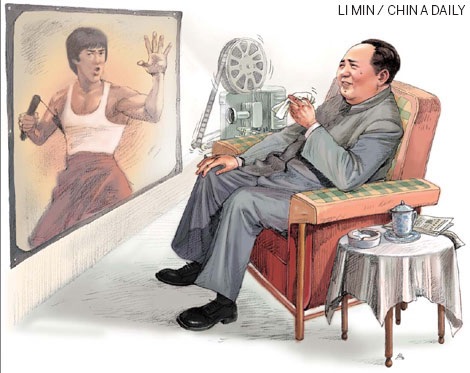
The Bruce Lee legend never fades but it might surprise some to learn that among his legion of fans was Chairman Mao, who called him a hero.
Chairman Mao Zedong (1893-1976) and Bruce Lee the martial arts legend (1940-1973) both declared – in their unique ways – that the Chinese people had “stood up”.
The man who was Mao’s hero
I grew up watching dubbed martial arts movies, as my dad was a fan of Bruce Lee.
FYI, I don’t know why this was unpublished. I didn’t do it.
April 28, 2024 by Mauro Gia Samonte
BRIGHT as the sun shines, this is what will happen in our country when the war that the United States has planned to detonate in the Philippines since 2014 breaks out. In the said year, America planned the war in Ukraine. It came true. In the same year, America planned Israel’s war against Hamas. It came true. The parallel plan made in the Philippines by America is what is contained in the Enhanced Defense Cooperation Agreement (EDCA) obtained by the United States (US) in the administration of Benigno Aquino III in 2014. Under the agreement, the US was granted five military base of the Armed Forces of the Philippines (AFP) to deploy American troops and military equipment that is unlimited in number and cannot be inspected by the Philippine authorities. Entering 2023, the five EDCA bases were increased by Bongbong by four more, which really boiled the tension in the South China Sea. China could not hide its simmering anger.
“Don’t be an idol in America,” the Chinese Foreign Ministry warned the Philippines.
Although the agreement states that nuclear weapons cannot be deployed at EDCA bases, the Philippine authorities have no way to ensure that this will be followed because of the EDCA provision that such American deployments cannot be inspected by the Filipino authority. Based on the double (treasonous) American face in world politics, it can be expected that at the EDCA bases nuclear weapons are already present and deployed, ready to be launched at any time needed.
Read More »
April 17, 2024
Secretary of the Navy Carlos Del Toro and senior members of his staff met with Wisconsin Governor Tony Evers, members of Michigan Governor Gretchen Whitmer’s cabinet, and the leadership of Fincantieri Marinette Marine to coalesce federal, state, and local initiatives to ensure timely completion and delivery of the Constellation-class frigate.
SECNAV Del Toro Meets with Wisconsin Governor, Michigan Cabinet, and Leadership of Fincantieri Marinette Marine
Previously:
Biden wants to hike tariffs on imports of Chinese steel and aluminum
Chinese steel imports account for less than 1% of U.S. demand, officials told reporters. But Chinese subsidies and programs mean its steel prices are 40% lower than U.S. prices, and the Biden administration is worried that there could be a surge of exports.
Related:
Trump’s tariffs are equivalent to one of the largest tax increases in decades
New Democrat Coalition Trade Task Force Statement on Section 301 Tariffs Announcement
US to change Japan command posture to boost deterrence in face China -US envoy
Sources with knowledge of the planning have told Reuters Washington will consider appointing a four-star commander for Japan to match the rank of the head of Japan’s new military headquarters. Experts say a U.S. officer of that rank could lay the groundwork for a future unified Japanese-U.S. command.
Related:
A Vital Next Step for the U.S.-Japan Alliance: Command and Control Modernization
Reimagining U.S. Forces Japan
The current structure of alliance command and control is not sufficient for the task. U.S. Forces Japan (USFJ) has changed little since the 1960s, when Japan was viewed as little more than a platform for U.S. military operations across the region. USFJ’s authorities and staffing are limited primarily to administering alliance agreements related to the 50,000-plus U.S. personnel stationed in Japan with the U.S. Navy, Marine Corps, Air Force, and Army. U.S. forces in Japan represent some of the most important U.S. military capabilities in the Indo-Pacific, but the three-star USFJ commander has limited joint operational authorities, and the separate U.S. service elements in Japan report back to their component headquarters in Hawaii.


 Ms. Cat’s Chronicles
You must be logged in to post a comment.