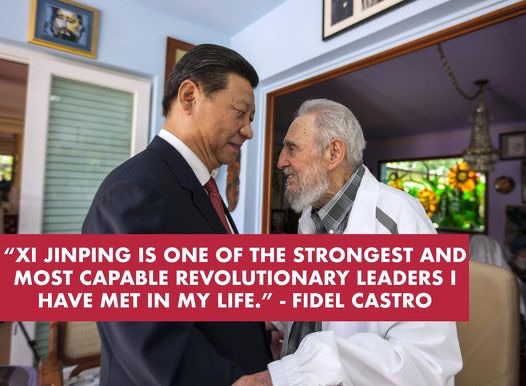
Twenty-six million Russians died in the defense of their homeland against the Nazis. Chinese combatants, men and women, inheritors of a millennial culture, are people of uncommon intelligence and an invincible spirit of struggle. Xi Jinping is one of the strongest and most capable revolutionary leaders I have met in my life.
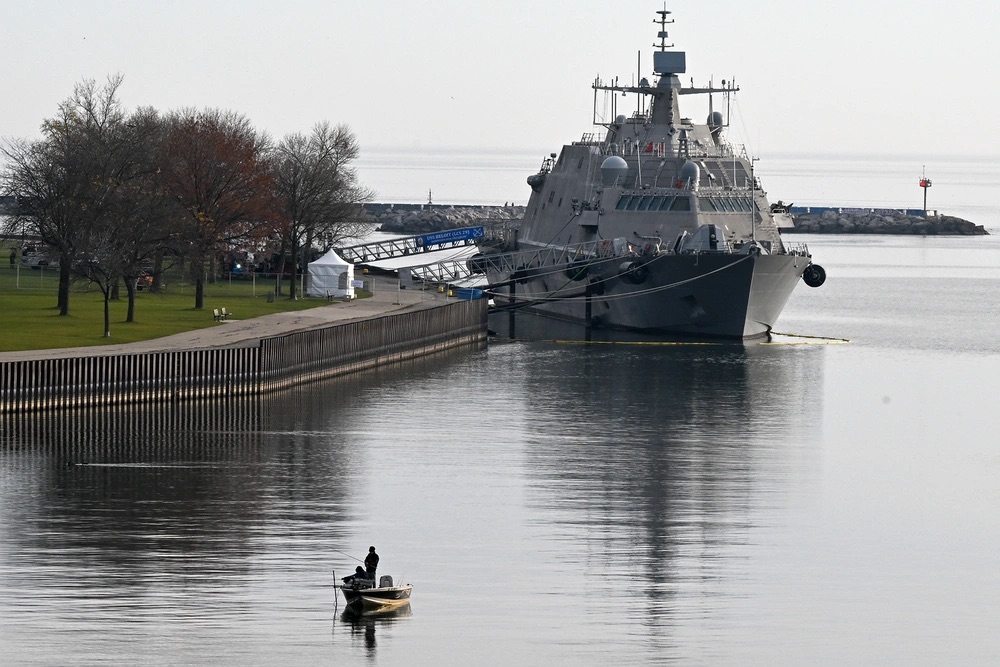
MANILA, Philippines — A United States Naval Ship (USNS) was spotted near the country’s landmass while China Coast Guard (CCG) was conducting what it considers as a patrol around Panatag (Scarborough) Shoal on Sunday morning, a West Philippine Sea monitor said.
As geopolitical tensions escalate, the U.S. wields its most formidable weapon—not military might, but a sophisticated network of political and informational control that reshapes nations and regions to serve its interests
The ban will challenge many semiconductor manufacturers in the coming months. After two years of flat consumer demand, exacerbated by the global semiconductor shortage, many companies are predicted to struggle to stay afloat. Access to critical raw materials like gallium, germanium, and antimony is becoming increasingly important due to the heightened demand for electronics due to AI.
TAIPEI (Taiwan News) — A Taiwan-US poll found that Taiwanese and Americans differ on whether Washington would send troops if Beijing launches an invasion, but both support maintaining the status quo.
On Monday (Dec. 2), the Ministry of National Defense’s Institute for National Defense and Security Research and the Chicago Council on Global Affairs released the results of a joint survey that examined how Taiwanese and Americans view the Taiwan Strait situation and bilateral security cooperation.
The Navy wants to use XLUUVs to, among other things, covertly deploy the Hammerhead mine, a planned mine that would be tethered to the seabed and armed with an antisubmarine torpedo, broadly similar to the Navy’s Cold War-era CAPTOR (encapsulated torpedo) mine.
I’ve always known that they would try to expand their information operation to the other countries that are in ASEAN, just by following the SeaLight podcast. If not their information operation, regimechange and terrorism (in Balochistan and Myanmar). I’ve also noticed that Powell has been referring to the Philippines’ “transparency initiative” as “non-violent resistance,” lately (RAND refers to it as “assertive transparency”). Ironic, considering that they’ve already succeeded in overthrowing the government of Bangladesh and are now attempting it in Cambodia, India and Pakistan. For those who don’t know about the regime change asset Gene Sharp and his neoliberal “nonviolence,” see the links on this page. Unfortunately, I don’t have as much time to dedicate to this right now due to other obligations.
NET foreign direct investments (FDI) remained positive in September but were markedly lower compared to a year ago, the Bangko Sentral ng Pilipinas (BSP) reported on Tuesday.
…
“Investors often prefer safe-haven assets in advanced economies under these conditions,” he explained, adding that heightened geopolitical tensions and economic uncertainties may have also further dampened investor confidence globally.



 Ms. Cat’s Chronicles
You must be logged in to post a comment.