Vietnam has jailed five party members for feeding information to Duong Van Thai, a blogger who is believed to have been abducted in Thailand last year and resurfaced in Vietnamese custody, the human rights group 88 Project reported, citing sources inside the government.
In addition to the 12 industrial parks built by the government and managed by the Industrial Parks Development Corporation and regional governments and the Diredawa Free Trade Zone, there are also industrial parks built and managed by private investors in various areas of Ethiopia. One of these private industrial parks is Eastern Industry Park. The industrial park is located in Dukem area, and 153 companies are engaged in production activities in the park. 95% of the companies are owned by Chinese investors, while the rest are owned by companies from India, England, and other countries. These producers are contributing significantly in terms of job creation, foreign exchange earnings, technology, and knowledge transfer.
In the second group on your list, you raise the question of “restricting alien parties”, that is, the question of the friction in various localities. Your concern over this matter is justified. There has been some improvement recently, but fundamentally the situation remains unchanged. Question: Has the Communist Party made its position on this question clear to the Central Government? Answer: We have protested. Question: In what way? Answer: Our Party representative, Comrade Chou En-lai, wrote a letter to Generalissimo Chiang Kai-shek as early as July. Then again on August 1, people from all walks of life in Yenan sent a telegram to the Generalissimo and the National Government, demanding the withdrawal of the “Measures for Restricting the Activities of Alien Parties”, which had been secretly circulated and which are at the very root of the “friction” in various places. Question: Has there been any reply from the Central Government? Answer: No. But it is said that there are also people in the Kuomintang who disapprove of these measures. As everybody knows, an army that participates in the common fight against Japan is a friendly army, not an “alien army”, and similarly, a political party that participates in the common fight against Japan is a friendly party, not an “alien party”. There are many parties and groups taking part in the War of Resistance and, while they vary in strength, they are fighting in the same cause; surely they must all unite and must in no circumstances “restrict” one another. Which party is an alien party? The party of the traitors headed by Wang Ching-wei, the running dog of Japan, because it has nothing in common politically with the anti-Japanese parties; that is the kind of party which should be restricted. Between the Kuomintang and the Communist Party there is common political ground, namely, resistance to Japanese aggression. Therefore, the problem is to concentrate all our strength on opposing and checking Japan and Wang Ching-wei, and not on opposing and checking the Communist Party. This is the only basis for formulating correct slogans. Wang Ching-wei has three slogans: “Oppose Chiang Kai-shek,” “Oppose the Communist Party”, and “Be friends with Japan”. Wang Ching-wei is the common enemy of the Kuomintang, the Communist Party and the entire people. But the Communist Party is not the enemy of the Kuomintang, nor is the Kuomintang the enemy of the Communist Party; they should unite and help each other rather than oppose or “restrict” each other. The slogans on our side must be different from Wang Ching-wei’s, they must be the opposite of his and never be confused with them. If he says, “Oppose Chiang Kai-shek”, everyone should support Chiang Kai-shek; if he says, “Oppose the Communist Party”, everyone should unite with the Communist Party; and if he says, “Be friends with Japan”, everyone should resist Japan. We should support whatever the enemy opposes and oppose whatever the enemy supports. In articles nowadays people often quote the saying, “Do not sadden your friends and gladden your enemies.” It comes from a letter which Chu Fou, a general under Liu Hsiu of the Eastern Han Dynasty, wrote to Peng Chung, the prefect of Yuyang. In context it reads, “Whatever you do, you must be sure that you do not sadden your friends and gladden your enemies.” Chu Pou’s words express a clear-cut political principle which we must never forget.
Maritime clashes between the Philippines and China had been mostly over the Philippines’ military outpost, BRP (BRP—Barko ng Republika ng Pilipinas, which translates to “Ship of the Republic of the Philippines”—the ship prefix for the Philippines) Sierra Madre, in the Spratly Islands, which is disputed by Brunei, China, Malaysia, the Philippines, Taiwan (a province of China, as recognized by the United Nations’ Resolution No. 2758), and Vietnam. The BRP Sierra Madre was intentionally run aground on a reef near the Second Thomas Shoal in the disputed Spratly Islands, in 1997, so that the Philippines could stake their territorial claim.
The Navy oiler – a tanker designed to refuel other ships while at sea – shuddered from the hit. Almost immediately, water began to flood into the engine room and at least one of the ship’s rudders was out of service. The damage and flow of water proved challenging for the crew. As the only US Navy fuel ship in the area capable of supporting a carrier strike group came to a stop, the vulnerability of the thin lifeline of American afloat logistics became apparent. How would an entire carrier strike group remain operational without fuel for its planes and escorts? With one stroke, the hitting power of a substantial portion of the U.S. Navy was reduced.
According to Japanese media, the US Space Force has stood up its most recent overseas component in Japan. This follows a similar component created in South Korea, both falling under its “Indo-Pacific” component command created in 2022.
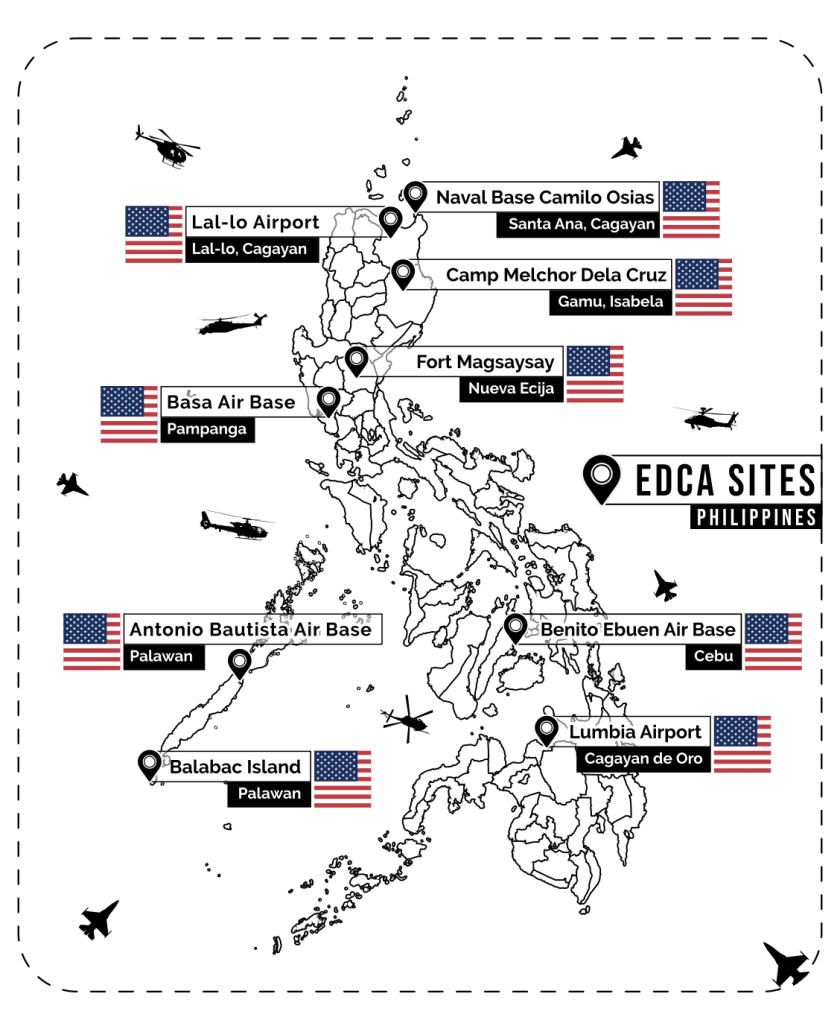
The outright re-establishment of US military bases in the country and its relentless and escalating war games on land, sea, and air are flagrant manifestations of US imperialist domination of the Philippines. This further tightens the grip of US imperialism on the Philippine neocolonial state, especially on the puppet Armed Forces of the Philippines (AFP).





 Ms. Cat’s Chronicles
You must be logged in to post a comment.