
August 2, 2021 By Stephen Sefton
Early in July this year Hezbollah’s Secretary General Sayyed Hassan Nasrallah spoke to a conference in which he outlined the main elements of the region’s Resistance Axis’ media and communications strategy. He stressed the rightness of the Resistance cause challenging Western imperialism, in particular Israel’s genocidal, colonialist settler occupation of Palestine. He pointed out the strength, unity and resilience of the Axis, led by Iran and Syria, but including Hezbollah itself and allied movements in Lebanon, Iraq, Palestine and Yemen. Nasrallah also emphasized the importance of the Resistance Axis leadership’s determination to report the facts of events in the region truthfully with rigorously honesty when offering analysis.
Defending Latin America’s Resistance Axis
Category: Latin America
Targeting Cuba and China: Disinformation against Communism
One of the filters in the Propaganda Model propounded by professors Edward Herman and Noam Chomsky was stoking a fear of communism. [1] The establishment’s anti-communism has never abated in the United States. The elitists require a populace fearful of communism to protect their own misbegotten wealth accumulation. Thus, the bugaboo of communism must be opposed wherever it arises. At its worst, the US would wage war against communist countries such as North Korea, Viet Nam, Cambodia, and Yugoslavia. When not militarily attacked, communist governments will be demonized by a relentless campaign of disinformation designed to bring about the fall of the government and its replacement by a government amenable to the US establishment, as happened in the Soviet Union. That is the nature of imperialism and predatory capitalism.
Targeting Cuba and China: Disinformation against Communism
Is China Transforming the World?
Is China Transforming the World?
From speeches by president Xi Jinping, including the one he gave at the World Economic Forum in Davos in 2017, journalists only wanted to retain his support of globalization—that is, his praise of free trade without obstacles—and a denunciation of protectionism. It is clear that the Chinese president was saying that “economic globalization has provided a powerful driving force for world growth, by facilitating the movement of capital and goods, the advancement of science, technology and human civilization, as well as exchanges between peoples.”1. What a sweet song in the ears of the neoliberals! Nevertheless, we should not hide the setbacks and problems, also underlined in this same speech: “Globalization is a double-edged sword.… The contradiction between capital and labor is accentuated.… The gaps between the rich and the poor, between the North and the South, are constantly widening.… The richest [elements] represent 1 percent of the world’s population, but have more wealth than the remaining 99 percent.”2
Related:
Peru To Withdraw From the US-Controlled Lima Group
teleSUR | August 2021
On Tuesday, Peru’s Foreign Affairs Minister Hector Bejar announced that his country would withdraw from the Lima Group, which supported the Venezuelan opposition to overthrow the Bolivarian Revolution in 2019.
Peru To Withdraw From the US-Controlled Lima Group
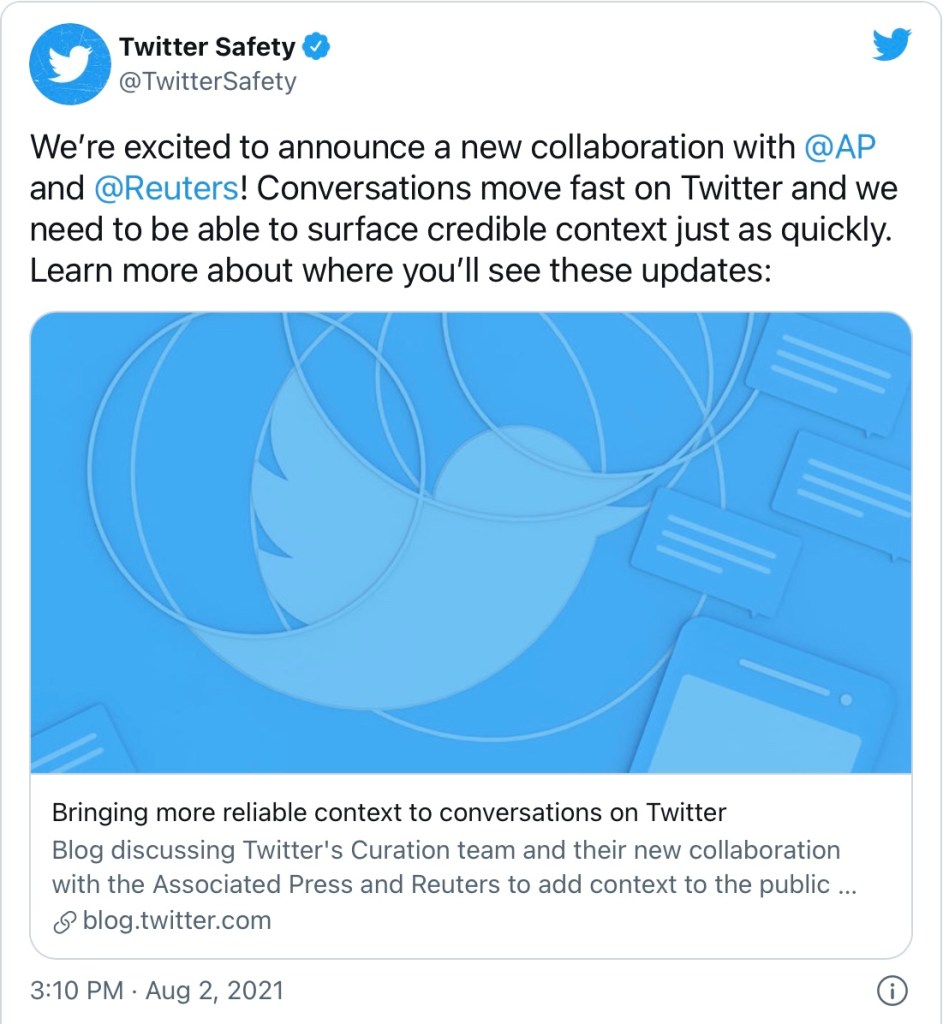
Twitter partners with UK govt-backed, CIA-linked Reuters to censor alternative views
Why Isn’t U.S. Policy Toward Nicaragua Working?
After the U.S.-Russian summit in June, there was no apparent irony in President Biden’s response to a question about electoral interference. “Let’s get this straight,” he said. “How would it be if the United States were viewed by the rest of the world as interfering with the elections directly of other countries, and everybody knew it?” But of course much of the world does take this view; by one count the United States has intervened in no fewer than 81 elections between 1946 and 2000, many of them in Latin America. Biden’s question reveals a fundamental gap in U.S. foreign policymaking: Why do its leaders appear unable to judge how U.S. actions are seen by ordinary people in the countries they affect?
Why Isn’t U.S. Policy Toward Nicaragua Working?
Alberto Fernández says that the OAS became a “squad” against popular governments in Latin America and “as it is, it is useless”
US Targets Nicaraguan Presidential Election
Bolsonaro And The CIA Conspire Against “New Pink Tide” In South America
Argentina Military Aid For Bolivia Coup Greater Than Initially Thought
Kawsachun News
Investigations carried out by Argentina’s Security Ministry have revealed that the military aid sent from Mauricio Macri’s government to the Añez regime was much larger than what had been published by Bolivia’s Foreign Ministry.
Argentina Military Aid For Bolivia Coup Greater Than Initially Thought
 Ms. Cat’s Chronicles
You must be logged in to post a comment.