The People’s Liberation Army Navy Z-9 utility helicopter that intercepted the Philippine Cessna. Photo Courtesy of Camille Elemia.
…
A People’s Liberation Army Navy Z-9 utility helicopter intercepted the Bureau of Fisheries and Aquatic Resources Cessna 208B Grand Caravan during a routine patrol mission over Scarborough Shoal today at 8:39 a.m. local time, according to Philippine officials. A number of Philippine journalists [embedded journalists] were on board the Cessna during the encounter, which saw the Chinese helicopter fly as close as three meters from the turboprop aircraft. Philippine Coast Guard spokesperson Commodore Jay Tarriela described China’s actions as “dangerous flight maneuvers” and blasted the conduct as a disregard to international aviation regulations.
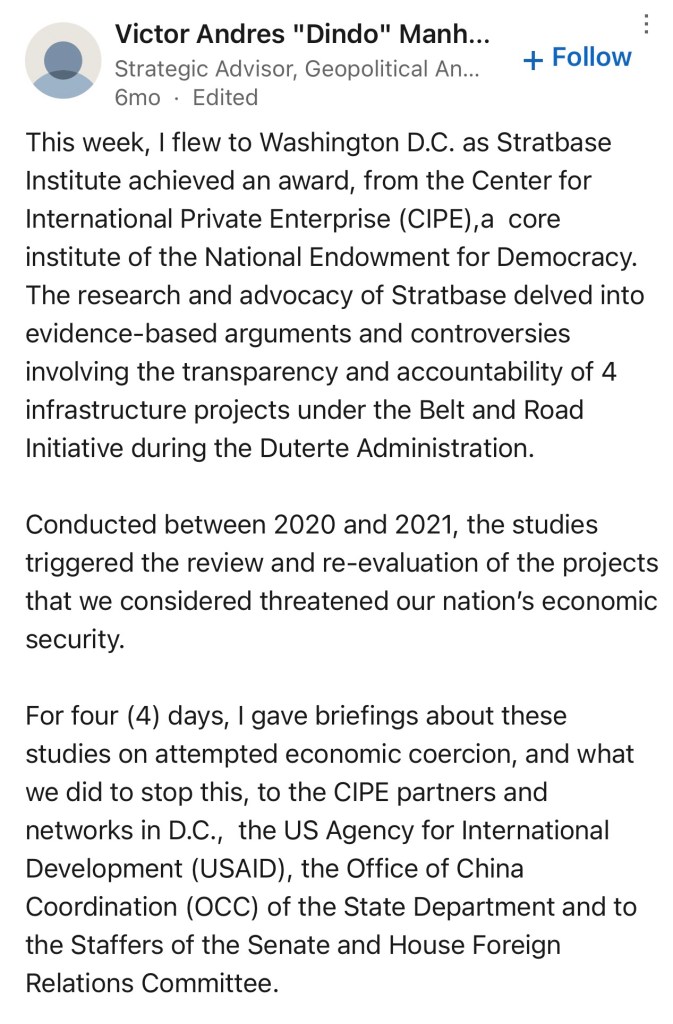
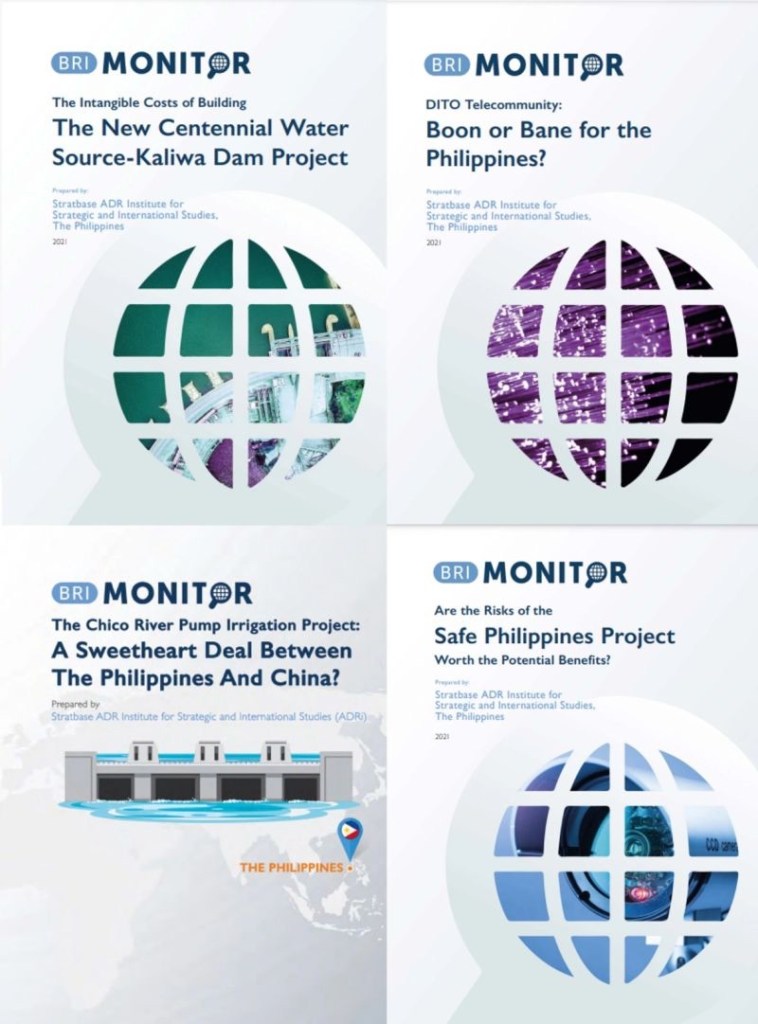
Our organization, the Stratbase ADR Institute, received an award from the prestigious Center for International Private Enterprise (CIPE), one of the four core institutes of the National Endowment for Democracy in Washington, DC. We were recognized for our research, advocacy, and strategic communication on four infrastructure projects entered into by the Philippines, during the administration of former President Rodrigo Duterte, under the Belt and Road Initiative of China.
…
The Philippines has currently withdrawn from the Belt and Road Initiative and the current administration has been careful to consider other partners aside from China.
…
Victor Andres “Dindo” C. Manhit is the president of the Stratbase ADR Institute.
Just like the National Endowment for Democracy, CIPE has been scrubbing their website. Search for the Philippines and click on the results. Most of the links are missing.
China’s most straightforward method of media outreach is directly broadcasting or publishing its state media content in target ASEAN countries. Xinhua, China’s official state media agency, has print bureaus in every Southeast Asian country. TV news channels CCTV-4 and the English-language CGTN likewise operate in nearly every country in the region, while China Radio International airs multilingual content in Vietnam, Laos, Cambodia, Thailand, and Myanmar. Xinhua is a ministry-level agency directly under the State Council, while the other media organizations all operate under the Chinese Communist Party Publicity Department.
Senior Col. Wu Qian, a spokesman for China’s Ministry of National Defense, accused the Philippines of causing disturbances in various areas with the support and encouragement of the United States.
“From Ren’ai Jiao (Ayungin Shoal) to Xianbin Jiao (Sabina Shoal) and from Houteng Jiao to Huangyan Dao (Scarborough Shoal), such repeated provocations have allowed the international community to see clearly who is undermining peace and stability in the South China Sea and who is fabricating and spreading lies,” Wu said.
I’ve always known that they would try to expand their information operation to the other countries that are in ASEAN, just by following the SeaLight podcast. If not their information operation, regimechange and terrorism (in Balochistan and Myanmar). I’ve also noticed that Powell has been referring to the Philippines’ “transparency initiative” as “non-violent resistance,” lately (RAND refers to it as “assertive transparency”). Ironic, considering that they’ve already succeeded in overthrowing the government of Bangladesh and are now attempting it in Cambodia, India and Pakistan. For those who don’t know about the regime change asset Gene Sharp and his neoliberal “nonviolence,” see the links on this page. Unfortunately, I don’t have as much time to dedicate to this right now due to other obligations.
New laws specifying Manila’s claims have also angered smaller countries such as Malaysia, which could hamper unified resistance to China’s attempts at regional dominance.









 Ms. Cat’s Chronicles
You must be logged in to post a comment.