Philippines’ Aggressive Territorial Claims In South China Sea: A New Threat to Regional Stability

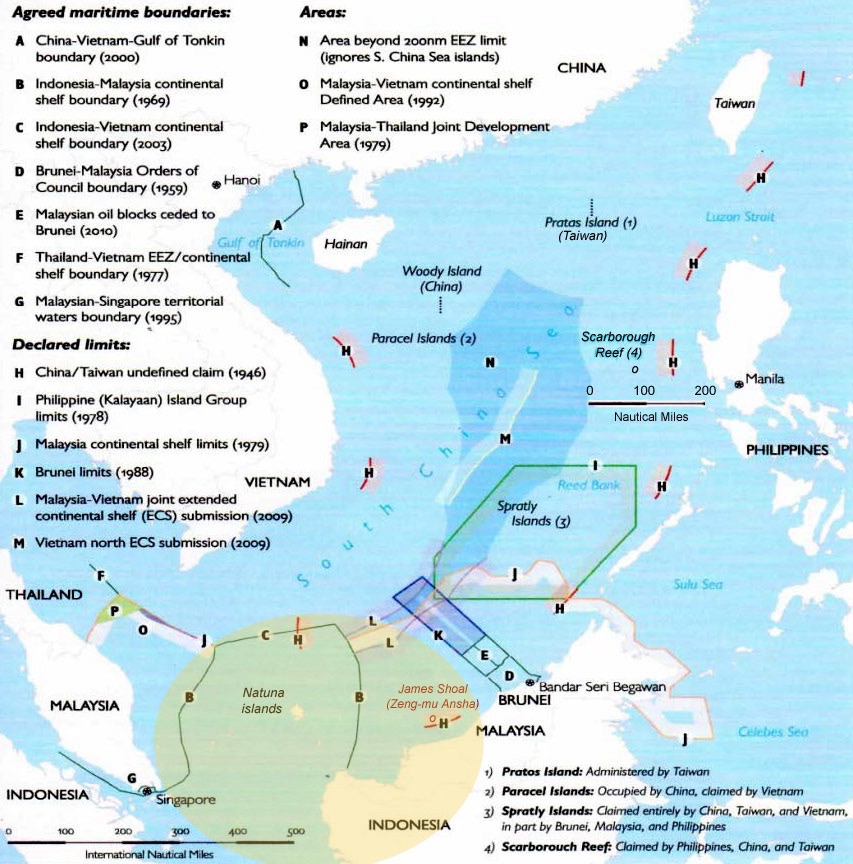
Philippine President Ferdinand Marcos Jr. has appointed a new Navy chief (Rear Admiral Jose Ma. Ambrosio Ezpeleta) amid tensions in the South China Sea, which include a number of maritime drills which are perceived as provocations by Beijing. One such military exercise earlier this month, for instance, included drills to simulate seizing an island in the disputed South China Sea. Last month Manila held military exercises in the same Sea together with Canada, Japan, and the United States, as part of Exercise Sama Sama 2024. The Philippines are also officially expanding their maritime claims. These developments are all connected.

Philippines’ Aggressive Territorial Claims In South China Sea: A New Threat to Regional Stability (archived)

Related:

What’s Really Going On In the South China Sea Between the Philippines and China

China looks to Indonesia for diplomatic resolution after coastguards’ Natuna encounters + More

China looks to Indonesia for diplomatic resolution after coastguards’ Natuna encounters

Source

Related:

[10-23-2024] Indonesian Coast Guard “Drives Out” Chinese Vessel Shadowing Seismic Ship (archived)

On Monday, Indonesia’s coast guard “drove out” a China Coast Guard cutter that was shadowing a survey vessel in Indonesian waters of the South China Sea. On Tuesday, the Chinese vessel was back again in the same spot, according to maritime security expert Ray Powell.

Geo Coral is a Norwegian-owned geophysical vessel flagged in Norway. She is operating under charter to PT Pertamina, Indonesia’s state-owned oil company, to conduct a 3D seismic survey off the Natuna Islands. “Pertamina East Natuna is focusing on oil and gas exploration activities in the East Natuna Working Area [East Natuna gas field], which has great potential to contribute to national energy security,” said a Pertamina spokesman on Tuesday. 

Read More »

Philippines sides with Vietnam in South China Sea dispute, hoping it will ‘return the favour’

Analysts believe that while Vietnam appreciates the gesture, it is unlikely to influence Hanoi’s strategy in the disputed waters.

Philippines sides with Vietnam in South China Sea dispute, hoping it will ‘return the favour’

Related:

BowerGroupAsia: Dr. Prashanth Parameswaran

Prashanth is concurrently a fellow at the Wilson Center, a senior columnist at The Diplomat magazine and an instructor for institutions including the U.S. State Department. He is the founder of the twice-weekly ASEAN Wonk newsletter, which offers research insights and analysis on the geopolitics and geoeconomics of Southeast Asia and the Indo-Pacific region. 

Stratbase ADR Institute Non-Resident Fellow: Dr. Prashanth Parameswaran

Dr. Parameswaran has held various roles across think tanks, governments, media and companies, including the Center for Strategic and International Studies, Singapore’s Ministry of Trade and Industry and the Associated Press. In those capacities, he worked on various issues including geopolitical and geoeconomic statecraft, Southeast Asia foreign and security policy, regional institutions, major power engagement in the Indo-Pacific as well as alliances and partnerships.   

Dr. Parameswaran holds a Ph.D. and MA focused on international business, international relations, Asian affairs, and U.S. foreign policy from the Fletcher School of Law and Diplomacy at Tufts University. He earned a BA from the University of Virginia, where he studied foreign affairs and peace and conflict studies with a focus on Asia. He regularly advises groups and individuals seeking to advance conversations on Indo-Pacific affairs and serves on the board of several institutions.  

Global Times: China and Vietnam capable to handle law enforcement conflict in S.China Sea properly; Philippines’ intention to stigmatize China ‘won’t work’

SeaLight document

Less politics more marine diplomacy – a fix for South China Sea?

Territorial wrangling over who owns the South China Sea has strangled local marine life, say scientists, urging China and the Philippines to set aside political differences and work to save the fish, coral and plants that live border-free.

Since 2013, China has built artificial islands that cover more than 3,000 acres of the Spratlys, according to U.S.-based policy organisation Asia Maritime Transparency Initiative.

A study last December by the Asia Maritime Transparency Initiative also blamed China’s dredging and clam harvesting for destroying almost 20,000 acres of reefs in the South China Sea.

Less politics more marine diplomacy – a fix for South China Sea?

The Asia Maritime Transparency Initiative (AMTI) is part of the Center for Strategic and International Studies (CSIS). Gregory Poling is director of the AMTI. The same Poling that told the U.S. government-funded Voice of America that “Vietnam’s use of cutter suction dredgers is much more environmentally destructive than its previous dredging methods.

According to the CIA’s World Factbook, Vietnam occupies around 50 outposts, The Philippines occupies nine, Malaysia occupies five, and China occupies seven in the disputed Spratly Islands.

Previously:

China unveils evidences showing Philippine grounded warship at Ren’ai Jiao destroys coral reefs, endangers marine organism

Experts warn of Philippines scheming for ‘new arbitration’ on South China Sea + More

Vietnamese Poachers using Cyanide and Dynamite Fishing in the Philippines’ EEZ

Philippine Coast Guard clarifies ‘assertive transparency’ tact

An open and free Indo-Pacific, or stability at home?

Source

The Voice of America, in an article about why the Quad met in Washington this week, claims that the aims of the Quad are to create an open and free Indo-Pacific. Biden, in a prepared remark, suggested his Administration believes “Xi Jinping is looking to focus on domestic economic challenges and minimise the turbulence in China’s diplomatic relationships, and he’s also looking to buy himself some diplomatic space”.

An open and free Indo-Pacific, or stability at home?

China unveils evidences showing Philippine grounded warship at Ren’ai Jiao destroys coral reefs, endangers marine organism

Source

While Manila mulls over filing a case against China with so-called “solid evidence of the damaged coral reefs caused by Chinese actions,” China, on Monday, released a report based on an unprecedentedly extensive and detailed on-site ecosystem survey around Ren’ai Jiao (also known as Ren’ai Reef), with solid evidence showing that the grounded warship has caused damage to the coral reefs and environmental pollution in the South China Sea.

China unveils evidences showing Philippine grounded warship at Ren’ai Jiao destroys coral reefs, endangers marine organism

Related:

(Full text in English) “Investigation Report on the Illegal “Beach” Warship Destroying the Coral Reef Ecosystem in Ren’ai Reef”

Experts warn of Philippines scheming for ‘new arbitration’ on South China Sea + More

Philippines rejects China’s accusation of environmental damage in South China Sea

China has in turn dredged sand and coral to build artificial islands in the South China Sea, which it says is normal construction activity on its territory, but which other nations say is aimed at enforcing its claim to the waterway.

A report by the Center for Strategic and International Studies last year found China’s construction activity buried more than 4,600 acres (1,861 acres) of reef.

China claims almost all of the vital waterway, where $3 trillion worth of trade passes annually, including parts claimed by the Philippines, Brunei, Malaysia, Taiwan and Vietnam.

Greg Poling, from the front CSIS, claims that Vietnam is also building artificial islands.