So-called realists are just cleverly disguised China Hawks. They seem to believe that China will mimic the U.S. government’s foreign policy. They’re afraid of China’s rise. I call it the fear of retribution.
Never get involved in a land war in Asia, MacArthur had told Kennedy, because if you do, you will be repeating the same mistake the Japanese made in World War II—deploying millions of soldiers in a futile attempt to win a conflict that cannot be won.
…
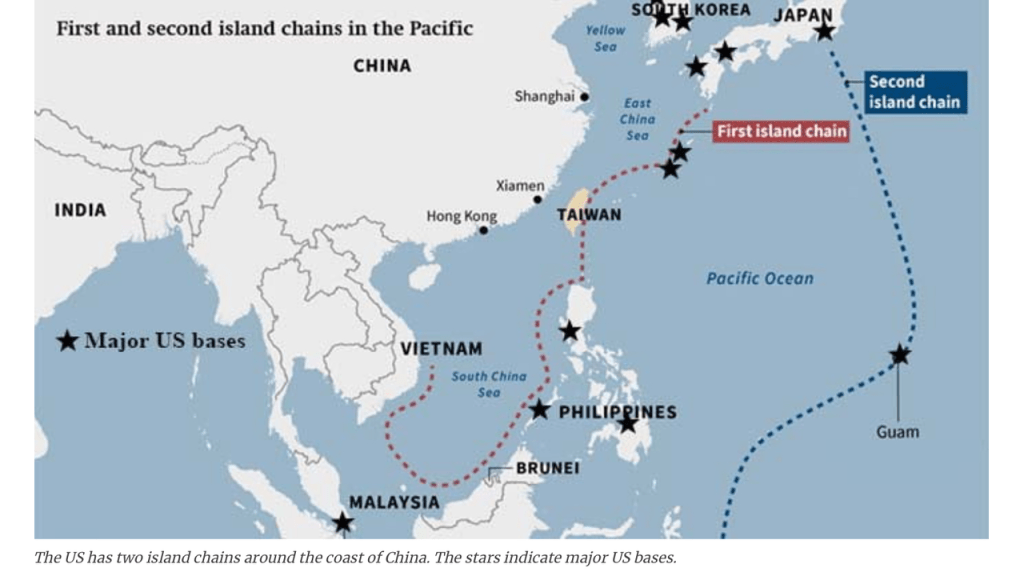
Kennedy appreciated MacArthur’s soothing judgment on Cuba (and would soon change the military’s top leadership—perhaps in keeping with MacArthur’s views), but then shifted the subject to Laos and Vietnam, where communist insurgencies were gaining strength. The Congress, he added, was pressuring him to deploy U.S. troops in response. MacArthur disagreed vehemently: “Anyone wanting to commit ground troops to Asia should have his head examined,” he said. That same day, Kennedy memorialized what MacArthur told him: “MacArthur believes it would be a mistake to fight in Laos,” he wrote in a memorandum of the meeting, adding, “He thinks our line should be Japan, Formosa, and the Philippines.” MacArthur’s warning about fighting in Asia impressed Kennedy, who repeated it in the months ahead and especially whenever military leaders urged him to take action. “Well now,” the young president would say in his lilting New England twang, “you gentlemen, you go back and convince General MacArthur, then I’ll be convinced.” So it is that MacArthur’s warning (which has come down to us as “never get involved in a land war in Asia”), entered American lore as a kind of Nicene Creed of military wisdom—unquestioned, repeated, fundamental.
From the ongoing US involvement in Ukraine, to an enduring US military presence in the Middle East, and growing US-Chinese tensions in the Asia-Pacific region, regardless of who controls the US Congress and regardless of who sits in the White House, these conflicts continue forward – often with a Democratic president setting the stage for his Republican successor, and vice versa.
DARWIN, July 26 (Reuters) – The U.S. military is building infrastructure in northern Australia to help it project power into the South China Sea if a crisis with China erupts, a Reuters review of documents and interviews with U.S. and Australian defence officials show.
SYDNEY – A remote Australian island close to an Indian Ocean chokepoint for Chinese oil shipments is on a list of possible locations for US military construction aimed at deterring China, with the US saying it “may or may not” support American forces.
Philippine and Japan navies held their first bilateral drills in the contested waters, the Southeast Asian nation’s military said in a statement Friday.
LAST July 30, US Secretary of State Antony Blinken and Defense Secretary Lloyd Austin III dropped by Manila for the Philippines-US 2+2 ministerial dialogue, the fourth such talks since it began in 2012. This is unprecedented because it’s the first time that talks have been held in Manila. Indeed, the PH-US 2+2 dialogue has set the stage for continued and expanded military cooperation, reflecting a strengthened military and defense alliance between the two sides. Before visiting Manila, the two US officials also held talks in Tokyo with their counterpart top Japanese defense and diplomatic officials on July 28 to bolster military and defense cooperation.
THE Philippine Army yesterday said a medium-range missile system [Typhon] of United States military may remain in the country beyond September this year, depending on the training needs of Filipino troops.
President Biden in a Thursday phone call with Prime Minister Benjamin Netanyahu pledged that the United States would help defend Israel in the event of reprisal attacks from Iran in the wake of Hamas leader Ismail Haniyeh’s assassination in Tehran.
The Philippines and China have just restored peace and stability in the areas of the South China Sea contested by the two countries in a July 21, 2024 “de-escalation” deal that aimed at “easing tensions.”







 Ms. Cat’s Chronicles
You must be logged in to post a comment.