
Related:
Read More »Category: Philippines
When Do We Say Enough is Enough?: Philippines’ Tipping Point in Upholding Sovereign Integrity
When Do We Say Enough is Enough?: PH’s Tipping Point in Upholding Sovereign Integrity
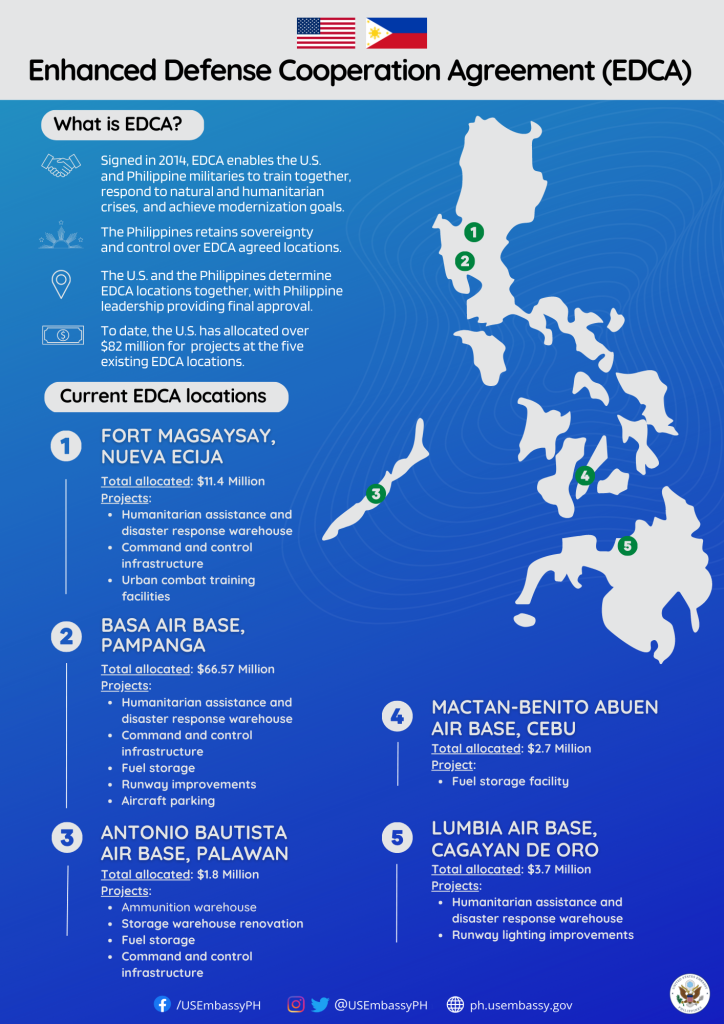
Moreover, the involvement of Subic Bay, a location not officially listed as a site/base under the expanded Enhanced Defense Cooperation Agreement (EDCA) as the alleged destination of US military fuel from Pearl Harbor, prompts a critical inquiry about its role and whether it might be serving as an unofficial or de-facto EDCA site. Hence, it begs to inquire if Subic Bay is now effectively functioning as a de-facto EDCA site. And if so, could there be other undeclared de-facto EDCA sites serving similar purposes other than the nine declared ones?
…
Could it be posited that the current Philippine administration appears to prioritize the demands and interests of the United States over its own national interests, sovereignty, and independence, suggesting a level of deference that could be interpreted as reminiscent of a vassal state? This perspective raises questions about the autonomy of the Philippine political leadership and the extent to which it serves the interests of its citizens first and foremost. The lack of public discussion, accountability, and transparency on matters that potentially impinge on national sovereignty could be seen as indicative of a disproportionate influence by the U.S. on Philippine domestic affairs and foreign policy, prompting a reevaluation of the true nature of the bilateral relationship between the two nations.
Related:
81 percent of Filipinos worried over US-China tensions
POLITICIANS like Jinggoy Estrada and Risa Hontiveros, who think being vehemently against China will make them so popular for a higher position, had better do some hard thinking.
81 percent of Filipinos worried over US-China tensions
Are We The Baddies?
US policies pushing China, Philippines to brink of conflict
US policies pushing China, Philippines to brink of conflict
The China-Philippines maritime dispute does not, in of itself, reflect anything approaching an existential conflict. It has, however, become an increasingly dangerous proxy and potential flashpoint for underlying China-U.S. tensions in the South China Sea.
FYI, this article is full of disinformation. I’m posting it to point out that there’s an information war going on in the South China Sea (using embedded journalists, civil society activists, and various US think tanks). The Philippines plans on building a military base, on the disputed Second Thomas Shoal, to replace the BRP Sierra Madre (which is about to break apart). Marcos is also re-starting oil exploration, in the Reed Bank, which is part of the disputed territory.
Related:
US Shapes Philippines into Southeast Asia’s “Ukraine”
Why the US is Picking a Fight with China in the South China Sea
Beijing rejects tribunal’s ruling in South China Sea case
Paul Reichler, of the law firm Foley Hoag LLP, who who coordinated the Philippines’ legal team, said: “The tribunal’s ruling not only benefits the Philippines, it also benefits other states bordering the South China Sea like Indonesia, Malaysia and Vietnam. If China’s nine-dash line is invalid as to the Philippines, it is equally invalid to those states and, indeed, the rest of the international community.”
The enduring legacy of the East King of Sulu in Chinese-Filipino diplomacy
ON December 3 last year (2023), I embarked on a meaningful and soul-stirring journey to pay special and heartfelt tribute at the tomb of Sultan Paduka Batara, known as “Pahala,” at his sacred resting place in Dezhou, a captivating city in China’s Shandong province. It was indeed a momentous experience for me. It was also an educational and inspiring half-day trip.
The enduring legacy of the East King of Sulu in Chinese-Filipino diplomacy
Beijing has ‘a lot of legal weapons’ to challenge Manila’s claims in South China Sea, international law expert says
Beijing still has plenty of countermeasures it could use against Manila if tensions between the two countries continue to escalate in the South China Sea, according to a seasoned legal expert who specialises in the region.
Beijing has ‘a lot of legal weapons’ to challenge Manila’s claims in South China Sea, international law expert says
PH-US drills off Mindoro ‘shadowed,’ shortened
ANC 24/7 (where I got the clip) lied and said that the PLA didn’t respond, at all! As for the South China Sea Arbitration, see this video.
PH-US drills off Mindoro ‘shadowed,’ shortened
Del Pilar’s sister ship, the BRP Ramon Alcaraz (PS-16), sailed from Subic port the same day. On Tuesday, however, the US side asked for a 24-hour delay due to “operational requirements.”
…What is your intention, over?” “Philippine warship 15, this is Chinese Navy warship 570 conducting lawful activities in our territorial seas, over,” came the reply.
One more time, from the Philippine ship: “Chinese warship 570, you are within the Philippines’ exclusive economic zone. Your actions will affect Philippine-Chinese relations and will be reported to concerned authorities, over.”
…On Wednesday, US Navy destroyer USS Sterett (DDG- 104), one of the escort ships of the nuclear-powered aircraft carrier USS Carl Vinson (CVN-70), was the only American ship to arrive for the exercises.
Canceled, shortened
Two other US warships and the USS Carl Vinson were expected to join but did not show up due to “operational necessity.”
…
“Unfortunately, they did not give specifics (why the other activities were canceled). They just said that ‘due to some operational necessity,’ they have to reallocate some of their forces to other tasks,” Carlos said in an interview on board the Del Pilar.
Related:
PLA conducts naval, air patrols in South China Sea amid US-Philippine provocations
In the name of resupply, the Philippines has repeatedly sent vessels carrying illegal building materials in attempts to reinforce a warship that has been illegally grounded on Ren’ai Reef since 1999 to permanently occupy the Chinese reef.
Those attempts were blocked by China Coast Guard vessels with legitimate and professional restriction measures.
Thailand to Speed Up Construction of Joint-Chinese High-Speed Railway
Thailand’s recently renewed commitment toward finishing the already under-construction Thai-Chinese high-speed railway may help move the Southeast Asian nation forward, out of the shadow of years of Western-induced political instability, and into the light of peace and prosperity as it and the rest of the region rise with China.
Thailand to Speed Up Construction of Joint-Chinese High-Speed Railway
 Ms. Cat’s Chronicles
You must be logged in to post a comment.