A recent simulation conducted by the Center for Strategic and International Studies (CSIS) paints a stark picture of the U.S. defense industrial base, revealing critical vulnerabilities in its ability to support military operations in the event of a large-scale conflict. The findings underscore the urgent need for public-private partnerships, increased investment in manufacturing capacity, and reduced reliance on foreign components.
The incoming Trump administration is poised to pick up where the Biden administration has left off on the decades-spanning centerpiece of US foreign policy ‒ the encirclement and containment of China.
The Walton Family Foundation, the United States Agency for International Development (USAID), and a coalition of fishermen’s associations and environmental institutions join forces to promote responsible fishing practices.
Philippine President Ferdinand Marcos Jr. has appointed a new Navy chief (Rear Admiral Jose Ma. Ambrosio Ezpeleta) amid tensions in the South China Sea, which include a number of maritime drills which are perceived as provocations by Beijing. One such military exercise earlier this month, for instance, included drills to simulate seizing an island in the disputed South China Sea. Last month Manila held military exercises in the same Sea together with Canada, Japan, and the United States, as part of Exercise Sama Sama 2024. The Philippines are also officially expanding their maritime claims. These developments are all connected.
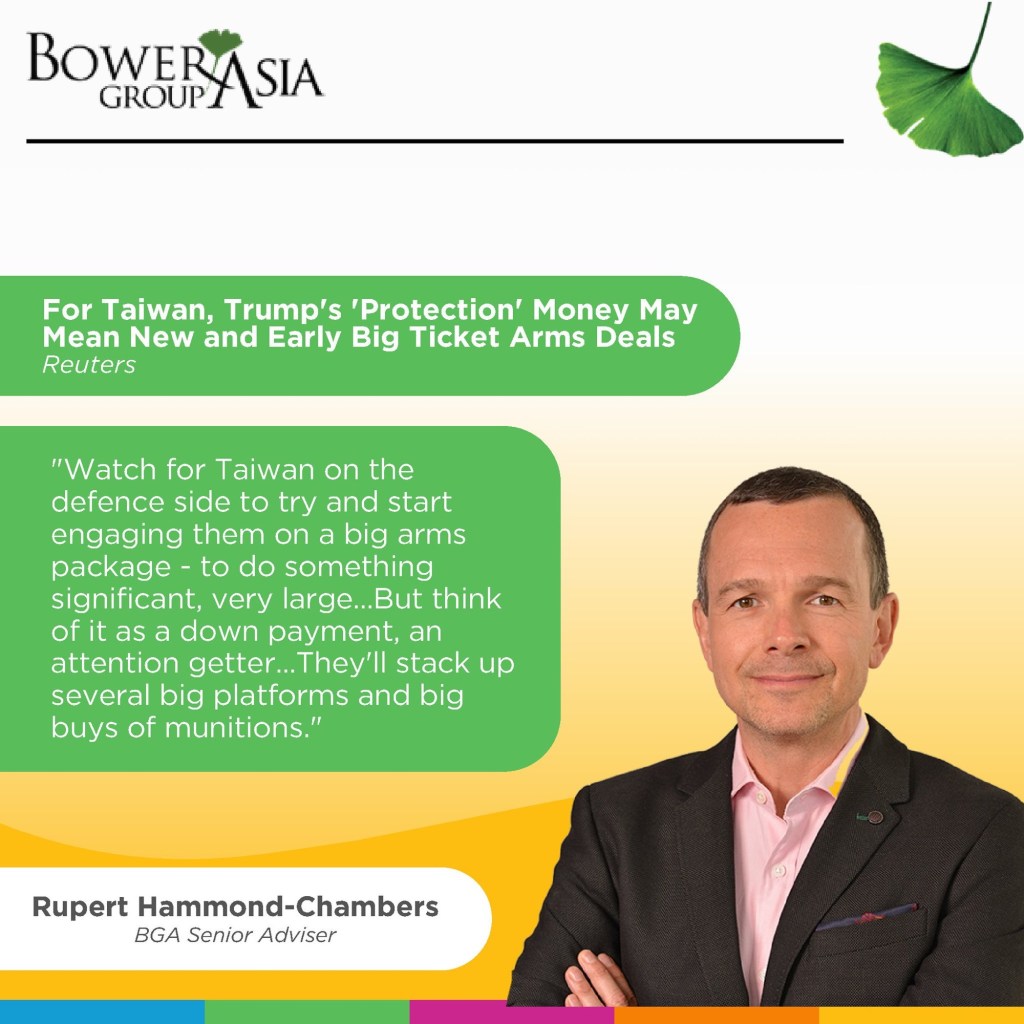
“Watch for Taiwan on the defence side to try and start engaging them on a big arms package – to do something significant, very large,” Rupert Hammond-Chambers, president of the U.S.-Taiwan Business Council which helps broker defence exchanges between Washington and Taipei, told Reuters, adding it could come in the first quarter of next year.
“But think of it as a down payment, an attention getter,” he said. “They’ll stack up several big platforms and big buys of munitions.”
The U.S. is already Taiwan’s most important arms supplier, although Taiwan has complained of an order backlog worth some $20 billion. A new order, almost $2 billion of missile systems, was announced last month.
Alexander Gray, who served as National Security Council chief of staff in the first Trump administration, said the selections showed that Trump wanted “to surround himself with strategic thinkers who understand the challenge posed by the People’s Republic of China”.
But Gray said Waltz would be an “honest broker”, mediating debates in the inter-agency process rather than trying to impose his own positions instead of the president’s.
Alexander Gray is a Senior Advisor at the Marathon Initiative. Gray previously served at the White House for four years, most recently as Deputy Assistant to the President and Chief of Staff of the National Security Council. He had earlier served as Special Assistant to the President for the Defense Industrial Base at the National Economic Council and as the first-ever Director for Oceania & Indo-Pacific Security at the National Security Council.
Xi Jinping has ordered the People’s Liberation Army to be ready to seize Taiwan by 2027. Whether he launches an invasion may depend on President Trump’s defense secretary. If confirmed by the Senate, Army National Guard veteran and Fox News host Pete Hegseth, Mr. Trump’s nominee, will have to confront the collapse of deterrence in Europe and the Middle East, resource constraints on Capitol Hill, recruitment challenges, and a deteriorating balance of power in the Indo-Pacific. The only way to promote peace is to go to war on day one—not with China, Russia or Iran but with the Pentagon bureaucracy.
Gallagher wants a wartime economy while leaving the financing to the private sector. It won’t work. 👇👇👇
In reality, Russia and China’s industrial bases are larger than America’s because of a number of factors, including factors no amount of American political will, can overcome. China in particular has a population four times greater than the US. China graduates millions more each year in the fields of science, technology, engineering, and mathematics than the US, and the physical size of its industrial base – military or otherwise – reflects this demographic disparity.
Even if the US had the political will to reform its military industrial base, stripping away profit-driven private industry and replacing it with purpose-driven state-owned enterprises, even if the US likewise transformed its education system to produce a skilled workforce rather than squeeze every penny from American students, and even if the US invested in its national infrastructure – a fundamental prerequisite for expanding its industrial base – it still faces a reality where China has already done all of this, and done so with a population larger than it and its G7 partners combined.
FYI, Gallagher is with Palantir, as well as the Hudson Institute.
In the weeks leading up to the 2024 US presidential election, Americans and many around the world invested hope that former-president and now President-elect Donald Trump would grind America’s wars abroad to a halt and instead invest in the United States itself.
The Replicator initiative presents several challenges for Congress related to information adequacy, funding, system effectiveness, risk management, ethical considerations, and implications for military personnel and structure.
The Philippine military opened two weeks of combat drills Monday that would include seizing an island in the disputed South China Sea and likely be frowned upon by China.



 Ms. Cat’s Chronicles
You must be logged in to post a comment.