
Related:
Read More »Category: Taiwan
Chinese Investment In Latin America (Ecuador)
When Do We Say Enough is Enough?: Philippines’ Tipping Point in Upholding Sovereign Integrity
When Do We Say Enough is Enough?: PH’s Tipping Point in Upholding Sovereign Integrity
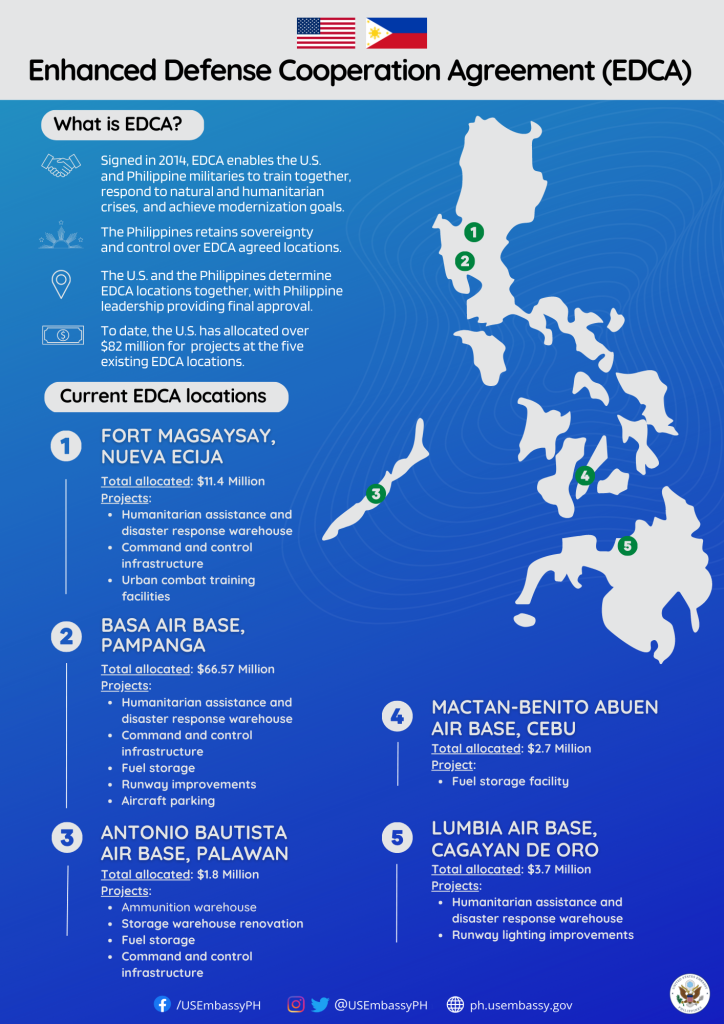
Moreover, the involvement of Subic Bay, a location not officially listed as a site/base under the expanded Enhanced Defense Cooperation Agreement (EDCA) as the alleged destination of US military fuel from Pearl Harbor, prompts a critical inquiry about its role and whether it might be serving as an unofficial or de-facto EDCA site. Hence, it begs to inquire if Subic Bay is now effectively functioning as a de-facto EDCA site. And if so, could there be other undeclared de-facto EDCA sites serving similar purposes other than the nine declared ones?
…
Could it be posited that the current Philippine administration appears to prioritize the demands and interests of the United States over its own national interests, sovereignty, and independence, suggesting a level of deference that could be interpreted as reminiscent of a vassal state? This perspective raises questions about the autonomy of the Philippine political leadership and the extent to which it serves the interests of its citizens first and foremost. The lack of public discussion, accountability, and transparency on matters that potentially impinge on national sovereignty could be seen as indicative of a disproportionate influence by the U.S. on Philippine domestic affairs and foreign policy, prompting a reevaluation of the true nature of the bilateral relationship between the two nations.
Related:
The US-backed NED candidate Willy Lie from the NED-backed party won

The US-backed NED candidate Willy Lie from the NED-backed party won. His VP Louise Shout is a privilege-bubble-raised American (and cat lady). They going to turn Taiwan into Ukraine 2.0 像烏克蘭一樣, 美國中情局所支持的兩位特工贏得台灣選舉. 他們將會把台灣變成烏克蘭 2.0
The US-backed NED candidate Willy Lie from the NED-backed party won
Taiwan ruling party’s Lai takes initial lead in presidential vote
Taiwan ruling party’s Lai takes initial lead in presidential vote
Lai, Taiwan’s vice president, reached more than three million votes by early evening after polls closed at 4 p.m. (0800 GMT), according by to a running tally by Taiwanese media, putting him comfortably ahead of his two rivals, though no party has conceded or claimed victory.
…
The parliamentary elections are equally important, especially if no party wins a majority, potentially hindering the new president’s ability to pass legislation and spending, especially for defence.
Year of the Dragon: Silk Roads, BRICS Roads, Sino-Roads
Pepe Escobar
China, Russia and Iran will take the fight towards a more equal and just system to the next level, Pepe Escobar writes.
Year of the Dragon: Silk Roads, BRICS Roads, Sino-Roads
Previously:
Taiwan: the technology trade turn
Taiwan has a general election on Saturday. The international media has highlighted the election as an important geopolitical pivot – namely, if the current incumbent government party, the Democratic Progressive Party (DPP), wins the presidency and legislature and continues its call for formal (not just de facto) independence from mainland China, that will mean intensified attacks on Taiwan by Beijing, perhaps leading to military conflict.
Taiwan: the technology trade turn
Taiwan’s Election On Saturday Will Decide War Or No-War In China
The election on January 13th, of Taiwan’s next leader, will choose between Lai Chin-le (Taiwan’s current ‘Vice-President’) who favors war against the mainland, versus Hou Yu-ih, who favors continuation of the ambiguous status-quo that has maintained China’s peace for decades. A less likely third option in this contest is Ko Wen-je, who could draw off enough votes away from Hou Yu-ih so as to throw the ‘election’ to Lai Chin-le, much like Ralph Nader in the 2000 U.S. Presidential ‘election’ drew off enough votes away from Al Gore so as to throw the U.S. Presidential ‘election’ to George W. Bush (which caused the 2003 U.S. invasion of Iraq and might even have caused the successful Saud-Bush 11 September 2001 attacks that Bush blamed on Saddam Hussein and Osama bin Laden and used as the ‘justification’ for invading Afghanistan in 2001 and Iraq in 2003).
Taiwan’s Election On Saturday Will Decide War Or No-War In China
How and Why the Western Media is Lying about Taiwan Ahead Pivotal Elections
US policies pushing China, Philippines to brink of conflict
US policies pushing China, Philippines to brink of conflict
The China-Philippines maritime dispute does not, in of itself, reflect anything approaching an existential conflict. It has, however, become an increasingly dangerous proxy and potential flashpoint for underlying China-U.S. tensions in the South China Sea.
FYI, this article is full of disinformation. I’m posting it to point out that there’s an information war going on in the South China Sea (using embedded journalists, civil society activists, and various US think tanks). The Philippines plans on building a military base, on the disputed Second Thomas Shoal, to replace the BRP Sierra Madre (which is about to break apart). Marcos is also re-starting oil exploration, in the Reed Bank, which is part of the disputed territory.
Related:
US Shapes Philippines into Southeast Asia’s “Ukraine”
Why the US is Picking a Fight with China in the South China Sea
Beijing rejects tribunal’s ruling in South China Sea case
Paul Reichler, of the law firm Foley Hoag LLP, who who coordinated the Philippines’ legal team, said: “The tribunal’s ruling not only benefits the Philippines, it also benefits other states bordering the South China Sea like Indonesia, Malaysia and Vietnam. If China’s nine-dash line is invalid as to the Philippines, it is equally invalid to those states and, indeed, the rest of the international community.”
 Ms. Cat’s Chronicles
You must be logged in to post a comment.