Hegseth visits Manila: Washington prepares for war with China + More

Hegseth visits Manila: Washington prepares for war with China

The language of Hegseth’s press conference in Manila is indicative of the openly aggressive face of US imperialism under Trump. Gone was any reference to what had been the political shibboleth of Washington in the Asia Pacific region: the defense of “freedom of navigation.” Hegseth spoke rather of “preparing for war,” using the phrase more than once. Every time Hegseth mentioned China he termed it “Communist China,” and spoke of its “aggression.” Hegseth referred to US Seventh fleet commander Admiral Samuel Paparo “and his war plans. Real war plans.”

Read More »

Due Process on Trial: The Duterte Arrest, the Rule of Law and Sovereignty + More

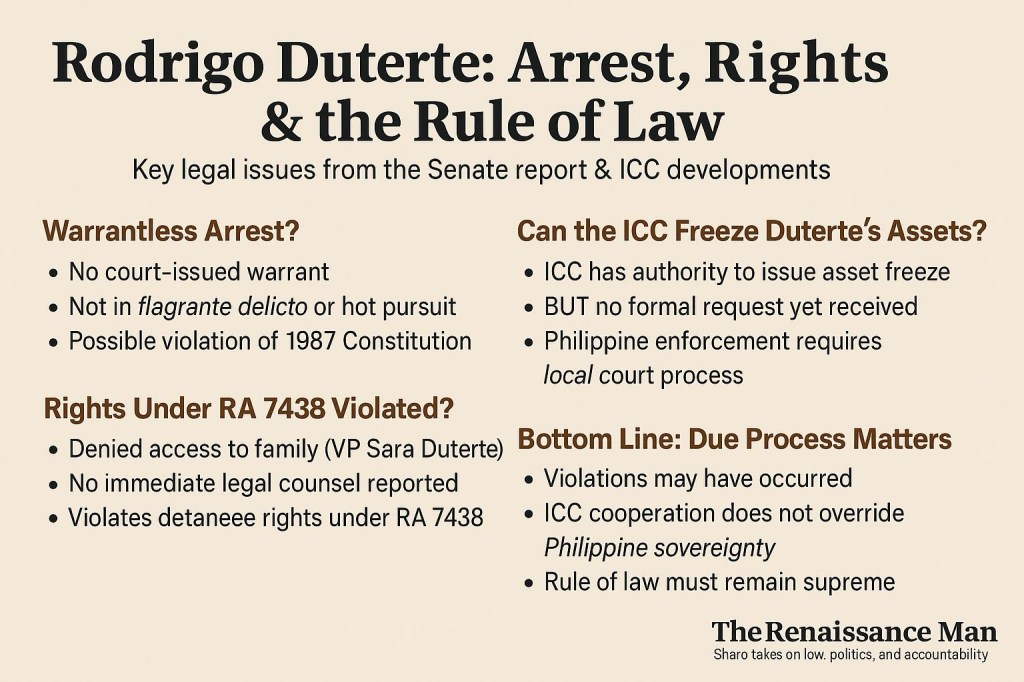
The recent release of the Senate Committee on Foreign Relations’ preliminary report on the arrest of former President Rodrigo Duterte has sent ripples through the Philippine legal and political landscape. Chaired by Senator Imee Marcos, the report outlines what it calls “glaring violations” of constitutional rights, procedural lapses, and questionable coordination between the Philippine government and the International Criminal Court (ICC).

Due Process on Trial: The Duterte Arrest, the Rule of Law and Sovereignty

Related:

Can Philippine President Marcos Survive the Wrath of the Dutertes? by Mong Palatino

As for President Marcos, he may have a solid plan to neutralize the Dutertes but it is the anguish of ordinary citizens reeling from high prices and low wages that he should be worried about. Even Vice President Sara Duterte is aware that the concern of the average voter is the economic crisis, which is why her arrival statement at The Hague when she visited her father focused on the need to address poverty, hunger, and joblessness in the Philippines. In other words, the most serious threat to the Marcos presidency is its own failure to fulfill the campaign promise of bringing down the price of rice and other goods, uplift the conditions of working families, and provide adequate and affordable services to the people.

Document: Arrest of Rodrigo Duterte

Duterte Arrest Raises Stakes in Clash for Control of Philippines

YouTube

Duterte Arrest Raises Stakes in Clash for Control of Philippines

Three years ago, the most powerful political families in the Philippines joined hands to secure the nation’s biggest election victory in four decades. Now they are locked in a feud that threatens to derail one of Asia’s economic growth stars.

In dramatic events on Tuesday, Philippine President Ferdinand Marcos Jr.’s government arrested and deported his predecessor Rodrigo Duterte to face the International Criminal Court in The Hague. The move came just over a month after the impeachment of his daughter, Vice President Sara Duterte, by allies of Marcos. A Senate trial, which would determine whether she gets removed from office, is scheduled to begin in July.

The Philippines Inaugurates New President Marcos Jr.
Sara Duterte, left, with Ferdinand Marcos Jr. in 2022. Photographer: Ezra Acayan/Getty Images
Read More »

‘Kill’ plot vs Marcos ‘maliciously taken out of context’ —VP Sara

‘Kill’ plot vs Marcos ‘maliciously taken out of context’ —VP Sara (archived)

BBM seems to be taking out his opponents from what I’ve been observing. The next presidential election is in 2028. I wonder how involved the CIA is?

Related:

Sara Duterte Exposes House Panel’s Off-Cam Confession: It’s All About Election Funds

“After that meeting with the Makabayan bloc and Martin Romualdez, they started destroying my name, pummeling me in the media with the multi million PR campaign. They even insulted me by lying that I was a traitor, a corrupt, an abusive person. Your motherfucker, who is corrupt?” she said during an online press briefing early Saturday.

“Those congressmen who are holding hearings, what do they say when the hearing is over, when the mic is off, when the media is gone- ‘Excuse me, we need money because the election is coming up. Please tell Sara, I don’t like what I’m doing,’” she said.

The country’s veep then directed her fury at Manila Rep. Joel Chua, head of the House panel probing the confidential funds use, accusing him of hypocrisy.

“You motherfucker, you don’t like what you’re doing, why are you ruining my name, Joel Chua?”

Politics at a critical juncture in Philippine history

For so many years, we have complained and howled against political dynasties.

Ever since we established ourselves as a republic and began electing leaders in government, it has become a given, even deep-rooted and thus an innate limitation. Ever since, only a few, and therefore the same people from the same families are always elected into office.

Politics at a critical juncture in Philippine history

Philippines counts the cost of tough South China Sea stance against Beijing

Philippines counts the cost of tough South China Sea stance against Beijing

The Philippines has become a laboratory in responding to Beijing on the South China Sea row, taking the most risk but showing inconsistency and underwhelming results thus far. Its predicament explains why other Southeast Asian claimant states remain unlikely to follow its lead. The tepid reaction to Manila’s pitch for an Asean claimants-only Code of Conduct is indicative.

As had happened in the past, lost economic opportunities and further erosion of Manila’s position in the flashpoint, relative to other disputants, may lead to a possible policy reversal in handling the maritime tiff come the 2028 presidential election.

Last year, the Philippines began to expose China’s illicit actions in the disputed waters. It inserted reporters in routine patrols and resupply sorties to document interference by the Chinese coastguard and maritime militia ships. The idea is to rally local and international support and impose reputational costs on Beijing. [Project Myoushu AKA Transparency Initiative]

This approach made strides in rousing public backing for Manila’s defence build-up, a stronger alliance with the United States, and a tougher stance against China. However, it also contributed to polarising domestic politics, affecting people-to-people ties and diminishing Chinese economic interest in the Philippines. Meanwhile, Beijing remains unmoved, weathering reputational costs and continuing to wield a capacity for escalation in the South China Sea.

During Xi’s visit to Hanoi last December, both sides vowed to upgrade the Kunming-Haiphong rail line. In contrast, Chinese funding for three rail projects discussed during the previous Duterte government is already dead in the water. China is unlikely to become a strong partner for President Ferdinand Marcos Jnr’s Build Better More infrastructure programme.

Losses in the tourism sector have also become evident. In 2019, before the pandemic, China was the Philippines’ fastest-growing tourist market, with more than 1.7 million arrivals, or a 21.1 per cent market share, just behind South Korea. Last year, as countries in Asia raced to benefit from the return of Chinese tourists, the Philippines only welcomed over 260,000 tourists from China, with the market share shrinking to just 4.84 per cent.

Ironically, for all the talk about Duterte’s China policy as appeasement, it was under his watch that the Philippines made the biggest upgrade in infrastructure in the Spratlys since the 1970s. He also invested in modernising the country’s military, procuring modern frigates from South Korea, multirole response vessels from Japan and cruise missiles from India. All these happened while relations with China remained stable.

Another irony is that while Manila celebrates every resupply mission to the Second Thomas Shoal that successfully eluded the Chinese blockade, Vietnam is busy doing substantial reclamation on its Spratly outposts and gearing for a potential second airfield, with reportedly little interference from Beijing. [Bueller?]

These should offer plenty of insights as the strategy of the Philippines over the maritime squabble evolves.