
Related:
Read More »Tag: 60 Minutes
Behind the DOJ’s Politicized Indictment of Maduro: A CIA-Created ‘Network’ and Coerced Star Witness +
The US Department of Justice indictment of Venezuela’s kidnapped leader, Nicolas Maduro, is a political rant that relies heavily on coerced testimony from an unreliable witness. Despite DOJ edits, it could expose more Americans to the CIA’s own history of drug trafficking.
…
Weaponizing the “narco-terror” hoax
The bulk of the case against Maduro rests on the accusation that the defendants “engaged in… drug trafficking, including in partnership with narco-terrorist groups.” According to the DOJ, Maduro conspired with TDA, as well as the Mexican Sinaloa and Los Zetas cartels to traffic drugs between 2003 and 2011. However, these cartels were not designated by the Trump administration as Foreign Terrorist Organizations until February 2025, a move obviously designed to justify Maduro’s kidnapping and juice up his indictment.Behind the DOJ’s Politicized Indictment of Maduro: A CIA-Created ‘Network’ and Coerced Star Witness
Related (Los Zetas):
Read More »Fabricated Cartel Terror Label Marks Washington’s Next Phase of Venezuela Action
The US State Department on Monday formally designated the Cartel de los Soles, or Cartel of the Suns, a group that doesn’t actually exist, as a “Foreign Terrorist Organization,” providing a pretext for a potential attack on Venezuela.
Read More »
Capes, Cameras, and the Cult of Visibility
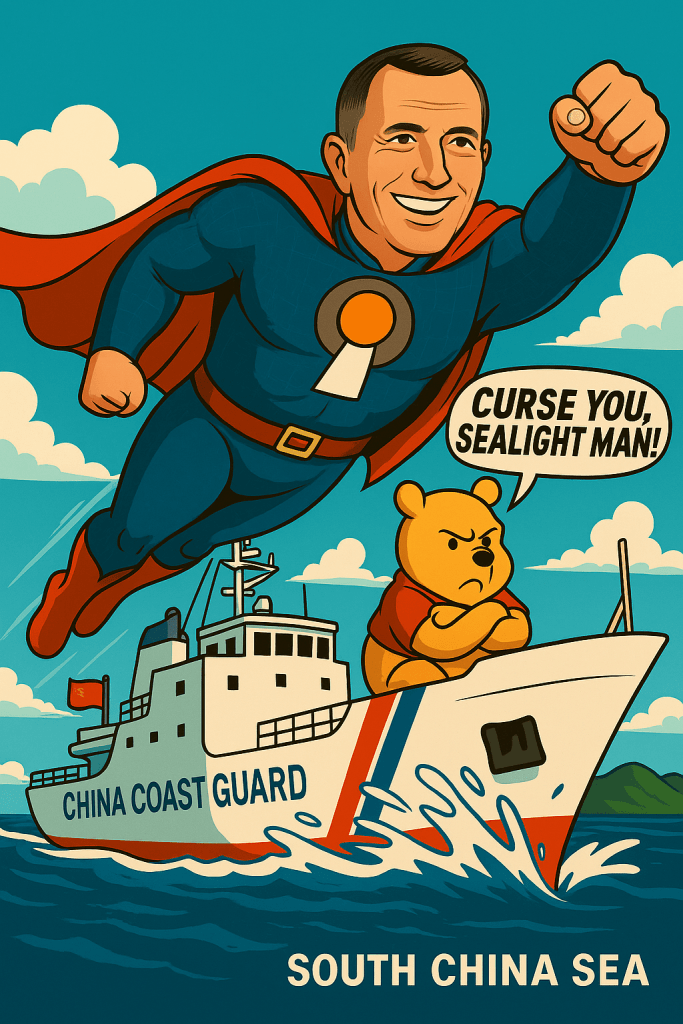
Capes, Cameras, and the Cult of Visibility: The SeaLight Crusade as White Savior Theater
By Tina Antonis
The South China Sea is more than a maritime dispute—it’s a theater of narrative warfare. While headlines focus on Chinese aggression and Philippine resistance, a quieter campaign unfolds in the background: one of satellite feeds, curated imagery, and Pentagon-backed storytelling. At the center of this effort is SeaLight, a project that claims to illuminate truth but often casts shadows of its own.
As explored in my article at Antiwar.com, SeaLight doesn’t just document—it performs. It reframes geopolitical tension through moral spectacle, positioning its creators as heroic arbiters of transparency. But when the messenger wears a cape and the funding flows from defense budgets, we must ask: is this clarity, or choreography?
Stage Left: The White Savior Enters
In the comic-strip cosmology of Ray Powell’s SeaLight project, transparency wears a cape. Clad in heroic postures and backed by satellite imagery, Powell casts himself as the guardian of maritime morality—unarmed, except with satellite feeds, theatrical flair, and strategic messaging.
Yet beneath the cartoon and Pentagon-funded optics lies a familiar archetype: the white savior, rebranded for the South China Sea.
China Is Imperialist? Says Who?
Calling China a “maritime occupier,” Powell positions himself as a bulwark against aggression. But that moral pose collapses under scrutiny. He speaks for a country with over 800 foreign military installations and a documented history of over 250 military interventions since 1991—wars in Iraq, Afghanistan, Libya, Syria, Somalia, and dozens more, all under the banner of peace, freedom, or preemption.
By comparison, China’s post–Cold War footprint includes no sustained foreign occupations and only scattered border conflicts and peacekeeping missions. The imbalance is staggering. And Powell’s framing doesn’t just ignore it—it performs around it.
As David Vine argues in The United States of War, this vast base empire is not a passive network—it’s an architecture of perpetual war. These outposts make military engagement not an exception but a structural habit, cloaked in strategic necessity and sold as global stewardship.
Powell’s cartoon rhetoric—calling China an occupier—obscures the scale of U.S. militarism. The term “occupation” is deployed not to analyze, but to project. When adversaries hold territory, it’s a crisis; when the U.S. spans the globe with armed installations, it’s policy.
Framing Conflict: The Optics of Consent
This isn’t irony. It’s performance. Powell’s language manufactures a moral frame for confrontation—costumed in transparency, but driven by escalation. The cape is literal. The conditioning is deliberate. And the stage is set for war.
SeaLight’s mission is not just visual documentation—it’s narrative warfare. As the Japan Times openly notes, its “chief weapon is photography, applied purposefully, generously and consistently over time.” These images—enhanced, curated, and distributed across media—are not neutral. They’re constructed to shape public perception, sway international opinion, and ultimately manufacture consent for confrontation.
Assertive transparency becomes a kind of ideological scaffolding—a stage on which geopolitical tension is dramatized, simplified, and morally polarized. The goal isn’t simply to reveal conflict; it’s to condition audiences for escalation.
And when the messenger dons a superhero’s cape, the spectacle transforms into something deeper: a story of rescue, of virtue, of intervention. This is not analysis—it’s soft propaganda dressed in heroic metaphor.
Consent for war doesn’t begin with missiles. It begins with mythmaking.
What’s Really Going On In the South China Sea Between the Philippines and China
What’s Really Going On In the South China Sea Between the Philippines and China
by Tina Antonis
Maritime clashes between the Philippines and China had been mostly over the Philippines’ military outpost, BRP (BRP—Barko ng Republika ng Pilipinas, which translates to “Ship of the Republic of the Philippines”—the ship prefix for the Philippines) Sierra Madre, in the Spratly Islands, which is disputed by Brunei, China, Malaysia, the Philippines, Taiwan (a province of China, as recognized by the United Nations’ Resolution No. 2758), and Vietnam. The BRP Sierra Madre was intentionally run aground on a reef near the Second Thomas Shoal in the disputed Spratly Islands, in 1997, so that the Philippines could stake their territorial claim.
Read More »It’s officially published!
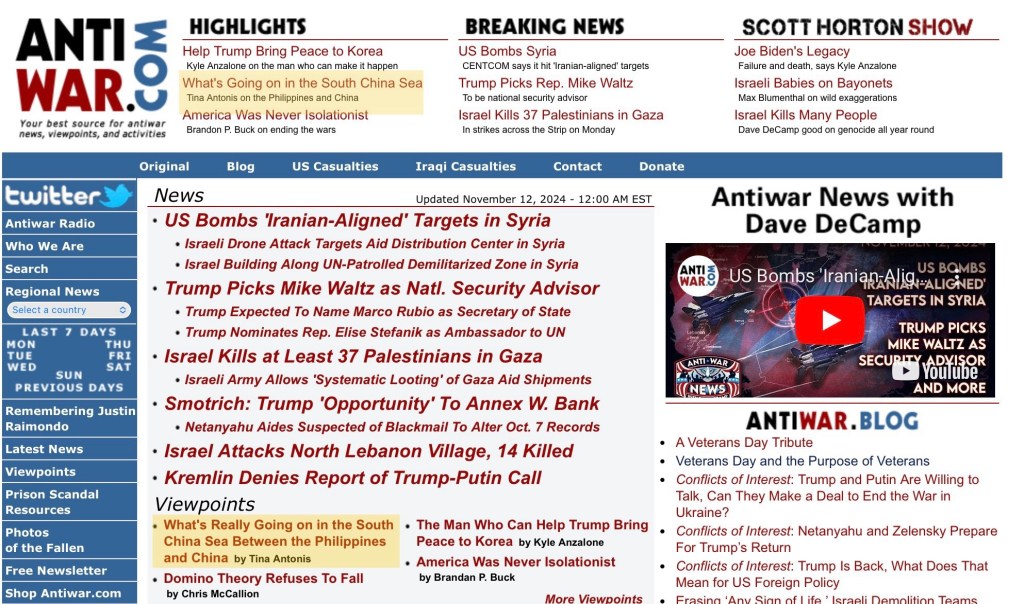
Read it at Antiwar.com or here with graphics. FYI, the “Ant” in Antonis is pronounced as 🐜.
The Many Meanings of Kamala Harris’s Glock
In a “60 Minutes” interview this week, the vice president shared the kind of gun she owns. Its associations with law enforcement and pop culture make it a potent symbol.
They forgot to mention the following about Gaston Glock:
Glock was born in Vienna on 19 July 1929. He was conscripted into the Wehrmacht as a teenager near the end of World War II, after which he graduated from school as an engineer and joined a hand drill company.
Related:
‘Hitman’ Recruited to Target John Bolton Was an FBI Informant
In August 2022, the Justice Department announced that the FBI had foiled an Iranian plot to assassinate former national security adviser John Bolton in retaliation for the U.S. killing Islamic Revolutionary Guard Corps–Qods Force commander Qasem Soleimani.
‘Hitman’ Recruited to Target John Bolton Was an FBI Informant
The CIA and War Propaganda (Fifth Estate, 1986)
U.S. can ‘certainly’ afford military support to both Israel and Ukraine, meanwhile…
U.S. can ‘certainly’ afford military support to both Israel and Ukraine, Janet Yellen says
“America can certainly afford to stand with Israel and to support Israel’s military needs and we also can and must support Ukraine in its struggle against Russia,” Yellen said, adding that the U.S. economy is doing “extremely well.”
“Inflation has been high and it’s been a concern to households, it’s come down considerably. At the same time, we have about the strongest labor market we’ve seen in 50 years with 3.8% unemployment. And at the same time, America, the Biden administration, has passed legislation that is strengthening our economy in years to come for the medium term.”
Related:
Ticking Time-Bomb: Food Inflation Is Crushing Millions Of Low Income Americans (archived)
And so the debate circles round and round. The US, the “most wealthy nation on the planet”, has a food security problem and is on the verge of an inflationary calamity for millions of low income citizens, all while it spends hundreds of billions of dollars on pointless climate change programs, diversity and inclusion initiatives and proxy wars. Something has to give, and the chances are growing that it will be the American consumer.
 Ms. Cat’s Chronicles
You must be logged in to post a comment.