
Lyyli Takki has kindly allowed us to publish a reminiscence which she presented on the radio concerning the death of Madame Kollontai.
“Reminiscence about a certain visit” (on the death of A. Kollontai, 1952)
Tag: Alexandra Kollontai
A Socialist, Feminist, and Transgender Analysis of “Sex Work” (2020)
The question of women’s liberation is central to any revolutionary project, and thus so is the question of “sex work.” Esperanza Fonseca’s contribution, although coming from a Maoist political orientation with which we often have differences, [1] makes the stakes of this debate crystal clear, as she combines personal experience, public policy research, and historical materialism to argue that Marxists cannot uphold what she calls “sex-trade-expansionary feminism.”
Content Warning: Descriptions of rape.
…
The right of the subordinated classes of men to buy access to women’s bodies has been used historically to break class solidarity in order to maintain the dominant social relations of the time. This was true in feudal Europe and remains true today: when proletarian and petit bourgeois men get to buy women too, they develop a false consciousness and build solidarity with bourgeois men of their own gender rather than aligning with women of their own class. And because the overthrow of capitalism is only possible by the overthrowing of the bourgeoisie, prostitution serves two great purposes: (1) allows bourgeois men access to a reserve army of women for their pleasure, and (2) prevent class consciousness and thus helps stop the proletariat from organizing as a class.
A Socialist, Feminist, and Transgender Analysis of “Sex Work” (2020)
Alexandra Kollontai: Prostitution and ways of fighting it
Alexandra Kollontai: Prostitution and ways of fighting it
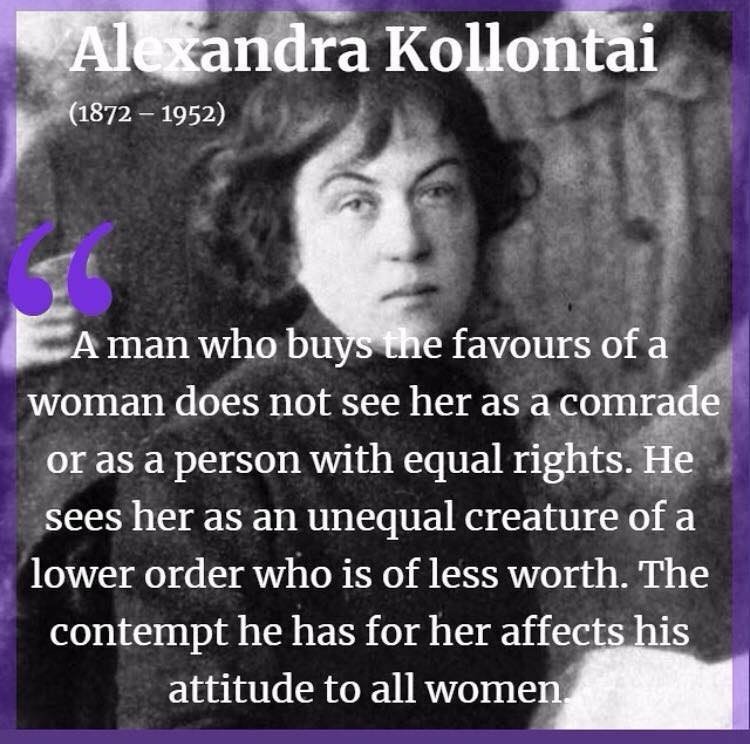
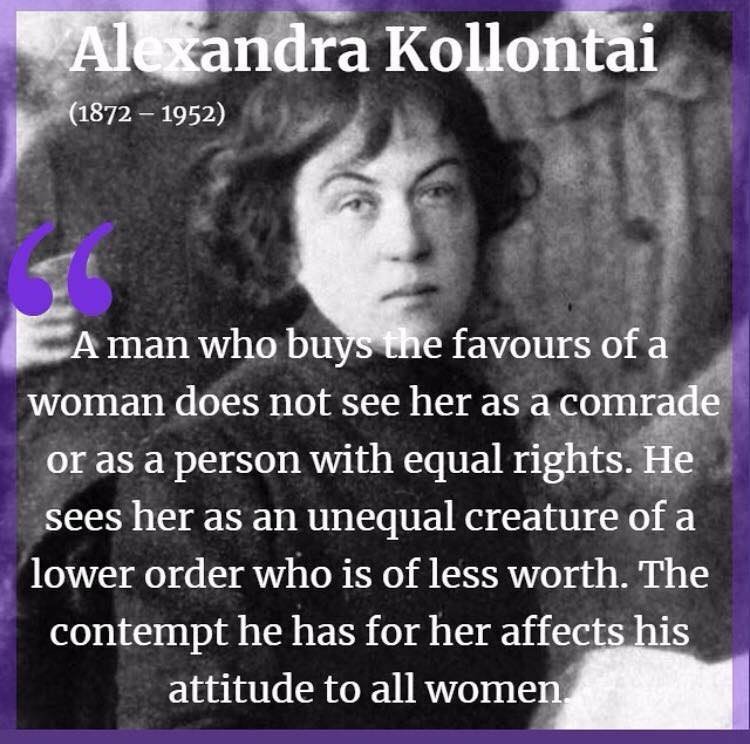
What is the fundamental quality of the working class? What is its strongest moral weapon in the struggle? Solidarity and comradeship is the basis of communism. Unless this sense is strongly developed amongst working people, the building of a truly communist society is inconceivable. Politically conscious communists should therefore logically be encouraging the development of solidarity in every way and fighting against all that hinders its development – Prostitution destroys the equality, solidarity and comradeship of the two halves of the working class. A man who buys the favours of a woman does not see her as a comrade or as a person with equal rights. He sees the woman as dependent upon himself and as an unequal creature of a lower order who is of less worth to the workers’ state. The contempt he has for the prostitute, whose favours he has bought, affects his attitude to all women. The further development of prostitution, instead of allowing for the growth of comradely feeling and solidarity, strengthens the inequality of the relationships between the sexes.
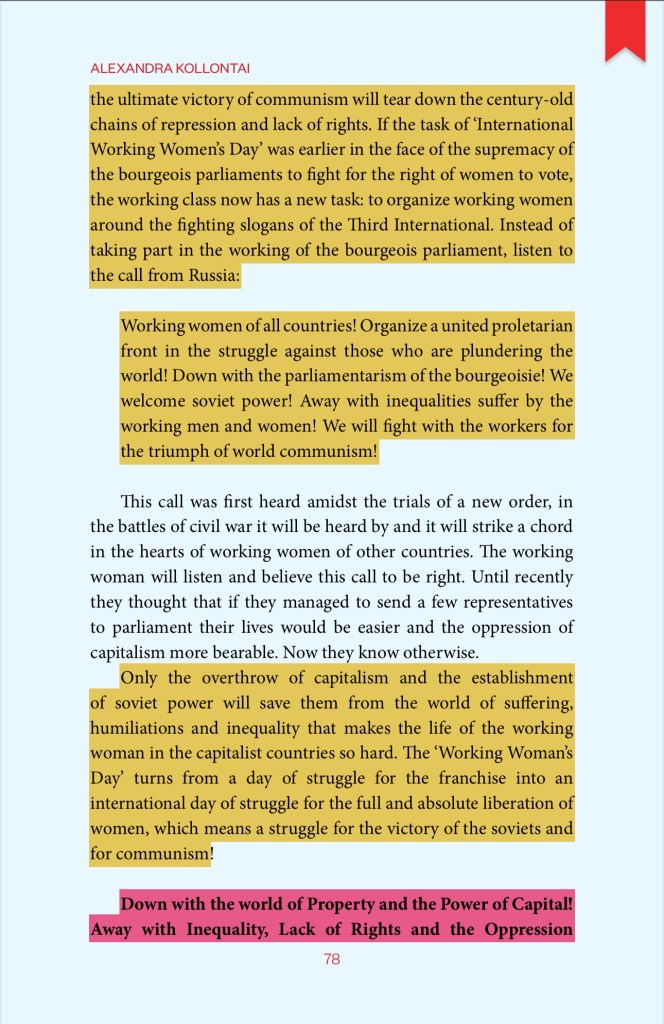
Alexandra Kollontai: International Womens’ Day

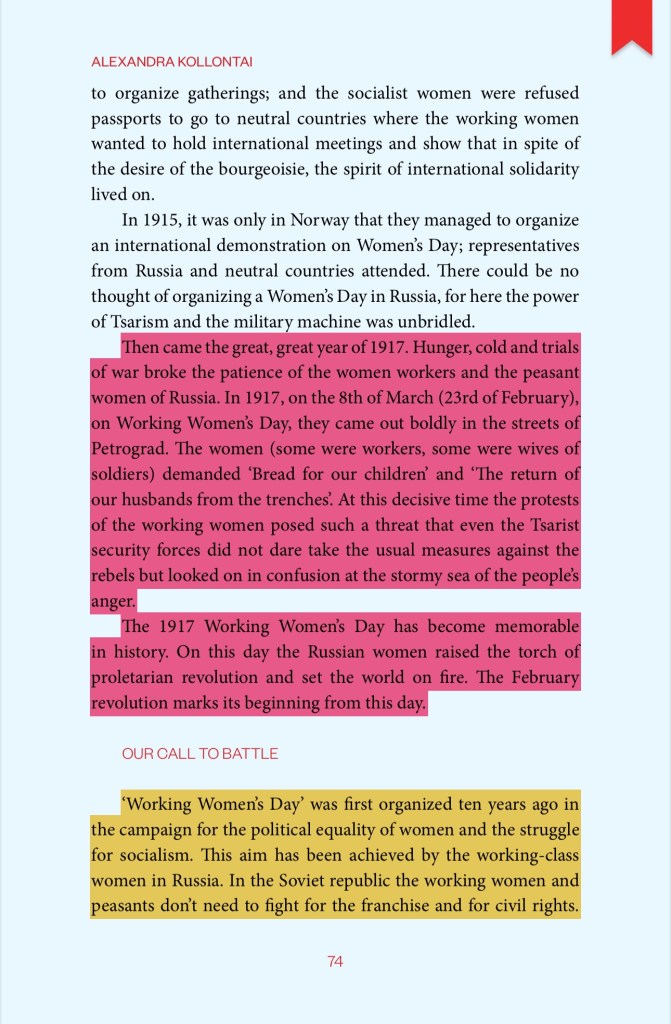

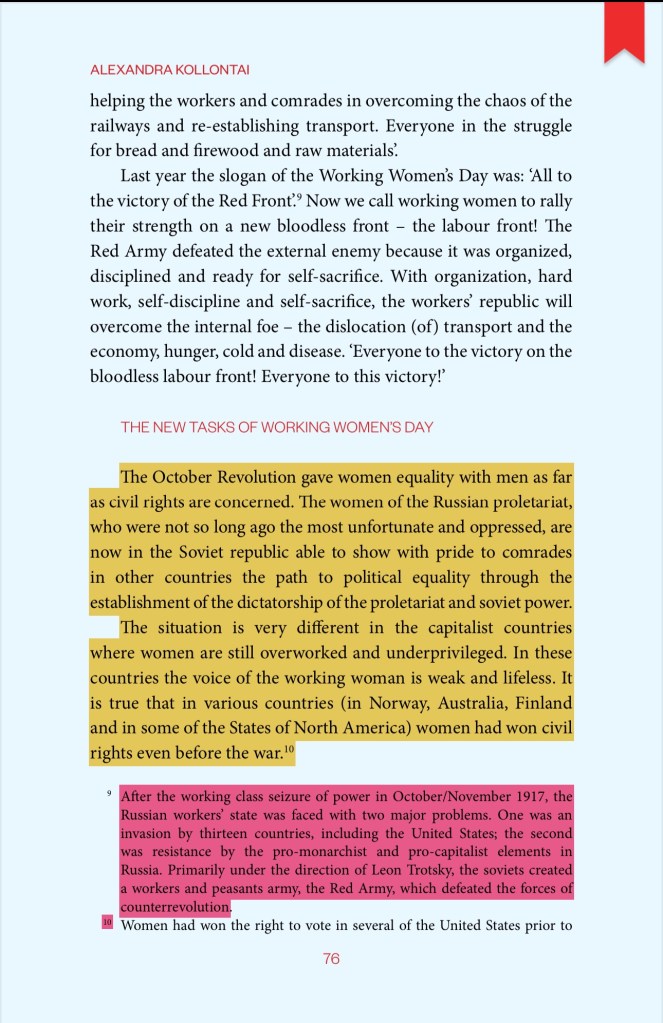
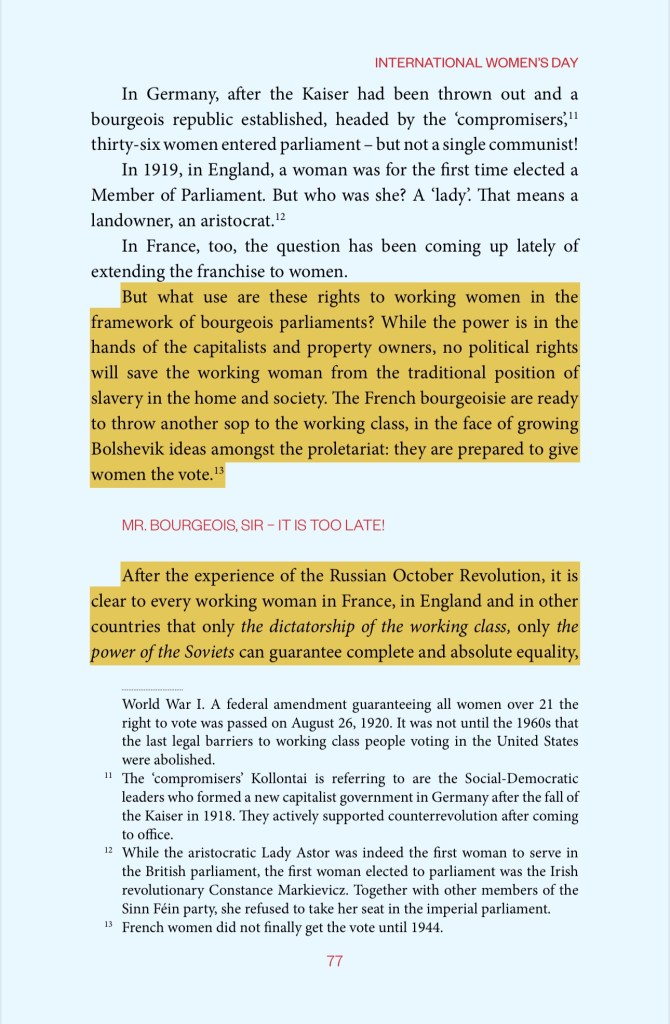

Today’s feminism has been co-opted by the oligarchs and the CIA (Gloria Steinem, et al. were CIA assets).
Previously:
Kollontai 150: Selected Writings of Alexandra Kollontai
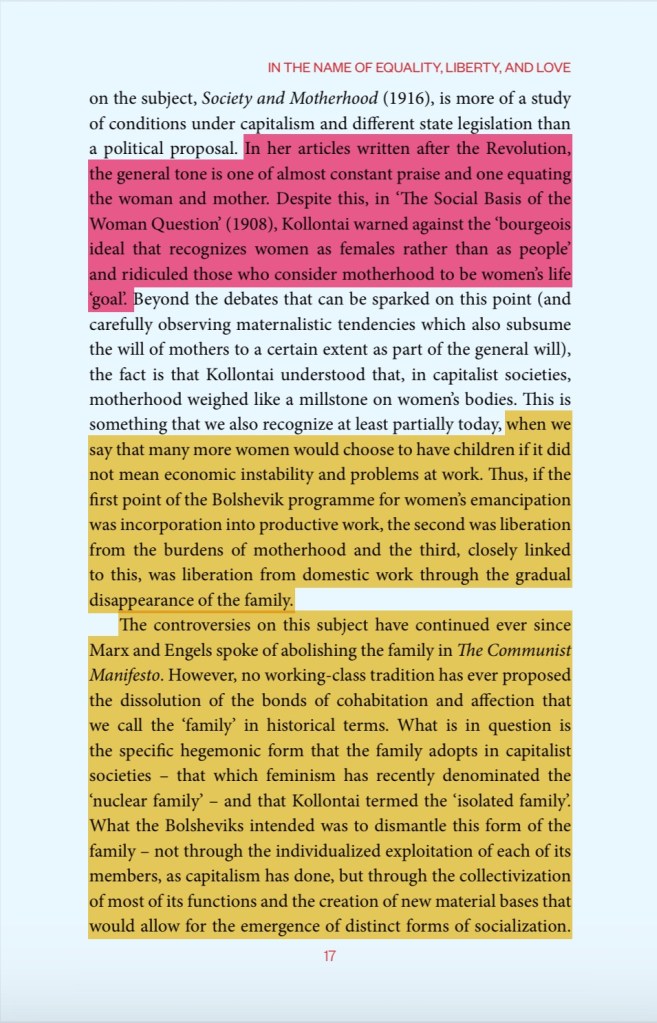
Sexual Relations and the Class Struggle
Among the many problems that demand the consideration and attention of contemporary mankind, sexual problems are undoubtedly some of the most crucial. There isn’t a country or a nation, apart from the legendary “islands”, where the question of sexual relationships isn’t becoming an urgent and burning issue. Mankind today is living through an acute sexual crisis which is far more unhealthy and harmful for being long and drawn-out. Throughout the long journey of human history, you probably won’t find a time when the problems of sex have occupied such a central place in the life of society; when the question of relationships between the sexes has been like a conjuror, attracting the attention of millions of troubled people; when sexual dramas have served as such a never-ending source of inspiration for every sort of art.
Kollontai: Love and the New Morality
Kollontai: Love and the New Morality
What are the chief inadequacies, what are the dark sides, of legal marriage? Legal marriage is based on two equally false principles: that marriage should be forever and that the partners belong to each other and are each other’s property.
Read More »
Communism and the Family
Women’s role in production: its effect upon the family
Will the family continue to exist under communism? Will the family remain in the same form? These questions are troubling many women of the working class and worrying their menfolk as well. Life is changing before our very eyes; old habits and customs are dying out, and the whole life of the proletarian family is developing in a way that is new and unfamiliar and, in the eyes of some, “bizarre”. No wonder that working women are beginning to think these questions over. Another fact that invites attention is that divorce has been made easier in Soviet Russia. The decree of the Council of People’s Commissars issued on 18 December 1917 means that divorce is, no longer a luxury that only the rich can afford; henceforth, a working woman will not have to petition for months or even for years to secure the right to live separately from a husband who beats her and makes her life a misery with his drunkenness and uncouth behaviour. Divorce by mutual agreement now takes no more than a week or two to obtain. Women who are unhappy in their married life welcome this easy divorce. But others, particularly those who are used to looking upon their husband as “breadwinners”, are frightened. They have not yet understood that a woman must accustom herself to seek and find support in the collective and in society, and not from the individual man.
Related:
Family Code On Marriage, The Family, And Guardianship
Read More »Political biography of Alexandra Kollontai (Ep. 4): October Revolution and Social-Welfare
In this episode I’ll be discussing Kollontai’s career throughout the February and October revolutions, and briefly her work as a commissar for social welfare.
Political biography of Alexandra Kollontai (Ep. 4): October Revolution and Social-Welfare
 Ms. Cat’s Chronicles
You must be logged in to post a comment.