
Kremlin says Russian missiles did not target residential building in Dnipro

Kremlin says Russian missiles did not target residential building in Dnipro:

The Ukrainian Air Force says the apartment complex was hit by a Russian Kh-22 missile, which Kyiv says it does not have the equipment to shoot down. Peskov suggested that the strike had been the result of Ukrainian “anti-aircraft counter-missiles” intercepting the Russian missile, saying that “some representatives of the Ukrainian side” had reached the same conclusion.

Oleksiy Arestovych, who advises the Ukrainian president’s office, said on Saturday evening that it looked as though the Russian missile had fallen onto the apartment building after being shot down by Ukrainian air defenses. The comment sparked anger in Ukraine, prompting him to apologize. He then retracted his online apology, saying that he had made clear in his initial comments that his conclusion was only a preliminary theory. Dnipro, a city of almost a million people which serves as a crucial supply hub for Ukrainian forces in the eastern Donbas region, has come under repeated bombardment from Russian missiles.

Related:

At distance, two separate fires: An air defense missile, respectively a cruise missile shot down by it. And the 9-story building inflamed at the front (other side of the building in the picture, at the far right of the explosions)

Source: Prof. Marcello Ferrada de Noli on Twitter

Video confirms Oleksii Arestovych’s explanation on the regrettable #Dnipro missile disaster. via THE INDICTER Channel

YouTube – Arestovych: building destruction in Dnipro caused by Ukr air defence when shot down Russian missile via THE INDICTER Channel

Flash : daily Ukrainian terrorist shelling in Donbass + More
Bakhmut is the blackest point of the Ukrainian war. Up to 400 Ukrainian soldiers [+ 90 Russian soldiers] a day are being killed

Maria Senovilla: “Bakhmut is the blackest point of the Ukrainian war. Up to 400 Ukrainian soldiers a day are being killed”

Yes, we have to look to the Donbas because Bakhmut is precisely the blackest point of the war in Ukraine. This week, both the Institute for the Study of War, which is a prestigious American think tank, and other international thin tanks, have agreed that up to 400 Ukrainian soldiers a day are being killed and wounded in Bakhmut.

Related:

Invaders Lose 90 People Killed And 100 Wounded Around Bakhmut During Day – AFU Eastern Group

Feet on the Ground in St. Petersburg: The Public Mood

by Gilbert Doctorow

One of the first questions put to me by a reader via the Comments function with respect to Monday’s report of my initial impressions after arriving in St Petersburg was: and what is the general mood of people? I begged off answering, saying that I would have to speak to a lot more people before I could confidently answer that question.

Feet on the Ground in St. Petersburg: The Public Mood

Sanctions don’t seem to be effecting the wealthy or the middle class, in Russia, much.

U.S. and NATO scramble to arm Ukraine and refill their own arsenals

Either this narrative about weapon stockpiles, being depleted, is part of the information war or Russia is demilitarizing NATO!?!

U.S. and NATO scramble to arm Ukraine and refill their own arsenals

In Ukraine, the kind of European war thought inconceivable is chewing up the modest stockpiles of artillery, ammunition and air defenses of what some in NATO call Europe’s “bonsai armies,” after the tiny Japanese trees. Even the mighty United States has only limited stocks of the weapons the Ukrainians want and need, and Washington is unwilling to divert key weapons from delicate regions like Taiwan and Korea, where China and North Korea are constantly testing the limits.

So the West is scrambling to find increasingly scarce Soviet-era equipment and ammunition that Ukraine can use now, including S-300 air defense missiles, T-72 tanks and especially Soviet-caliber artillery shells

There are even discussions about NATO investing in old factories in the Czech Republic, Slovakia and Bulgaria to restart the manufacturing of Soviet-caliber 152-mm and 122-mm shells for Ukraine’s still largely Soviet-era artillery armory.

The European Union has approved €3.1 billion ($3.2 billion) to repay member states for what they provide to Ukraine, but that fund, the [ironically-named] European Peace Facility, is nearly 90 percent depleted.

Smaller countries have exhausted their potential, another NATO official said, with 20 of its 30 members “pretty tapped out.” But the remaining 10 can still provide more, he suggested, especially larger allies. That would include France, Germany, Italy and the Netherlands.

NATO’s secretary general, Jens Stoltenberg, has advised the alliance — including, pointedly, Germany — that NATO guidelines requiring members to keep stockpiles should not be a pretext to limit arms exports to Ukraine. But it is also true that Germany and France, like the United States, want to calibrate the weapons Ukraine gets, to prevent escalation and direct attacks on Russia.

Washington is also looking at older, cheaper alternatives like giving Ukraine anti-tank TOW missiles, which are in plentiful supply, instead of Javelins, and Hawk surface-to-air missiles instead of newer versions. But officials are increasingly pushing Ukraine to be more efficient and not, for example, fire a missile that costs $150,000 at a drone that costs $20,000.

New $1.1 Billion Arms Package for Ukraine Includes 18 HIMARS Launchers, as The U.S. and Europe are running out of weapons to send to Ukraine

New $1.1 Billion Arms Package for Ukraine Includes 18 HIMARS Launchers

The HIMARS that the US has been sending to Ukraine are equipped with missiles that have a range of about 50 miles. But that can change, and Kyiv is requesting Army Tactical Missile Systems, which have a range of 190 miles, but Washington has been hesitant to send the longer-range missiles. Russia has warned that providing such arms would cross a “red line.”

Related:

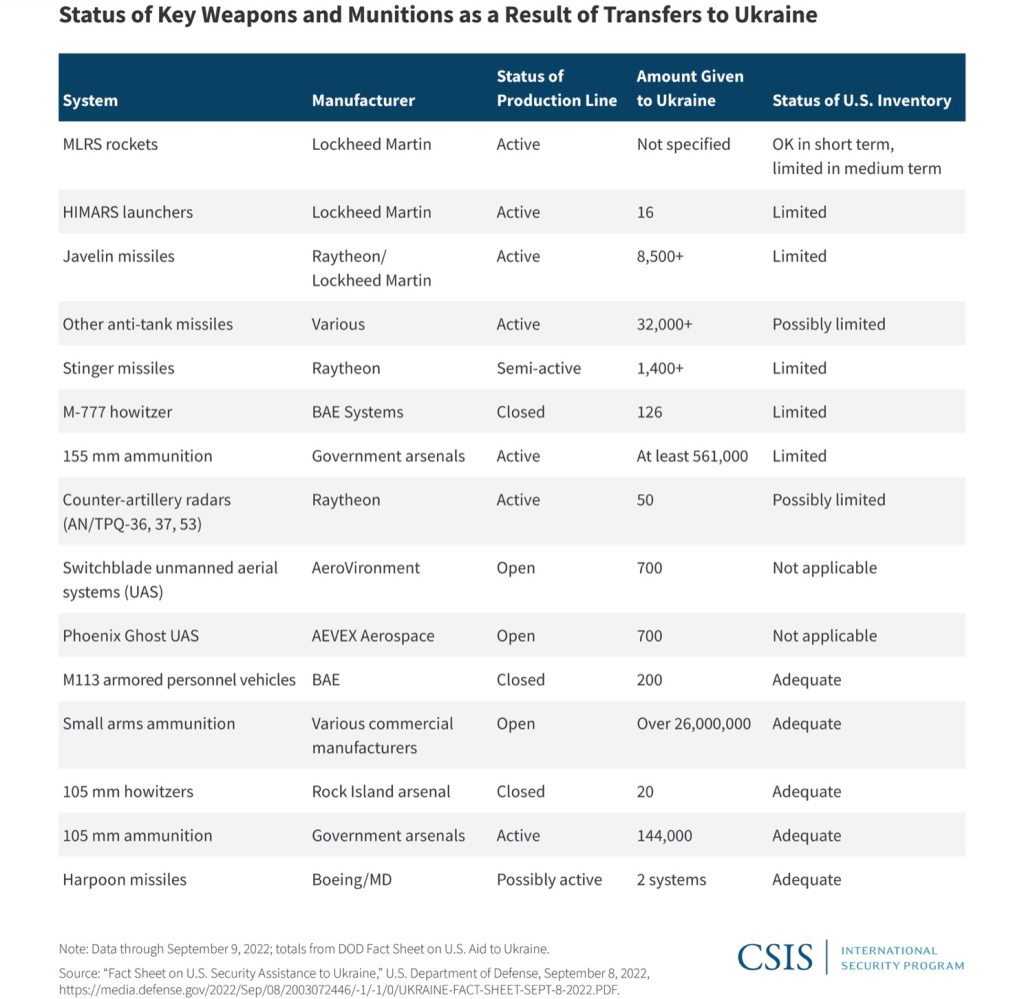
The U.S. and Europe are running out of weapons to send to Ukraine

In the U.S. weapons industry, the normal production level for artillery rounds for the 155 millimeter howitzer — a long-range heavy artillery weapon currently used on the battlefields of Ukraine — is about 30,000 rounds per year in peacetime.

The Ukrainian soldiers fighting invading Russian forces go through that amount in roughly two weeks.

Is the U.S. ability to defend itself at risk?

The short answer: no.

The U.S. has essentially run out of the 155 mm howitzers [M777?] to give to Ukraine; to send any more, it would have to dip into its own stocks reserved for U.S. military units that use them for training and readiness. But that’s a no-go for the Pentagon, military analysts say, meaning the supplies reserved for U.S. operations are highly unlikely to be affected.

Source: CSIS.

Former Western prime ministers propose military alliance with Ukraine

Former Western prime ministers propose military alliance with Ukraine

On Tuesday, a group of former prime ministers, foreign ministers and other high-level officials from NATO countries published a document effectively proposing a formal alliance between Ukraine and NATO countries that, if adopted, threatens to transform the proxy war in Ukraine into a full-scale conflict between NATO and Russia.

The document hints at the creation of a “no-fly zone” in Ukraine, pointing to a “set of agreements, between Ukraine and countries producing anti-aircraft and anti-missile defense equipment to provide Ukraine with modern and effective air defense and anti-missile defense systems in sufficient quantity to ensure a ‘closed sky’ from air attacks.”