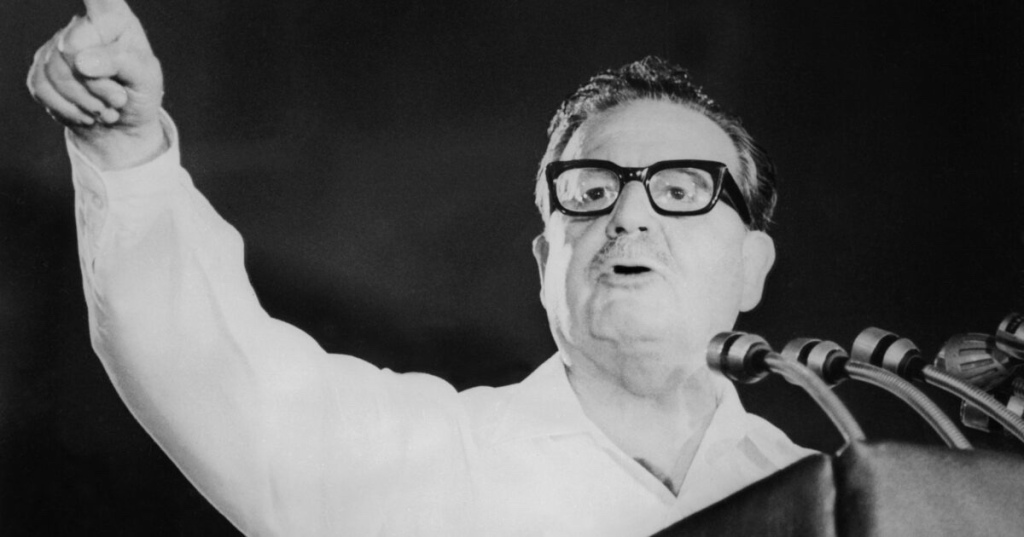
Chile, September 11, 1973: The Horrors of ‘the First 9/11’ Are Routinely Overlooked

Salvador Allende’s Final Speech on Sept. 11, 1973

Each September large memorials are held for the 9/11 attacks on the US. Yet few recall the far more destructive 9/11 that occurred 28 years before.

Chile, September 11, 1973: The Horrors of ‘the First 9/11’ Are Routinely Overlooked

Related:

Chile and the United States: Declassified Documents Relating to the Military Coup, September 11, 1973

The “Mock Revolution” at Mosinee: On The Racism of Anti-Communism in the US

British Pathé

For most of the last one hundred and fifty years, anti-communism has been a defining aspect of American political culture, both domestic and foreign. As historian Nick Fischer has argued, after the Civil War, anti-communism was deployed to suppress an unruly underclass of people, including the working poor, women, and Black Americans, and prevent any real attention on their working and living conditions. This anti-communism was deployed by an “elitist” class who sought to divide working people among themselves, and prescribe acceptable behaviors, including patriarchal heteronormative familial relationships. When those same people made demands for equal treatment, or even just decent treatment, the epithet “communist” or “socialist” has been deployed to delegitimize their claims to rights.

The “Mock Revolution” at Mosinee: On The Racism of Anti-Communism in the US

AOC-Led Delegation Can Push for New Approach to Latin America

You might not know it by the relatively scant news coverage, but the U.S. congressional delegation, led by Rep. Alexandria Ocasio-Cortez, that visited Brazil, Chile, and Colombia in August marked a big step forward in the development of a new U.S. approach to Latin America and highlighted the important role that the U.S. progressive left has to play in it.

AOC-Led Delegation Can Push for New Approach to Latin America

Related:

AOC urges US to apologize for meddling in Latin America: ‘We’re here to reset relationships’

Asked if the left needs to build a counterweight network, Ocasio-Cortez, whose trip to Latin America was branded “AOC’s socialist sympathy tour” by Rupert Murdoch’s conservative Wall Street Journal newspaper, replied: “I absolutely believe that the battle for democracy must be transnational and it must be global, and it especially must be hemispheric.

GOP debate bloodbath over Ukraine leaves room for agreement — on China

GOP debate bloodbath over Ukraine leaves room for agreement — on China

For all the talk about a divided GOP on foreign policy, it should be clear that when it comes to China, these eight candidates are more in agreement about where the country should be training its firepower, than not. Pinning them each down on what exactly they are proposing, and how far they will go to meet the threat, would be an interesting next exercise, sans the bloodletting.

Soros Foundation to End Most EU Operations in Radical Shift

Soros Foundation to End Most EU Operations in Radical Shift

The foundation will also continue to fund initiatives promoting human rights, democracy and accountable government across eastern Europe and central Asia, particularly in non-EU members Ukraine, Moldova, Kyrgyzstan, and the Western Balkans, the spokesperson said. The focus of grants in the new model will be determined in the coming months.

In the EU, OSF financed a wide range of philanthropic programs in the bloc’s eastern former communist members, including Hungary, Poland, Slovakia, Romania, the Czech Republic, Bulgaria and elsewhere.*

Regime Change coming to Ukraine, Moldova, Kyrgyzstan, Central Asia, and the Western Balkans soon?!

H/T: SDer Friedensstifter

Related:

Soros Foundation to be restructured to focus on non-EU countries

They will also continue to support NGOs in Europe, including groups working on the EU’s foreign policy, the Roma community, and human rights, democracy and accountable governance in the region, and the spokesperson specifically mentioned Ukraine, Moldova, Kyrgyzstan and the Western Balkans here.

*NGOs, “Unions”, & Media Outlets in the Service of Imperialism

Biden’s ally in Guatemala?

CHIUL, Guatemala − Life in Bartolo Báten’s village has been defined by corruption: A teacher who can’t get a job at the school until she pays a bribe. A water project that runs out of money before the pipes reached town. Sick residents who can’t afford the medicine that’s available elsewhere.

Insurgent candidate tells Guatemalans: Stay, don’t go to the U.S. This time, they’re listening. (archived)

Related:

Seven Decades After Guatemala Coup, Bernardo Arévalo Sees a Dramatic Rise (Will Freeman, CFR)

Arévalo and Semilla are centrists—but in a country where politics habitually skews right, they are often described as center-left. “Semilla has a social democratic element, but its program is centrist, and it also has some center-right followers,” said Lucas Perelló, a political scientist who has spent time studying the party’s formation. Arévalo says he wants to gradually universalize existing social assistance programs to include a greater share of poor Guatemalans, reduce the cost of medicines and healthcare, and link isolated parts of the country through new infrastructure—doable tasks, given Guatemala’s exceptionally low share of debt as GDP, and necessary ones, given the country’s soaring poverty and malnutrition rates.

On security issues, another major concern for Guatemalans, Arévalo promises to increase state presence in crime hotspots, reclaim jails from gangs, and use intelligence-gathering to dismantle mafias. He says Bukele’s anti-gang strategy is not applicable to Guatemala. He is also critical of human rights abuses in Venezuela and Nicaragua and Putin’s war on Ukraine and has no stated plans to recognize China over Taiwan. Asked for a leader he admires, he named the ex-president, José Pepe Mujica, of Uruguay, where he was born during his father’s exile.